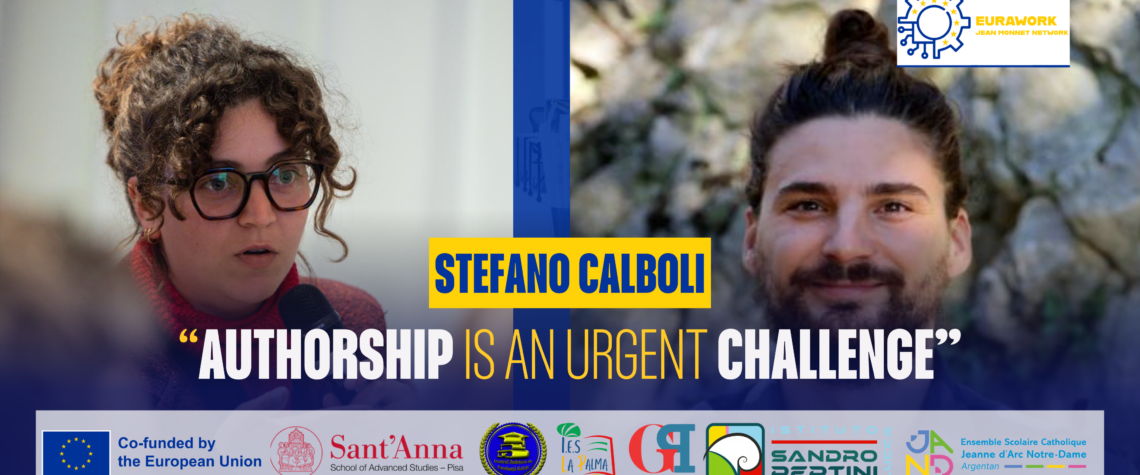
How can artificial intelligence and robotics shape a fairer society? And what happens when the technologies designed to improve efficiency reproduce existing inequalities or introduce new forms of discrimination? These questions lie at the heart of Robotics and AI Bias Prevention for Fostering Justice, one of the courses within the teacher trainings developed within EURAWORK, the European project promoted by the Scuola Superiore Sant’Anna in Pisa and funded by the European Union’s Erasmus+ Jean Monnet programme.
The course, taught by Elena Ricci and Stefano Calboli, explores the ethical and social implications of artificial intelligence and robotics, with a particular focus on justice, bias prevention, and European policies. Through an interdisciplinary approach, it provides teachers with the conceptual tools to understand how technological systems can influence decisions, shape opportunities, and affect fundamental rights.
The first lesson, led by Elena Ricci (Post-doc at Scuola Superiore Sant’Anna), addresses the ethical challenges of robotics, exploring questions of human control, responsibility, transparency, and the prevention of bias in robotic systems. By examining applications of robotics in healthcare, industry, work, and everyday life, the lesson encourages participants to reflect on how technological systems are shaped by human choices, values, and assumptions, and why robots cannot be considered entirely neutral tools.
The second lesson, led by Stefano Calboli (Research Fellow at CISC), focuses on AI bias, justice, and education, examining how biases can emerge from data, design choices, and the deployment of AI systems, giving particular attention to the relationship between efficiency and fairness, the impact of AI on the world of work, and the opportunities and risks associated with its growing use in education.
One particularly relevant issue addressed in the course is the question of authorship in the age of artificial intelligence: when can someone truly be considered the author of a piece of work created with the assistance of AI? As AI-generated content becomes increasingly common, the boundaries between human creativity, technological assistance, and intellectual ownership are becoming more difficult to define. This question raises important challenges for educators, particularly when it comes to assessing students’ work, recognising individual contributions, and ensuring academic fairness. It also offers valuable opportunities for reflection among teachers from EURAWORK’s partner schools, some of which have already integrated AI tools into their educational practices. For these institutions, understanding how AI reshapes traditional notions of authorship and originality is not simply a theoretical debate, but an increasingly practical concern in everyday teaching and assessment.
The course is part of European Union and Digital Transition: The Age of a Renewed Interplay Between Robotics, Artificial Intelligence, and Meaningful Work (EURAWORK), an initiative involving five partner schools from Italy, France, Spain, and Romania. By bringing academic research into dialogue with secondary education, the project aims to equip teachers and students with the critical skills needed to navigate the digital transition and reflect on the future of fair, dignified, and meaningful work.
Where do biases in artificial intelligence come from, and how can education help prevent them? Who can claim authorship when AI contributes to the creative process? And what does it mean to develop and use technology responsibly? In an interview conducted by Sara Bertolli, journalist at Focus Europe Italia, Stefano Calboli, Research Fellow at the Interdisciplinary Research Center on Sustainability and Climate at the Scuola Superiore Sant’Anna in Pisa, introduces the course and its central themes, highlighting the importance of placing justice, fairness, and human values at the heart of technological innovation.