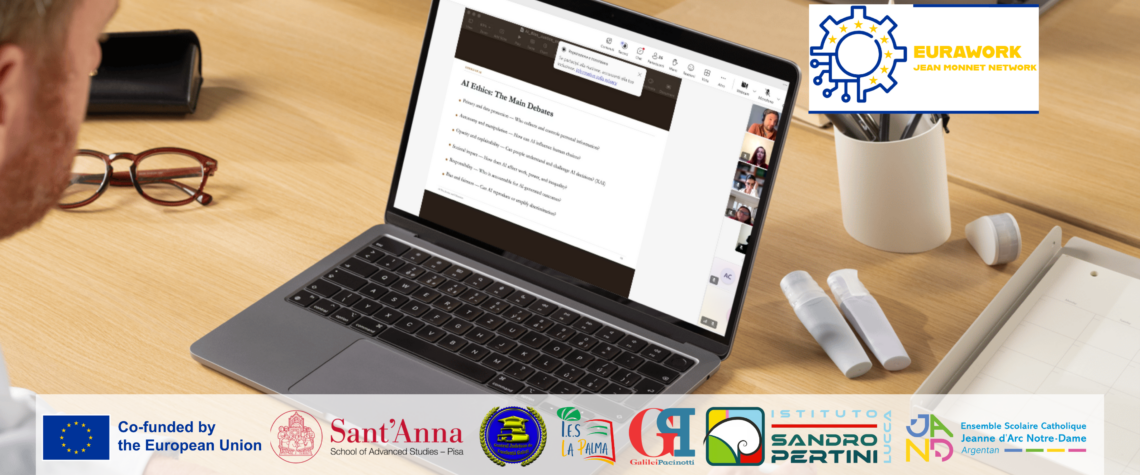
The Jean Monnet project coordinated by the Scuola Superiore Sant’Anna has launched its training programme for teachers from five European partner schools. The opening sessions, led by Stefano Calboli and Elena Ricci, explored the ethical and social implications of artificial intelligence and robotics.
The EURAWORK teacher training programme has officially begun. On Tuesday, October 20, the first online lesson marked the start of a series of courses designed for teachers from five partner schools in Italy, France, Spain and Romania. The initiative is part of “European Union and Digital Transition: The Age of a Renewed Interplay Between Robotics, Artificial Intelligence, and Meaningful Work” (EURAWORK), a Jean Monnet project promoted by the Scuola Superiore Sant’Anna (SSSA) in Pisa and funded by the European Union through the Erasmus+ programme.
Following the online launch meeting held on October 8, the project has now entered its first teaching phase, bringing together academic expertise and secondary education to address some of the most pressing challenges of the digital transition.
The first lessons: AI bias, justice and the ethics of robotics
The training programme opened with the course “Robotics and AI Bias Prevention for Fostering Justice”, delivered by Stefano Calboli and Elena Ricci, both researchers at the Scuola Superiore Sant’Anna.
The first course marks the beginning of a broader training programme consisting of six courses, each lasting eight hours, including six hours of teaching and two hours of assessment. The programme runs from October 20 to December 22, 2026, and combines different disciplinary perspectives, ranging from the history of technological change to European labour law, robotics, artificial intelligence, meaningful work and EU citizenship.
EURAWORK, the Jean Monnet project to prepare students for the jobs of tomorrow
Teachers can attend the lessons live through Microsoft Teams or access recordings asynchronously via the project’s Moodle platform. This flexible format aims to facilitate participation among educators from different countries and educational institutions.
The training activities are primarily addressed to teachers from EURAWORK’s five partner schools: Istituto Galilei Pacinotti in Pisa and IIS Sandro Pertini in Lucca, Italy; IES La Palma in Spain; Lycée Jeanne d’Arc in Argentan, France; and Centrul Județean de Excelență in Romania.
By bringing together schools from four European countries, EURAWORK aims to strengthen cooperation between universities and secondary education institutions, encouraging teachers to integrate European perspectives on digital transformation into their curricula.
The next steps: from technological change to European citizenship
Following the opening course, the programme will continue on October 29 with “Labour and Technological Change: Placing the Rise of AI in History”, taught by Alessandro Brizzi of the Scuola Normale Superiore. The module will examine how technological innovation has transformed work throughout history, from the Industrial Revolution to the rise of artificial intelligence.
In November, Luca Ratti of the University of Luxembourg will address the European regulatory framework governing AI and robotics, while Paolo Dario of the Scuola Superiore Sant’Anna will explore the impact of advanced technologies on the labour market within the Industry 5.0 framework.
The December sessions will focus on meaningful work in the European Union, with Francesco Tommasi and Alberto Pirni, and on EU citizenship education, with Alessandro Chiessi and Adriano Angelucci.
Through these courses, participating teachers will acquire interdisciplinary knowledge and develop educational activities that can subsequently be transferred to their classrooms, helping students understand both the opportunities and the challenges associated with technological innovation.
EURAWORK: preparing students for the future of work
Coordinated by Professor Alberto Eugenio Ermenegildo Pirni, associate professor of Moral Philosophy at the Scuola Superiore Sant’Anna, EURAWORK seeks to bridge the gap between the rapid evolution of digital technologies and the knowledge and skills provided through secondary education.
The three-year project aims to involve approximately 40 teachers and 2,500 students through 160 teaching units, promoting a deeper understanding of European policies, emerging technologies and the principles of decent and meaningful work. The project’s approach is based on a multiplier effect: by training teachers first, EURAWORK seeks to ensure that the knowledge acquired during the courses reaches a much wider audience of students.
Following the first year dedicated to teacher training, the project will organise a Seasonal School in Pisa for selected students, who will act as ambassadors within their schools. In the third year, students and teachers will participate in a workshop in Brussels, with opportunities to engage directly with European institutions and stakeholders in the technology sector.
With the first two lessons now delivered, EURAWORK has taken a concrete step towards its central objective: equipping educators and future generations with the knowledge and critical awareness needed to navigate a rapidly changing world of work, while placing human dignity, fairness and European values at the heart of technological progress.