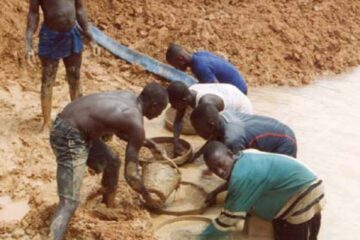
A diamond’s sparkle when it is displayed in a European jewellery shop, sometimes hides most of its history: It may begin in a riverbed in Sierra Leone, pass through border crossings, trading offices and cutting centers and eventually reach a consumer. The people who extracted it and the conditions in which they worked rarely form part of its final picture. Nevertheless, this story is central to Europe’s relationship with Africa’s diamond-producing countries.
The term “blood diamond” became widely known during the civil wars of the 1990s, particularly the war in Sierra Leone. The Revolutionary United Front took control of diamond-producing areas (especially the alluvial fields in Kono District and Tongo Field) and used the profits to buy weapons and sustain its campaign. The process of seizing, holding and extracting them involved systematic violations against civilians including forced labor, terror and other abuses used to control the resource. The trial and conviction of former Liberian President Charles Taylor at the Special Court for Sierra Leone brought this connection to light: diamonds served as the critical commodity that tied the violence and human rights abuses in Sierra Leone to far-reaching political and commercial networks.
Demand in wealthy consumer markets did not cause the war. It however, made diamonds especially useful to armed groups. Their high value, portability and international appeal, as high luxury goods, allowed them to be exchanged easily for money and weapons. Responsibility cannot therefore stop at the mine or the smuggling route. It also reaches the traders, companies and consumers.
The main international response was the Kimberley Process Certification Scheme, which began operating in 2003. It brought governments, the diamond industry and civil-society organizations into a shared framework for regulating the trade in rough diamonds. Participants in the scheme are required to satisfy a set of “minimum requirements” by establishing appropriate national legislation, institutions and import/export controls, to commit to transparent practices and the exchange of critical statistical data, to trade exclusively with other participants in the scheme and to certify shipments as conflict-free. This was an important step forward as it introduced common minimum standards and made the declared origin of rough diamonds a matter of official oversight.
The European Union participates in the Kimberley Process as a single entity and is represented by the European Commission. Within the EU, Council Regulation (EC) No 2368/2002, as amended, sets out the criteria for importing or exporting rough diamonds in order to ensure adherence to the requirements of the Kimberley Process. Rough diamonds entering or leaving the EU must pass through designated authorities, with Antwerp remaining the best-known European trading center. This position gives Europe considerable responsibility: once a certificate is accepted at an EU border, a rough diamond can enter the single European market.
However, according to critics, the certificate is not adequate. The Kimberley Process defines conflict diamonds as “rough stones used by rebel movements or their allies to finance conflict against legitimate governments.” This definition leaves out many serious abuses associated with diamond extraction. A stone may not legally qualify as a “conflict diamond” but its production may involve violence, child labor, unsafe working conditions, or even severe environmental damage. In other words, the “conflict-free” condition does not capture the complete account of a diamond’s social and environmental history.
The limits of the system became clear at the Kimberley Process plenary meeting in Dubai in November 2025. The EU supported a broader definition that would include diamonds linked to armed conflict or to systematic or widespread violence by state actors. Participants were unable to reach the consensus needed to reform the scheme.
ESG principles provide a broad framework for addressing the environmental, social and governance impacts of diamond mining. Also, EU due-diligence rules may provide an additional layer of scrutiny, but the Corporate Sustainability Due Diligence Directive will apply from 2029 and only to very large companies. Also, If compliance becomes too expensive or complicated, artisanal miners and small suppliers may be forced out of the market.
Ethical trade is also another variable. African producers do not want to remain limited to exporting rough diamonds while most of the profits (cutting, polishing, branding etc.) are made elsewhere. Ethical trade should also be measured by formal employment, stronger local businesses, higher public revenues and better services in mining communities.
For consumers, responsibility extends beyond asking whether a diamond is a “blood diamond.” Consumers can encourage better practices by seeking reliable information and considering whether their purchases contribute to positive local development.
By combining responsible access to its market with support for local skills and a fairer share of the profits, Europe can help turn the diamond trade into a test of a more balanced relationship with Africa.
Nikolaos Gaitenidis (Aristotle University of Thessaloniki)