The worldwide shift to climate neutrality has made critical raw materials (CRMs) central to international economic policies, linking sustainability goals with industrial competitiveness and geopolitics. As demand for these materials grows, they are reshaping relations between the European Union and African countries. Thus, climate policy can no longer be separated from industrial strategy, trade and foreign policy.
For Europe, the principal challenge is not simply whether these minerals exist, but whether they can be sourced reliably and from a sufficiently diverse range of suppliers. The Critical Raw Materials Act establishes several benchmarks for 2030: 10% of the EU’s annual needs should be extracted within the Union, 40% processed domestically and 25% met through recycling. It also seeks to prevent any single third country from supplying more than 65% of a strategic raw material at a relevant stage of processing. Even if these ambitious targets are achieved, Europe will remain dependent on international partners.
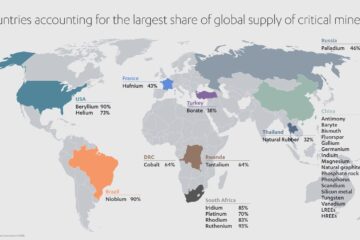
This dependence has increased the strategic importance of several African states. The Democratic Republic of the Congo occupies a central position in global cobalt and copper supply chains, while neighboring Zambia is a major copper producer within the same Central African Copperbelt. Namibia has significant mineral deposits and a growing portfolio of projects connected with battery and renewable-energy technologies. South Africa, meanwhile, is a leading producer of manganese and platinum-group metals.
These countries shall not be viewed only as points of the European supply map. They have their own development priorities and industrial ambitions, while intensifying competition for their resources gives them greater room to negotiate with Europe, China, the United States and other international actors.
The EU has responded by establishing raw-material partnerships and memoranda of understanding with Namibia, the Democratic Republic of the Congo, Zambia and Rwanda. These agreements are formally presented as more than instruments for securing access to minerals. Their scope includes transport and energy infrastructure, traceability, environmental and social safeguards, research cooperation, training and the development of local value chains. The Lobito Corridor, connecting the mineral-producing regions of the DRC and Zambia to Angola’s Atlantic coast, illustrates how transport infrastructure, logistics and mineral policy have become part of the same geopolitical discussion.
The first EU-South Africa Clean Trade and Investment Partnership, signed in Johannesburg on 20 November 2025, makes this shift particularly visible. It places mineral value chains within a broader framework covering renewable energy, electricity transmission, clean fuels, investment and industrial cooperation. From a European perspective, such arrangements can strengthen supply security and industrial competitiveness. For South Africa, their longer-term value will depend on whether they can support domestic production, skilled employment and a just energy transition and not only in their facilitation of higher volumes of mineral exports.
These developments point towards what may be described as “normative resource governance”: access to strategic materials is increasingly organized through a combination of market rules, sustainability standards and long-term partnerships. The EU is not abandoning its stated values in favor of strategic interests. Instead, it is seeking to pursue both through the same policy instruments. This hybrid approach creates possibilities for closer cooperation, but also produces strong tensions, especially regarding sustainability.
Requirements concerning human rights, environmental protection, due diligence and traceability can help prevent minerals associated with dangerous working conditions, severe pollution or conflict from entering European supply chains. At the same time, compliance can impose substantial burdens on artisanal miners, local suppliers and smaller firms that lack the necessary technology, finance or administrative capacity. European standards are more likely to be regarded as legitimate and to work effectively in practice, when African governments, institutions, workers and communities participate in shaping them and receive adequate financial and technical support for their implementation.
For many African governments, the central objective remains beneficiation: processing minerals closer to where they are extracted and moving into refining, components, manufacturing and specialized services. The African Green Minerals Strategy places this objective within a broader continental vision of resource-based industrialization, electrification, green-technology production and regional value chains. From this perspective, success cannot be measured solely by the volume of minerals exported. It must also be assessed in terms of, among others, public revenue and the creation of secure and skilled employment.
Critical raw materials are therefore moving EU-Africa relations beyond the familiar frameworks of development assistance and trade. What is now being negotiated is the structure of future industries and the distribution of value within them. Europe brings finance, technology, market access and demanding regulatory standards. African partners bring indispensable resources, local knowledge and growing political agency. A durable relationship must connect Europe’s need for resilient supply chains with African ambitions for economic transformation.
Will new infrastructure also serve local communities and businesses? Will processing projects create lasting industrial capabilities? Will African countries retain a larger share of the value generated by their resources? The answers will determine whether this emerging relationship becomes a genuine partnership or remains a more sophisticated form of trade. If these questions are neglected, the green transition may reproduce an older extractive model framed with new language of sustainability.
In any case, mineral interdependence represent a foundation for co-production, responsible growth and a more balanced relationship between Europe and Africa.
By Nikolaos Gaitenidis (Aristotle University of Thessaloniki)