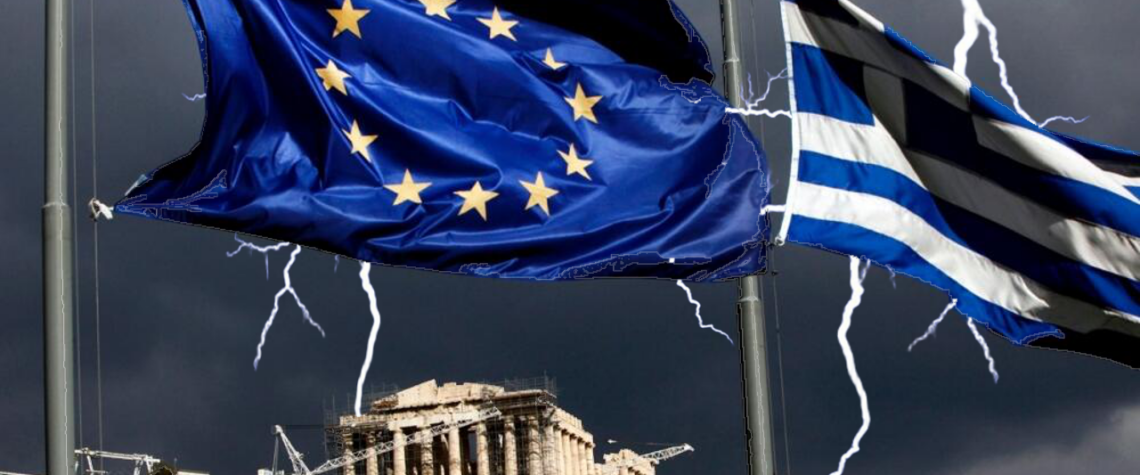
This is the lesson 2.2, the number 8 of the first module of EUPress Teacher Training, relating to the macro topic of “Steering the Euro Across the Crises: (2008-2019) and possible evolutions in the coming future.”
The Greek debt crisis of 2010 didn’t just shake financial markets — it forced the European Union into a crash course on how to manage the economic fallout of a monetary union without a fiscal union. Lesson 2.2 looks back at the frantic years between 2010 and 2012, when the EU hastily assembled a new architecture of “economic governance” to stabilize the eurozone and contain the domino effect of sovereign default risk.
EFSF vs. ESM — Two Roads, One Crisis
At the height of the crisis, the European Commission proposed a first-line tool to support Greece: the European Financial Stability Facility (EFSF) — a temporary vehicle backed by a modest amount of guarantees.
But national governments were skeptical. They didn’t trust the Commission to manage the situation independently, so they took matters into their own hands and created a more powerful alternative: the European Stability Mechanism (ESM).
- The ESM is a permanent intergovernmental institution, established outside the EU treaties but owned by euro area governments.
- It has a paid-in capital of €80 billion and a total lending capacity of €500 billion, backed by a nominal capital of €704.5 billion.
- Decisions often require a supermajority of 85%, giving Germany, France, and Italy effective veto power (as each holds more than 15%).
In practice, the ESM bought Greek bonds at near-zero interest rates, replacing Greece’s expensive market debt and preventing default. While controversial in public debate, especially in Southern Europe, the ESM helped neutralize the immediate crisis — but left open the broader question: what is the ESM for, now that the Greek crisis is over?
Harder Rules, Tighter Oversight — The “Economic Governance” Toolkit
Beyond the ESM, the EU introduced a series of new instruments to enhance fiscal discipline and oversight:
- European Semester: Annual cycle where Member States submit draft budgets each spring for Commission review. The Commission issues country-specific recommendations and can reject excessive deviations.
- “Six-Pack” and “Two-Pack” legislations: Strengthened fiscal surveillance and deficit procedures.
- Fiscal Compact (2012): Intergovernmental treaty requiring countries to move toward a 60% debt-to-GDP ratio within 20 years — an almost impossible task in many cases, especially for countries like Italy (currently at ~150%).
Such strict rules helped contain market panic but also fueled perceptions of Brussels-enforced austerity, feeding a backlash in countries already struggling with low growth.
The PIIGS domino — Why contagion spread
As Greek bond yields soared above 25%, panic spread across markets. Investors feared that if Greece left the euro, other weak countries might follow. The so-called PIIGS — Portugal, Ireland, Italy, Greece, and Spain — all saw interest rates climb due to common vulnerabilities in productivity, competitiveness, and high public debt.
Even countries like Italy — whose struggles were also tied to political instability — were heavily targeted, showing how fragile the entire euro architecture was.
2012: The turning point — Draghi’s “Whatever It Takes”
The decisive shift came in July 2012. At a Forex conference in London, ECB President Mario Draghi delivered the now-famous line:
“The ECB is ready to do whatever it takes to preserve the euro. And believe me, it will be enough.”
With that single statement — backed by the credibility of a central bank with unlimited liquidity power — speculation halted overnight. Draghi’s implicit promise of bond purchases under what would later become the OMT programme restored calm and bought time.
But as the lesson highlights, it was time the EU did not immediately use to fix deeper flaws — a failure that would later fuel populism and euro-exit narratives.
The response to the Greek crisis was a story of institutional improvisation: building governance while the system was already burning. The new tools — ESM, Fiscal Compact, Semester — stabilized the euro. But whether they strengthened the Union, or merely postponed its unravelling, is a debate still unfolding today.