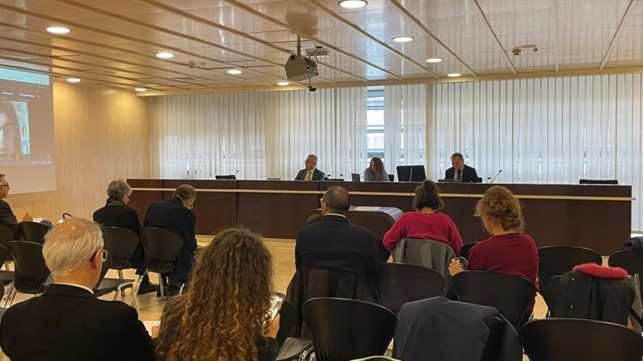
On Friday (November 22), in the Department of Political Sciences at Roma Tre University, a meeting was held with various stakeholders in the sector to discuss the main themes of the EUPress project, co-funded by the European Union.
The project seeks to equip young journalists with the skills and knowledge necessary to critically analyze and report on European issues. By promoting civic engagement and media literacy, it aims to nurture a new generation of informed and responsible journalists and European citizens.
The event was attended by representatives from various regional school offices, civil society associations (including youth organizations), think tanks, public institutions, and universities.
“Trying to create a generation of young people who narrate the EU accurately and as close as possible to reality, becoming advocates of the European integration process,” were the words used by Professor Fabio Masini, the academic coordinator of the project, to describe the goals of the initiative.
Through EUPress, “we aim to convey a narrative of the EU’s history that differs from the traditional story of successes and failures through a series of initiatives.”
Among the project’s various initiatives was a Summer School held in September on the island of Ventotene, which brought together 50 young people from 10 schools in Italy, Spain, Poland, and Romania.
Conclusion of the EUPress Summer School: A Successful Event that Leaves a Mark
Francesca Berti, the EUPress project officer, presented the outputs of the Summer School to the stakeholders in attendance and shared the project’s future developments.
The plan is to organize an online collaborative workshop for students who could not attend the Summer School. During this workshop, students will write journalistic articles, and “the role of editors-in-chief will be assigned to the students who were already trained in Ventotene.”
The final output to be produced by the collaborative workshop is a Didactic Notebook, i.e. an interactive notebook on civic education and European citizenship, intended for teachers, inside which is a collection of short articles written by the students.
Each text is designed in ‘wikipedia mode’, with active links to explanations and insights. Everything will be accompanied by qr-codes that refer to videos, tutorials, fact sheets, galleries, music selections with testimonials from artists, influencers, experts in the sector and much more.
The content proposed will be user-friendly and developed in an appealing manner, with an immediate and clear language without compromising the scientific nature of the content.
Given the digital nature of the notebook, the content can be constantly updated over time and implemented during the course of the project with the contribution of the participating schools.
EUPress: Exploring the European Union. Unveiling History and Functionality
Roberto Castaldi from Euractiv Italia also participated in the event, explaining the daily challenges and difficulties in narrating the European Union, further reinforcing the objectives of EUPress.
A significant contribution to the event has come from CesUE, a key player in the project specializing in communication and dissemination. CesUE’s involvement underscores the project’s commitment to effectively promoting European awareness and ensuring that its messages reach a broad and diverse audience.
Other stakeholders shared their experiences and ongoing activities, expressing satisfaction with the meeting and highlighting the need for more opportunities for dialogue between various actors involved in European education-related topics.