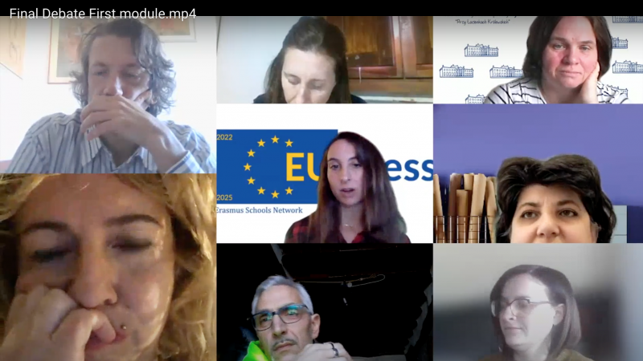
Today, March 17, at 3 p.m., the first debate scheduled for the end of the first module of the training course for high school teachers provided by the EUPress project, funded by the European Commission, was held.
The project officer, Francesca Berti of Roma Tre University, moderated the debate among the participants who expressed their reflections on the need to integrate within the teaching program of their subjects, some of the important European issues addressed in the training course: from the origins of the European integration process, to the challenges of European Union, to the Concepts and categories to understand the EU and its development and working.
Teachers had the opportunity to share short presentations on the topics that most impressed them and how to integrate these topics into their school curricula, resulting in an interesting discussion on the integration of European civic education in secondary schools.
“I believe all of the topics covered in the first module would be useful in class. In order to learn the ins and outs of the mechanisms of such a complicated system as the European Union, knowledge about its parts and their inner relations is necessary.” sustained Piotr Nazaruk, English teacher from CLVI Liceum Ogólnokształcące Integracyjne (in Warsaw). “The challenge – continued Piotr – remains, how to make all that complicated material easy to deliver to students in a limited amount of time.”
How to convey the issues of European civic education to students is a crucial topic that will be addressed next month in a dedicated lesson. However, in the meantime Piotr believes that “while some parts of the topics might be integrated into curriculum material during my the classes, the majority of the topics could be covered during extra classes”.
Regarding the integration of specific European topics Ernesto Bellucci, English teacher from Petrarca Classical-musical high school (Arezzo) affirmed he was impressed by “the way Lagarde changed bond issuing during the pandemic, considering the extent a Country’s life was affected by Covid and not the Country’s capital in the EU Central Bank. I do not exactly how, – continued Ernesto – but I would love to include this point in a syllabus, maybe joining it to Dickens’s sense of solidarity that underlies all, or most, of his novels.”