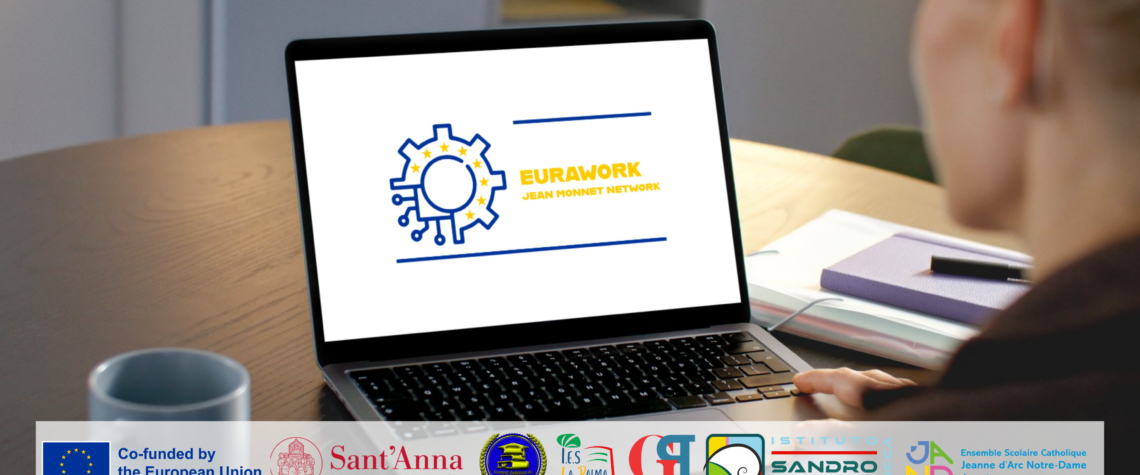
On Thursday, October 8th at 4:00 PM, the online launch event for the teacher training of EURAWORK will take place. “European Union and Digital Transition: The Age of a Renewed Interplay Between Robotics, Artificial Intelligence, and Meaningful Work” (EURAWORK) is the Jean Monnet project by the Scuola Superiore Sant’Anna (SSSA) dedicated to the relationship between artificial intelligence, robotics, and decent work. All the School’s lecturers will participate, and starting Tuesday, October 20th through Tuesday, December 22nd, they will deliver lessons aimed at teachers from partner schools.
The training path includes six eight-hour courses – six hours of teaching and two of evaluation -, all scheduled for the late afternoon, from 3:30 PM to 6:30 PM. Participants will be able to attend the lessons in synchronous mode, via Microsoft Teams, or in asynchronous mode, through the recordings available on the course’s Moodle platform. The lessons are designed for high school teachers from the project’s partner schools, but they will later be made available to anyone wishing to delve deeper into these topics.
Courses and lecturers
It begins on October 20th with “Robotics and AI Bias Prevention for Fostering Justice”, held by Stefano Calboli, research fellow at SSSA’s Interdisciplinary Research Center on Sustainability and Climate, and Elena Ricci, also a research fellow at SSSA. The course introduces the central topics of the ethical debate on artificial intelligence and robotics, with a particular focus on justice and bias prevention. Calboli will address the sources of bias, the applications of AI in education, and their impact on assessment, authorship, and educational equity. Ricci will focus on robotics as a technological and social infrastructure: from applications in healthcare, industry, and public life to the ethical challenges of responsibility, human control, and fundamental rights, up to strategies for preventing prejudices, starting from the idea that robots are not neutral artifacts.
The second module, “Labour and Technological Change: Placing the Rise of AI in History”, taking place from October 29th to November 3rd, is entrusted to Alessandro Brizzi of the Scuola Normale Superiore. A historical journey ranging from the First Industrial Revolution and workers’ protest movements to the transformations induced by information and communication technologies, to place the rise of AI into a long-term perspective. Topics of the lessons include job substitution and displacement, worker autonomy, and the transformation of “human capital”, in a path spanning from Edward P. Thompson, Daniel Nelson, and Beverly Silver, to Gramsci and Braverman.
Prof. Luca Ratti, professor of European and comparative labor law at the University of Luxembourg, will hold the third module on “Robotics and AI Regulation in the EU Framework” on November 10th and 12th. At the center is the European regulatory architecture, from the regulation of high-risk systems used in employment provided for by the AI Act to the rules on algorithmic management in the Platform Work Directive, up to the relationship between AI regulation and traditional labor law institutions.
EURAWORK, the Jean Monnet project to prepare students for the jobs of tomorrow
With Paolo Dario, professor emeritus at the Institute of Robotics of the Scuola Superiore Sant’Anna, teachers will explore how robotics and AI are transforming work, from collaborative robots to wearable exoskeletons, up to avatar robots. The course titled “Advanced Technologies Impact on Labour Market in the Industry 5.0 Framework” adopts the “One Health” perspective, with aging as a case study, and examines the ethical and legal conditions for robots to make work safer, more inclusive, and meaningful. The course will be held on November 19th and 24th.
The fifth module (December 1st and 3rd), “Meaningful Work in the EU”, is led by Francesco Tommasi, researcher in Work and Organizational Psychology at the University of Milan, and Prof. Alberto Pirni, professor of Moral Philosophy at SSSA and coordinator of the EURAWORK project. After a reflection on the future of work in the European context and the role of meaning in the subjective experience of workers, the lessons will explore the organizational and individual conditions that make work meaningful in the interaction with robotics and artificial intelligence.
Closing the cycle, on December 15th and 17th, is “EU Citizenship Education”, with Alessandro Chiessi, researcher at the Interdisciplinary Research Center on Sustainability and Climate at SSSA, and Adriano Angelucci, research fellow at the DIRPOLIS Institute of the Scuola Sant’Anna. The module reconstructs the conceptual and legal foundations of European citizenship and analyzes the origins, structure, and risk classification of the AI Act, helping teachers build citizenship education activities starting from hypothetical scenarios related to AI threats.
At the end of each course, an evaluation is scheduled through group presentations or designing teaching modules; otherwise, those attending asynchronously will have to submit a short essay.
The EURAWORK project
“European Union and Digital Transition: The Age of a Renewed Interplay Between Robotics, Artificial Intelligence, and Meaningful Work” (EURAWORK) is promoted by the Scuola Superiore Sant’Anna and funded by the European Union’s Erasmus+ Jean Monnet program. The project coordinator is Prof. Alberto Eugenio Ermenegildo Pirni, associate professor of Moral Philosophy at the Scuola Superiore Sant’Anna.
The initiative, launched in January, involves five high schools from France, Italy, Spain, and Romania: the Istituto Galilei Pacinotti in Pisa, the IIS Sandro Pertini in Lucca, IES La Palma in Spain, Lycée Jeanne d’Arc in Argentan in France, and Centrul Județean de Excelență in Romania.
The project combines the analysis of European policies with the ethics of emerging technologies and the concept of “decent and meaningful work”, within the framework of European citizenship, in a dialogue between universities and schools. The choice is to start with teachers, creating a cascade effect: training one teacher means multiplying knowledge across dozens of classrooms, fostering an interdisciplinary approach that weaves together history, philosophy, law, economics, computer science, and innovation.
The first year is dedicated to teacher training. In the second year, a Seasonal School will be held in Pisa, where a group of students selected for merit and inclusion will act as “ambassadors” in their respective schools. In the third year, students and teachers will travel to Brussels for a multi-day workshop, featuring meetings with members of the European Parliament, EU agencies, and technology sector stakeholders.
Click here to join the event