Is artificial intelligence really an unprecedented revolution in the world of work? Or can looking back at previous technological transformations help us better understand the challenges we face today? Throughout history, technological innovations have repeatedly reshaped employment, working conditions, and labour relations, often generating uncertainty and fears about the future. From the Industrial Revolution to the rise of artificial intelligence, understanding these transformations through a historical lens can offer valuable insights into today’s debates about automation and the future of work.
This historical perspective is at the heart of Labour and Technological Change: Placing the Rise of AI in History, one of the courses developed within EURAWORK and taught by Alessandro Brizzi, postdoctoral researcher at the Scuola Superiore Sant’Anna in Pisa and lecturer in Labour History at the University of Pisa. Holding a PhD in Contemporary History from the Scuola Normale Superiore and Université Paris Nanterre, Brizzi specialises in the history of welfare, industrial relations, wage policies, and the relationship between working time and leisure.
Through the lessons, the course explores how successive waves of technological change have transformed the world of work, focusing on their impact on employment, professional skills, working conditions, and labour relations. One of its central messages is that the anxieties surrounding artificial intelligence are not entirely new. Previous industrial and technological revolutions also raised concerns about job displacement, changing skills, and the future of employment. Looking at how societies responded to these transformations, and how institutions and policies adapted over time, can help place the current AI revolution in a broader historical context.
Particular attention is also given to the technological and economic transformations that began in the 1970s, tracing the developments that have contributed to today’s digital transition. This approach offers teachers an opportunity to connect contemporary debates about artificial intelligence with longer-term historical processes, helping students understand that technological change is not an isolated phenomenon but part of an ongoing transformation shaped by social, economic, and political choices.
The course is part of European Union and Digital Transition: The Age of a Renewed Interplay Between Robotics, Artificial Intelligence, and Meaningful Work (EURAWORK), a project promoted by the Scuola Superiore Sant’Anna in Pisa, funded by the European Union’s Erasmus+ Jean Monnet programme, and involving five partner schools from Italy, France, Spain, and Romania. By bringing academic research into dialogue with secondary education, the project aims to equip teachers and students with the critical skills needed to navigate the digital transition and reflect on the future of fair, dignified, and meaningful work.
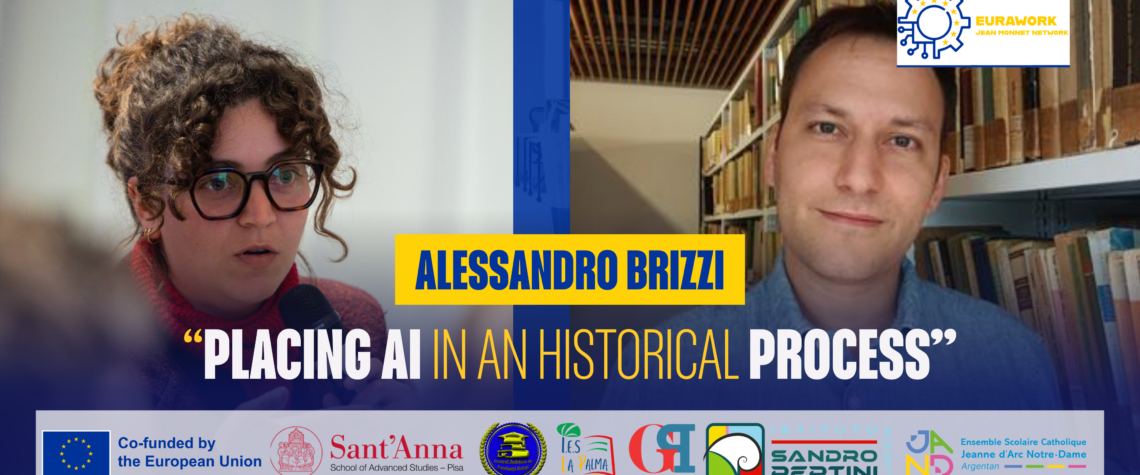
What can past technological revolutions teach us about the rise of artificial intelligence? How can historical knowledge help teachers explain the current transformation of work without reducing it to fears or technological predictions? And what role can public policies play in helping societies adapt to change? In an interview conducted by Sara Bertolli, journalist at Focus Europe Italia, Alessandro Brizzi introduces the main themes of his EURAWORK course, highlighting why understanding the history of technological change is essential to making sense of the challenges and opportunities of the AI era.