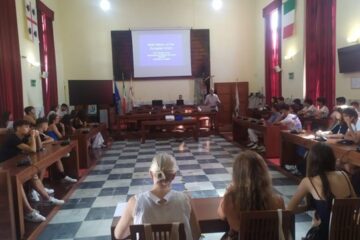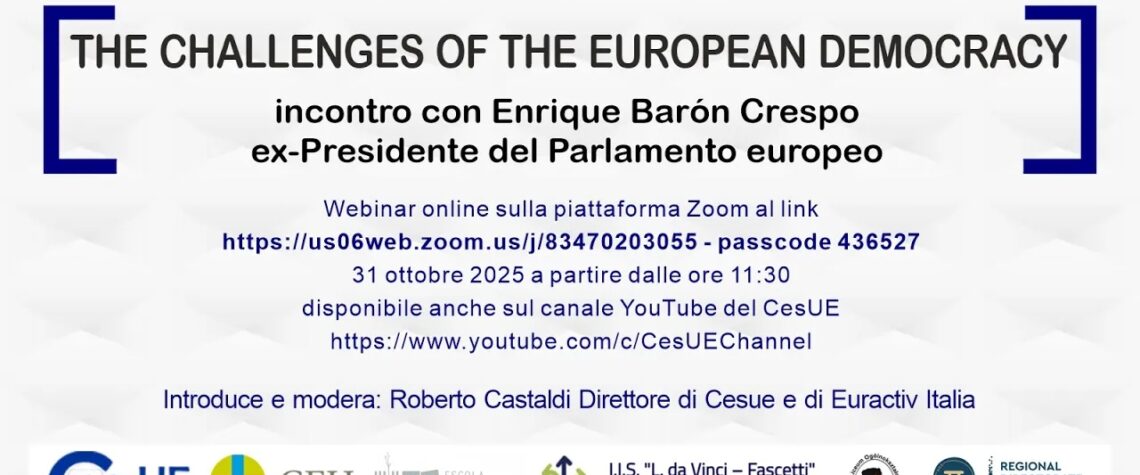
On 31 October 2025, the EUdemos project held a new high-level Policy Maker Session featuring an exceptional guest: Enrique Barón Crespo, former President of the European Parliament and one of the most authoritative voices in the history of European integration.
His lecture, titled “The Challenges Faced by European Democracy,” offered participants a lucid, thought-provoking reflection on the state of the Union at a pivotal moment.
From the very beginning, Barón Crespo issued a strong and urgent message:
Europe risks sliding backwards, returning to a logic of confrontation between nation states that would undermine the unity patiently built over decades.
He referenced the notion of “pragmatic federalism,” famously outlined by Mario Draghi, arguing that the European Union must equip itself with the institutional tools necessary to act decisively at the global level—without giving up its political vision or losing sight of its founding democratic values.
The Evolution of the European Parliament
A key part of Barón Crespo’s intervention focused on the transformation of the European Parliament, which he described as one of the greatest successes of European democracy.
From a consultative assembly to a full co-legislator, the Parliament has gained significant influence through:
- its growing role in shaping the EU budget,
- the expansion of the co-decision procedure,
- and the gradual strengthening of democratic accountability.
Barón Crespo emphasised that these achievements must never be taken for granted. Instead, they require continuous vigilance and commitment.
The Rise of Extremism and the Erosion of Consensus
The former EP President also highlighted one of the most troubling trends in today’s political landscape:
the growth of extremist movements on both the far right and the far left.
This polarisation, he warned, poses a serious threat to the principles at the heart of the European project—democracy, pluralism, human dignity, and respect for the rule of law.
To counter this trend, Europe must recover a culture of dialogue, compromise, and cooperation, the very elements that made the EU a global model for peaceful integration.
The Question of Enlargement: Reform Before Expansion?
The session concluded with a deep dive into one of the most consequential debates of the coming years:
Should the EU enlarge further without first reforming its institutions?
Barón Crespo presented both sides of the dilemma:
- Enlargement without reform could overload the system.
- But institutional reform may be the very element that enables meaningful enlargement.
For him, the issue is central to ensuring the future effectiveness and cohesion of the Union. The ability of the EU to welcome new members while remaining functional will define the Union’s credibility both internally and internationally.
A Decisive Moment for Europe
Participants left the session with a clear message:
Europe stands at a crossroads.
The decisions taken in the coming years will determine:
- the strength of its democratic institutions,
- the resilience of its unity,
- and its capacity to navigate an increasingly unstable global environment.
EUdemos: Bringing Democracy Closer to Young Europeans
By hosting leading figures such as Enrique Barón Crespo, EUdemos reaffirms its mission:
to engage young people in meaningful dialogue, strengthen civic participation, and make European politics accessible, understandable, and relevant to the next generation.