Who protects workers when algorithms make decisions about their jobs? How is the European Union regulating artificial intelligence in the workplace, and what rights do individuals have when their professional lives are increasingly shaped by automated systems? As AI and robotics transform the labour market, these questions are becoming central to the debate on the future of work, raising new challenges for policymakers, employers, workers, and educators alike.
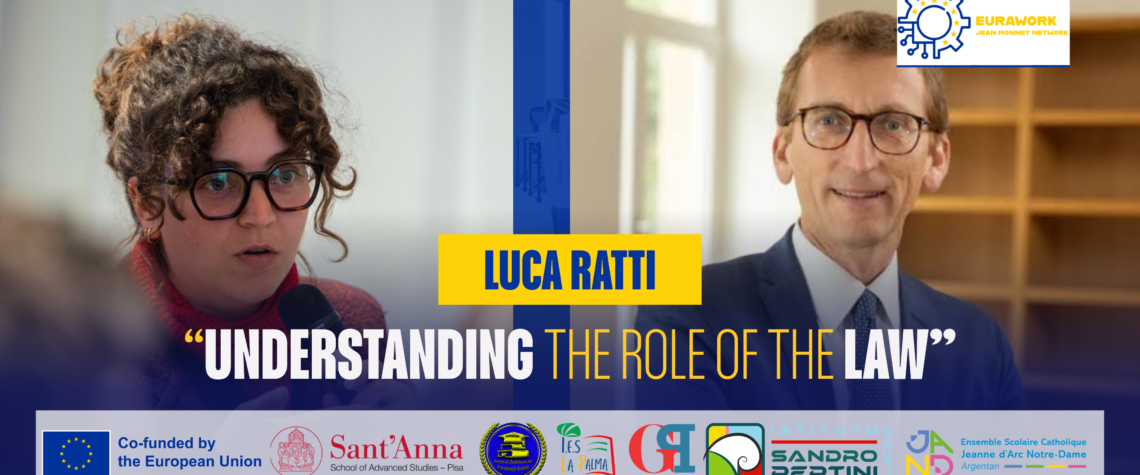
These issues are at the heart of the EURAWORK teacher training programme, which includes a course delivered by Luca Ratti, Professor of European and Comparative Labour Law at the University of Luxembourg, where he also directs the Master in European Law. A former Jean Monnet Chair in European Labour Law (2022–2025), Ratti has extensive experience researching employment, social rights, and working conditions. He previously coordinated the Wellbeing at Work (W@W) project, funded by the University of Luxembourg’s Institute of Advanced Studies, and Working Yet Poor (WorkYP), a research project funded by the European Union’s Horizon 2020 programme.
The course examines how European legislation is responding to the growing interaction between humans and intelligent machines in the workplace. Particular attention is given to the EU Artificial Intelligence Act, the Platform Work Directive, and the General Data Protection Regulation (GDPR), exploring how these regulatory frameworks address the challenges posed by emerging technologies. A central focus is algorithmic management: the increasing use of automated systems to organise, monitor, evaluate, and influence workers’ activities and working conditions.
Stefano Calboli presents the course on Robotics and AI bias prevention for fostering justice
The course also investigates the rise of platform work and other emerging forms of employment, highlighting how digital technologies are reshaping traditional labour relationships and raising new questions about workers’ rights, transparency, and human oversight. Understanding these developments means recognising that technological innovation is not only a matter of efficiency or economic growth, but also of legal protections, social justice, and the balance between technological progress and human dignity.
For high school teachers, these issues are particularly relevant. Students are already interacting with AI-powered technologies in their everyday lives and will soon enter a labour market increasingly influenced by automated decision-making. As Ratti emphasises, educators have an important role in helping young people become familiar with these technologies while developing an understanding of how the law regulates the relationship between humans and machines. Bringing European labour law into the classroom can therefore help students connect the digital transformation with their future rights and responsibilities as workers and European citizens.
Francesco Tommasi presents the course on Meaningful work in the EU
The course is part of European Union and Digital Transition: The Age of a Renewed Interplay Between Robotics, Artificial Intelligence, and Meaningful Work (EURAWORK), a project promoted by the Scuola Superiore Sant’Anna in Pisa, funded by the European Union’s Erasmus+ Jean Monnet programme, and involving five partner schools from Italy, France, Spain, and Romania. By bringing academic research into dialogue with secondary education, the project aims to equip teachers and students with the critical skills needed to navigate the digital transition and reflect on the future of fair, dignified, and meaningful work.
How can European labour law protect workers in an increasingly automated economy? What challenges do platform work and algorithmic management pose for employment rights? And why should young people begin exploring these issues while they are still at school? In an interview conducted by Sara Bertolli, journalist at Focus Europe Italia, Professor Luca Ratti introduces the main themes of his EURAWORK course, explaining why understanding the European regulatory framework is essential to preparing the next generation for a world of work shaped by artificial intelligence and robotics.