This is the fifth lesson of the macro topic “EU institutions, competences and functioning” in the first module.
The objective of this lesson, led by Francesca Berti, is to examine the operational dynamics of the European Council.
Once an informal forum for strategic talks among Europe’s leaders, the European Council has evolved into one of the most powerful institutions in the European Union — providing the political direction and long-term vision that guide the Union through crises and transformation.
From informal summitry to treaty-defined body
The European Council traces its origins back to the early 1960s, when heads of state and government began meeting periodically to discuss Europe’s future outside the formal structures of the European Community. It was officially recognized at the Paris Summit of 1974 and institutionalized with the Single European Act (1987). Today, it is fully embedded in the EU’s institutional framework through the Lisbon Treaty (2009).
Unlike the Council of the European Union, which legislates, the European Council does not adopt laws — but it defines the EU’s political priorities, shaping the course of integration across all major policy fields.
Who sits at the table?
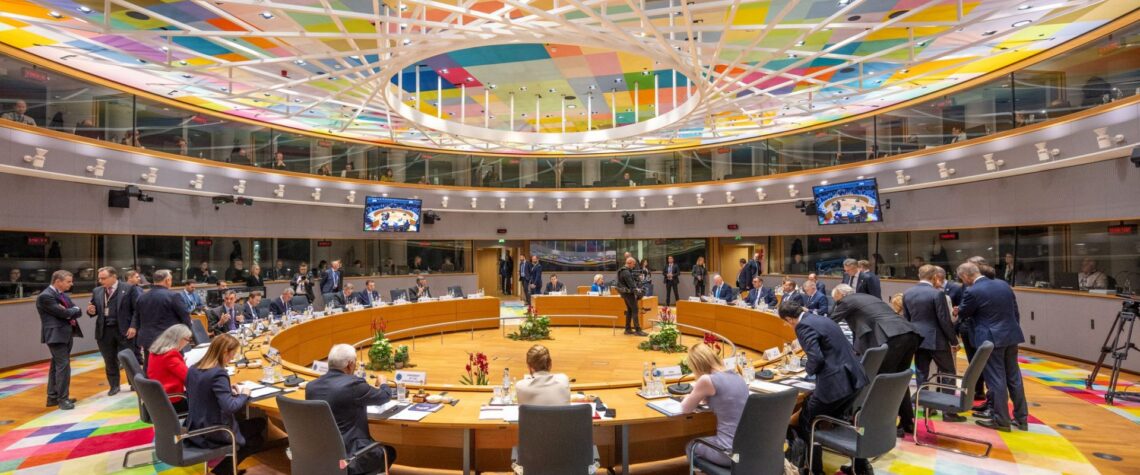
The European Council brings together:
- The heads of state or government of all 27 Member States
- The President of the European Commission
- The President of the European Council (who chairs the meetings)
- The High Representative for Foreign Affairs and Security Policy (participating, but not as a voting member)
The body functions as a collective presidency, giving national leaders the space to negotiate high-level decisions together.
The President: Consensus Builder-in-Chief
Since the Lisbon Treaty, the European Council has had a permanent President elected for a renewable term of 2.5 years. The current holder of the office (as of 2019) is former Belgian Prime Minister Charles Michel.
The President:
- Chairs and prepares meetings
- Fosters consensus among leaders
- Represents the EU externally on foreign and security policy (alongside the High Representative)
Importantly, the President must not hold national office — a safeguard to ensure dedicated, European-wide leadership.
How the European Council works
- Meets at least four times a year (commonly known as “EU summits”)
- Final conclusions from each meeting set policy direction — influencing everything from economic governance to foreign affairs
- Agenda-setting and preparation handled by the General Affairs Council (foreign ministers), working closely with the Commission and the President
- Decisions are usually taken by consensus — majority voting is rarely used, except for electing the President or appointing top EU officials
What does the European Council decide?
While not a legislature, the European Council wields enormous influence through:
- Treaty reform decisions
- Enlargement leadership (approving candidate states and accession)
- Top EU appointments (e.g. Commission President, ECB President)
- Economic and monetary policy guidelines
- Foreign and security strategy, including defense implications
It can also give instructions to the Commission or Council, request policy proposals, and shape multi-annual budget priorities.
One institution above the fray — yet central to it
The European Council operates at the crossroads of national interest and European vision. As crises from Brexit to the Covid-19 pandemic have shown, it has become the arena where the EU’s biggest challenges converge — demanding both political leadership and compromise.
It may not pass laws, but with its power to set the Union’s strategic direction, the European Council remains the de facto helm of Europe’s political ship.