This is the fourth lesson of the macro topic “EU institutions, competences and functioning” in the first module.
The objective of this lesson, led by Francesca Berti, is to examine the functioning of the EU Council.
Often confused with the European Council or the Council of Europe, the Council of the European Union — also known as the Council of Ministers — is one of the EU’s core institutions, responsible for representing the Member States’ governments within the Union’s legislative and policy process.
An institution of national ministers, not heads of state
Each Council meeting brings together one minister per Member State, but the composition changes based on the topic under discussion. Whether it’s agriculture, finance, justice, or foreign affairs, the relevant ministers from all 27 EU countries gather to coordinate and negotiate their national positions.
Based primarily in Brussels (though some sessions are held in Luxembourg), the Council embodies the intergovernmental dimension of the EU — balancing national interests with Union-wide goals.
Rotating Presidency and Core Council Formations
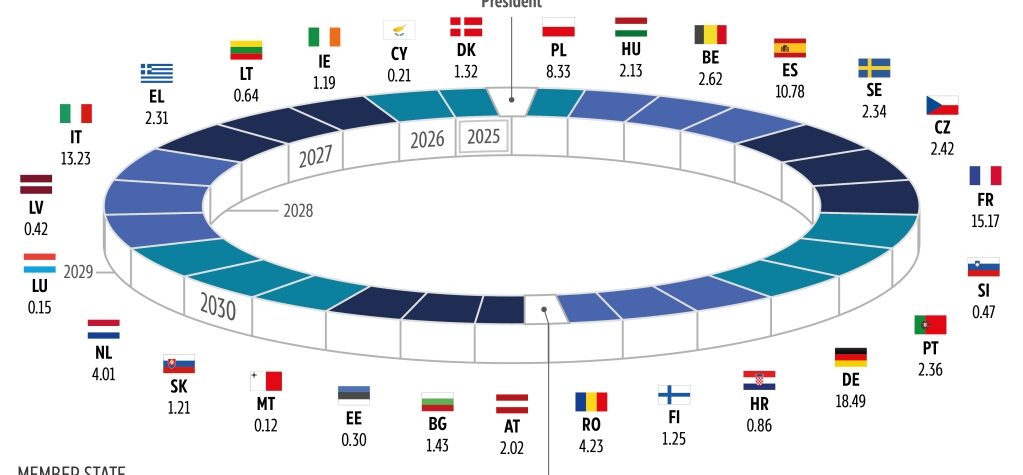
The Council is chaired by the Presidency, a Member State government rotating every six months. This position is not permanent but passes in a set order, giving each country equal responsibility for guiding the Council’s agenda and mediating discussions.
Since the Lisbon Treaty (2009), two Council formations are specifically named:
- General Affairs Council (GAC): Coordinates across different policy fields and prepares European Council meetings.
- Foreign Affairs Council (FAC): Overseen by the High Representative for Foreign Affairs and Security Policy, providing an EU voice in international relations — though the High Representative does not vote.
Other key formations include:
- ECOFIN (Economic and Financial Affairs), which focuses on budgets, taxation, and financial stability.
- Agriculture and Fisheries Council
- Justice and Home Affairs Council
- And others, depending on policy area.
Behind the scenes: COREPER’s crucial role
Most Council decisions are not taken in the spotlight but are prepared by the Committee of Permanent Representatives (COREPER), composed of national diplomats stationed in Brussels.
COREPER:
- Prepares all Council meeting agendas,
- Conducts both technical and political negotiations,
- Builds preliminary agreements that ministers can adopt — often without debate,
- Facilitates cooperation with the European Parliament during co-decision procedures.
A shared legislative power
The Council shares nearly all legislative and budgetary power with the European Parliament under the ordinary legislative procedure. In this process, the European Commission proposes legislation, but the Council and Parliament decide jointly — making compromise across both institutions essential.
Despite the Parliament’s growing influence, the Council still has significant power:
- It sets broad political priorities for the EU,
- Approves international agreements,
- Coordinates Member States’ economic and foreign policies,
- Monitors implementation of EU law and can trigger legal action,
- Decides on sanctions under foreign policy frameworks.
How does the Council vote?
Voting mechanisms depend on the type of decision:
- Qualified Majority Voting (QMV) is the most common method. Since 2014, it uses a “double majority” rule:
- 55% of Member States (at least 15 countries),
- Representing at least 65% of the EU population.
- Unanimity remains essential for sensitive issues like:
- Foreign and security policy,
- EU membership changes,
- Taxation,
- Some social and budgetary matters.
- Simple majority applies in procedural decisions.
Additionally, the Lisbon Treaty includes a “passerelle clause” that allows the European Council to move certain decisions from unanimity to QMV — provided there’s unanimous support.
A shifting balance of power
Though once the dominant legislative body, the Council has gradually ceded power to the Parliament. Yet, it remains vital: few EU laws pass without Council approval, and its control over areas like foreign and fiscal policy makes it an essential pillar of the Union.
Its work, often technical and consensual, reflects the intricate reality of EU governance: a hybrid system where national interests and supranational goals meet — and where compromises shape Europe’s future.