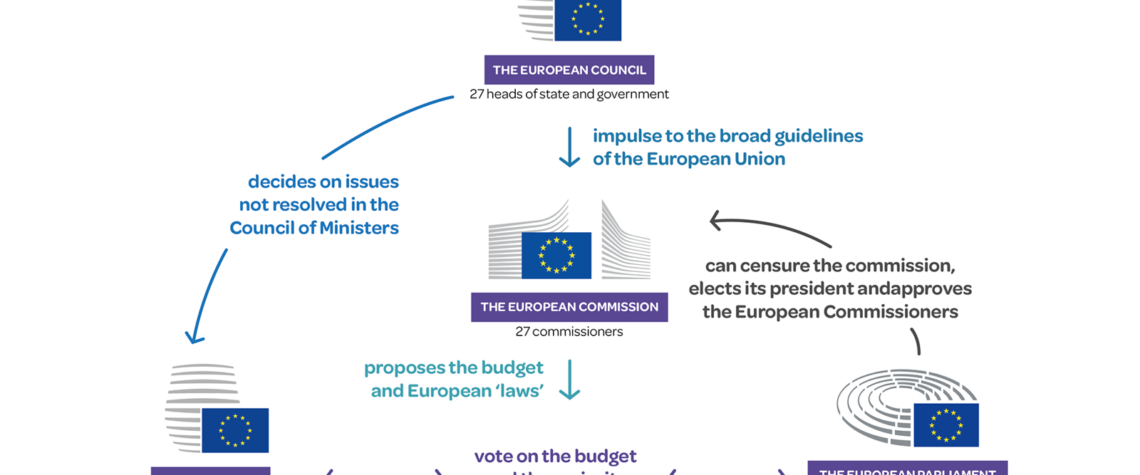
This is the inaugural lesson of the macro topic “EU institutions, competences and functioning” within the first Module.
The objective of this lesson, led by Francesca Berti, is to examine the governance of the EU by analysing its legislative and decision-making procedures.
The European Union’s legislative system is unlike any other in the world — a constantly evolving partnership between supranational institutions and national governments. Rather than a single model of governance, the EU operates with multiple decision-making mechanisms, spanning federal, quasi-federal, and intergovernmental logics.
Three decision-making modes in the EU
Depending on the policy area, the EU operates through:
- Supranational and quasi-federal governance – Most evident in the single market, where the EU has the power to legislate over national law.
- Fully federal governance – Applied to the single currency and handled autonomously by the European Central Bank (ECB).
- Intergovernmental decision-making – Dominant in areas like foreign policy, justice, home affairs, taxation, treaty reform, and budgetary resources. In these fields, the Council decides unanimously, and the Parliament’s role is often limited.
This blend contributes to what some call the “complexity” and “opacity” of EU governance — but it also reflects a tailored approach to integration based on political sensitivity and member state sovereignty.
From the EEC to the European Union: evolving powers and procedures
- European Economic Community (EEC) – Featured a confederal structure:
- The Commission held a strong initiative role, proposing laws.
- The Council of Ministers adopted legislation — initially by unanimous vote, later by qualified majority voting (QMV) after a transitional phase.
- The Parliamentary Assembly had only an advisory function.
- The Court of Justice emerged as a powerful supranational body, shaping EU law in the spirit of federalism.
- European Union (Post-Maastricht) – Introduced:
- The ordinary legislative procedure (“Community method”) co-designed by the Commission, Council, and Parliament.
- Federal decision-making via the ECB, using majority voting and rotation systems — essential during financial crises.
- Partial “communitarisation” of some intergovernmental fields, expanding Parliament’s influence and introducing QMV in select areas.
The EU legislative toolkit
EU legal acts vary in strength:
- Regulations – Directly applicable and binding across the Union.
- Directives – Bind Member States, but require national law for implementation.
- Decisions – Binding on addressees only.
- Recommendations and opinions – Non-binding, serving as policy guidance.
Areas of competence: who does what?
The EU wields power based on three levels of competence:
- Exclusive competences – Only the EU can act (e.g. competition policy, trade, monetary policy for eurozone states).
- Shared competences – Both the EU and Member States can legislate, though EU law takes precedence (e.g. internal market, environment).
- Supporting competences – The EU supports, coordinates, or supplements national policies (e.g. education, culture).
The ordinary legislative procedure: the EU’s law-making engine
This co-decision process — now applied to ~60% of EU law — works as follows:
- Commission proposes legislation (after consultations and impact assessments).
- Parliament and Council jointly adopt it, with up to two readings and possible conciliation.
- A conciliation committee resolves disagreements. If no compromise is reached, the proposal fails.
Behind the scenes, “trilogues” — informal negotiations between the three institutions — help broker early agreements.
The role of national parliaments: subsidiarity watchdogs
Under the Lisbon Treaty, national parliaments gained a direct role in checking whether EU laws respect the principle of subsidiarity — i.e., that decisions should be made as closely as possible to citizens.
Each national parliament receives draft EU legislation and has 8 weeks to issue a reasoned objection. If:
- 1/3 of national votes object → the “yellow card” is triggered.
- 1/2 object → a “red card” forces full reconsideration, and the process can halt.
National parliaments can also bring an action before the Court of Justice if subsidiarity is breached.
The EU’s legislative system is neither purely supranational nor purely intergovernmental. Instead, it reflects the Union’s core identity: a shared authority built on cooperation, compromise, and multi-level governance — constantly adapting as integration deepens and democratic pressures evolve.