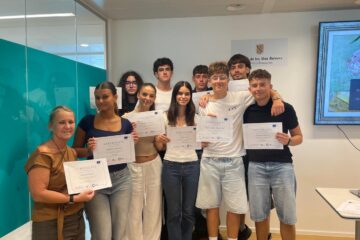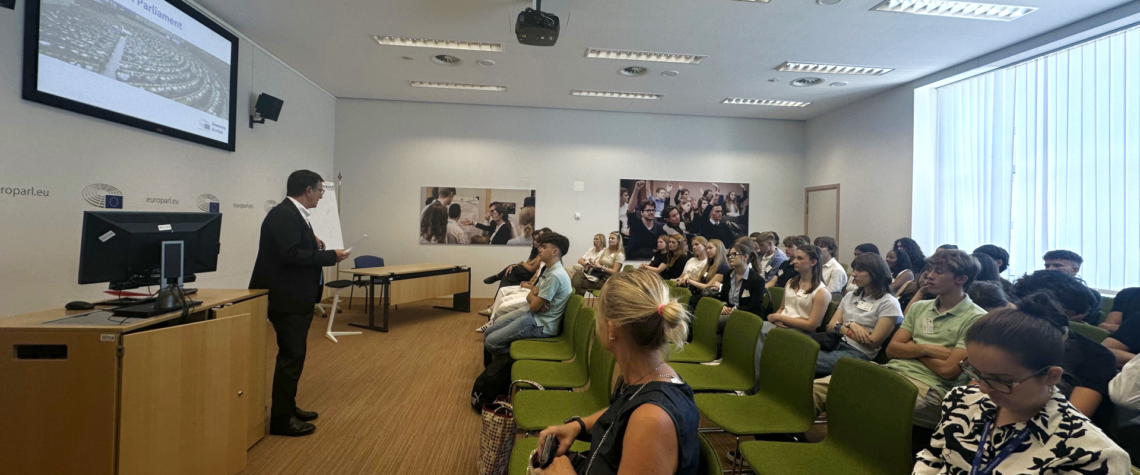
Brussels, July 14. Outside it’s 30 degrees and the asphalt is simmering. Waiting at the entrance to the European Parliament are forty-five students from four European countries. As they wait, they look around, and on the facade of the Eurocamera they recognize a name they heard yesterday: “Altiero Spinelli,” one of the founding fathers of the European Union, or so they’ve been told. After a group photo under the blazing sun, the Spanish, Bulgarian, Polish and Italian students – accompanied by their respective teachers – collect their badges and step into the House of all European citizens.
The excitement is palpable. Today they will meet a Member of the European Parliament and visit the hemicycle, the chamber where the decisions that shape our daily lives are made.
We take the elevator and head to one of the many meeting rooms, where a Parliament official is waiting to guide us through the visit. She isn’t alone: beside her is Giorgio Gori, a Member of the European Parliament from the Socialists and Democrats group, who wanted to meet the students in order to talk with them directly.
“Europe isn’t just institutions, treaties and regulations. It’s people with different languages, different histories, different points of view, meeting and trying to build something together. That’s what Jean Monnet’s project is about,” he said as he opened the meeting.
EUAMI students meet the European Commission and Parliament in Brussels
Gori spent the last ten years as mayor of Bergamo, Italy, and brings political experience forged on the ground – including through difficult moments, such as the COVID-19 pandemic, which made Bergamo one of the hardest-hit cities in the world. “That experience taught me something simple: when a real crisis hits, national borders aren’t enough,” Gori said, recalling those days. “We need European institutions that can decide, protect people, and show real, concrete solidarity.”
During the pandemic, while individual states closed their borders, the European Commission rolled out joint relief plans and, in that moment, the strength of unity won out over fragmentation. Faced with global crises, Gori argued, the response cannot be a national one. “If Europeans stay divided, each of our countries counts for very little on its own. Together, we can defend our interests and a model built on democracy, the rule of law and freedom.”
The MEP went on to say that the EU’s founding values – freedom, democracy, the rule of law, human dignity, the protection of minorities – are not “a ceremonial formality,” but rather “very concrete”. “They decide whether a government can limit the power of judges. Whether a journalist can do their job without fear. Whether a majority can strip rights away from a minority. Whether a person, even a foreigner, even someone without papers, still has fundamental rights.”
“These values aren’t guaranteed forever. Every generation has to choose them again and turn them into real political decisions,” he told the students, reminding them of the political potential each of them holds.
EUAMI Summer school opens in Brussels with a lesson in “Concrete Europe”
Turning to European migration policy, he added: “An effective migration policy has to hold several things together at once. We need returns for people who have no right to stay. We need real agreements with countries of origin, no return works without their cooperation. Above all we need legal pathways in, not only because Europe needs workers, but because without legal alternatives, people end up in the hands of traffickers instead. And we need integration: learning the language, going to school, training, finding a job. Integration isn’t just an act of solidarity, it’s also the best way to build security and make coexistence work.”
He closed by reminding the students that in three years they will be called to vote, and will have to decide what kind of Europe to build. “So don’t just ask yourselves whether Europe works. Ask what it would take to make it work better, and what part of that you’re willing to take on.”
The visit at the European Parliament took place as part of the Summer school of the Jean Monnet project European Values and Migration, led by University of Padua in consortium with Emilian Stanev School (Bulgaria), Enrico Fermi Institute of Mantua (Italy), Canossa Campus of Brescia(Italy), Zespół Szkół Administracyjno-Ekonomicznych (Poland), and Sant Josep Obrer school (Spain).