A week that promises to bring the European Union out of the abstract and into the everyday lives of young Europeans has begun. Today marked the opening of the summer school in Brussels of the Jean Monnet project “European Values and Migration” (EUAMI), led by the University of Padua together with a consortium of five secondary schools from across the continent: the Emilian Stanev School Union from Bulgaria, the Enrico Fermi Institute of Mantua and the Canossa Campus of Brescia from Italy, the Zespół Szkół Administracyjno-Ekonomicznych from Poland, and the Sant Josep Obrer school from Spain. CesUe and Focus Europe Italia, acting as media partners, are supporting the initiative.
Running from Monday 13 to Friday 17 July, the summer school will take students through the corridors of the European Council and the Council of the EU, the European Commission and the European Parliament, offering direct exchanges with policymakers, including Members of the European Parliament.
The programme also includes visits to the MigrationMuseum and to a youth-led NGO. A particularly significant feature of the week will be the visits to the Brussels representation offices of European regions – Tuscany today, and the Balearic Islands on Friday – a reminder, organisers say, that the EU is not a distant or abstract institution but one rooted in local communities and daily life.
Day one: Tuscany welcomes the students to Brussels
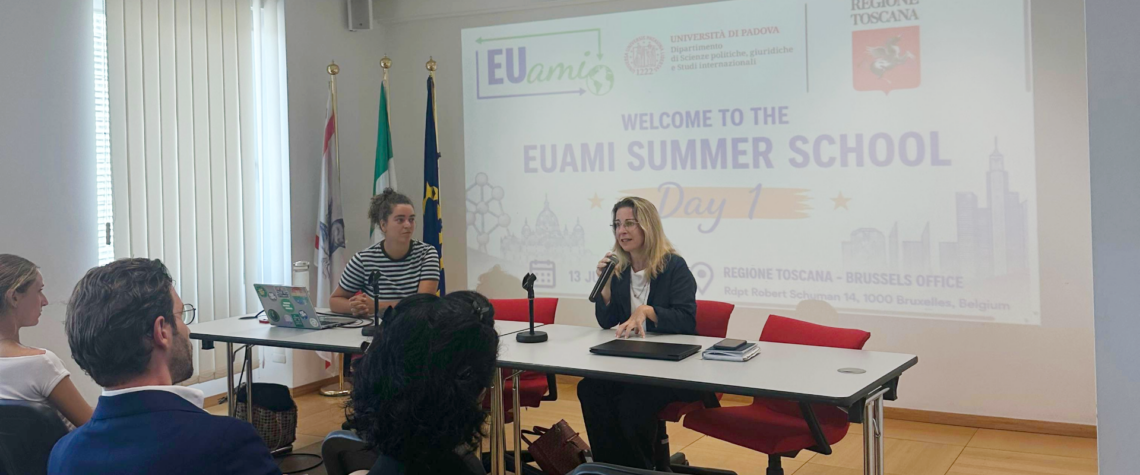
The first day of activities took place at the Brussels office of the Region of Tuscany, opening with remarks from Regional Minister Cristina Manetti, who holds the portfolios of Culture, Relations with Universities and Research Centres, and Relations with the Tuscan Delegation to the EU, and from Irene Galletti, President of the Committee on European Affairs of the Tuscany Regional Council.
Manetti focused her address on the importance of cohesion policy for local territories, describing it as a policy that delivers concrete answers to citizens through services rather than abstract promises. As she put it, “Cohesion policy means no one is left behind. It looks at both the economic and social levels.” She added that her hope was for the students to understand that “the EU project isn’t something abstract, it’s yours. Europe invests in knowledge and solidarity.”
During the question-and-answer session that followed, Manetti pointed to concrete examples of EU funding reaching citizens directly – from dedicated support funds for young artists under 35 to healthcare and student scholarships financed in large part through European resources.
“Even though the EU may seem untouchable, you’ll see that it’s actually close to you and your region,” she told the students, while acknowledging with a smile that “the EU is a labirinth of bureaucracy” – one that becomes manageable once you know who to turn to. She closed with a message of encouragement to the young audience: “If you manage to catch the opportunities the EU can give you, it’s a great added value for young citizens!”.
President Galletti, for her part, spoke about the role of the European Union for new generations, describing the Brussels office not merely as a regional representation but as a platform for engaging in business and cultural opportunities well beyond Europe’s borders. “It’s not simply a market, it’s a project, a community built on shared values and shared responsibility,” she said, adding that democracy “is not something to take for granted, it’s something to engage with critically”.
Addressing the students directly, she remarked, “You are the future,” and encouraged them to “build friendships across borders,” noting that “the best way to understand Europe is to actively experience it, not just study it”.
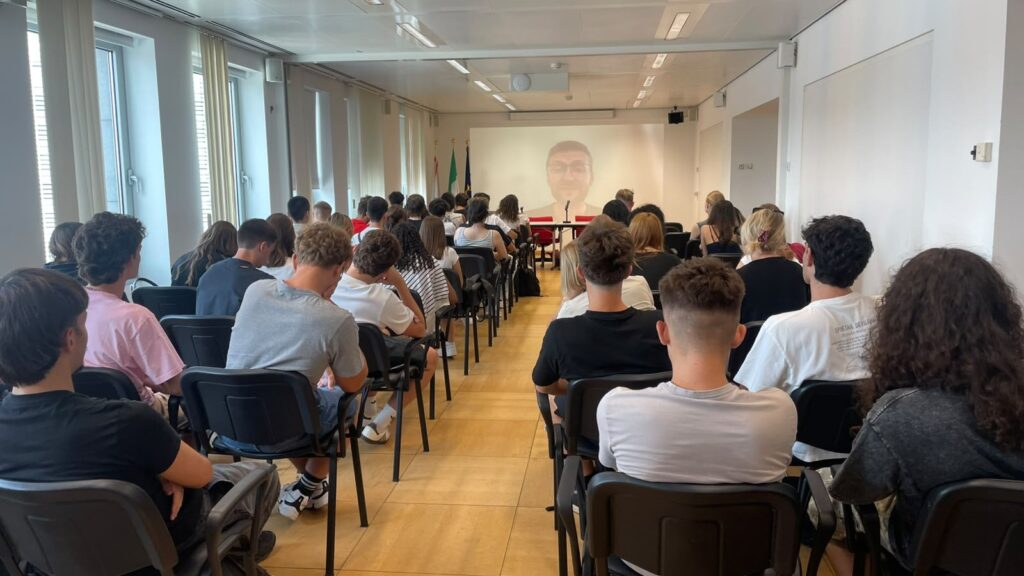
Matteo Bassoli, professor at the University of Padua and coordinator of the project, sent a video message to the students: “The summer school is a cornerstone of our project. Looking back at last year, I still carry beautiful memories of our summer school – the energy, the debates, and the process I shared with your colleagues and professors. I saw your passion for European integration growing day by day. This year, you will step directly into the rooms where history is made, and you won’t just be observers – thanks to the simulation of the Foreign Affairs Council, you’ll step into the shoes of our ministers.”
The morning continued with presentations by each participating school, showcasing the activities carried out over the past year as part of the EUAMI project. Students then relocated to the Parc du Cinquantenaire for an international picnic, where each school brought and shared typical dishes from their home country – a light-hearted moment of cultural exchange between the five nations represented.
In the afternoon, the group returned to structured activities with an icebreaker built around a Europe-themed Bingo game, designed to help students from different countries get to know one another. This was followed by a presentation from Sara Bertolli and Matilda Aleandri of CesUe and Focus Europe, both organisers of the summer school, who traced the history of European integration and its institutions, from the Ventotene Manifesto to the crises shaping the Union today.
The day closed with an introduction to the simulation exercise students will carry out over the course of the week: a mock Foreign Affairs Council tasked with negotiating the so-called “Return Regulation.”
A stimulating first day, organisers noted, that sets the tone for what promises to be an equally intense week ahead.