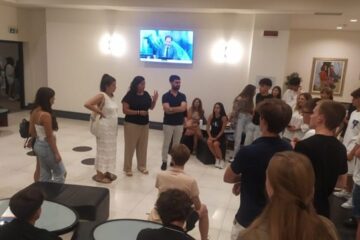
As part of the European project EU Demos, designed to foster democratic participation and a shared European identity among students, Sara Bertolli (CesUe and Euractiv Italia) interviewed two Italian teachers who played a key role in the initiative: Barbara Licheri, English teacher and Antonella Viale, project coordinator, both at Istituto Da Vinci-Fascetti in Pisa, Italy.
Together with their students, from Environmental Biotechnology and Aeronautical specialisations, they took part in several transnational activities, including the final Summer School of EU Demos project held in Brussels.
What was the most meaningful moment of the EU Demos project for you?
Barbara: For me, one of the most important moments was the very first meeting in Madrid, during the Steering Committee. That’s where everything started. Even though I already knew some participants, meeting everyone as a group gave us the chance to lay the foundation for this new adventure. It was an inspiring moment, especially meeting Jeronimo (Prof. Jerónimo Maillo González-Orús of CEU San Pablo University in Madrid), who continued the coordination work. I truly believe in the value of European projects, and that meeting marked a meaningful beginning.
Do you think your students’ perception of the EU changed thanks to this experience?
Barbara: Absolutely. It was a big step for them. Before the project, their perception of the EU was vague. But through class lessons, joint school activities, and travel, they developed a clearer, more practical sense of what the European Union is and what it offers. Many now feel more connected to Europe as a shared space.
Antonella: I wanted them to stop thinking in overly simplified terms. We often hear things like “immigrants are only a problem for Italy,” or “everything is the EU’s fault.” I tried to show them that these issues are complex and interconnected. I hope that they now approach things more critically and are less likely to fall for slogans or populist messages that reduce reality to blame games.
What did the project offer you, personally, as a teacher?
Antonella: It pushed me to dig deeper, to explore complex topics like the Green Deal and the future of Europe. The lectures by university professors were rich and informative. But I felt there was a missing link: support on how to translate that content into classroom teaching. These topics are not easy to communicate to teenagers, and a bit more focus on pedagogy, on how to teach such complexity, would have helped.
What EU-related topics do you find most important to teach in class?
Barbara: Environmental issues, such as climate change and renewable energy, are a priority. They’re relevant and of real interest to the students. Immigration is also key, especially in Pisa, where it’s a significant local issue. But we also need to focus on human rights. Students often take for granted freedoms and opportunities that aren’t guaranteed in other places, or weren’t in the past. They need to understand that these rights were earned through long struggles, and that we must not take them lightly.
What do you think was the biggest added value of this project for your students?
Antonella: I hope it helped them understand what Europe is and why it matters. The goal was to help them move beyond a national mindset. The challenges we face today are huge, global powers like China, the U.S., or Russia can’t be countered by any single country alone. We must start thinking in European terms. That’s what I wanted my students to take away from this experience.
What would you improve in a future version of the project?
Barbara: I would reduce the amount of theoretical content, especially from university lecturers. While that’s valuable for us teachers, students need more hands-on, practical activities. In a future project, I’d ask for more interactive, student-centred sessions: debates, workshops, simulations, to increase engagement.
Would your school participate again in similar projects?
Barbara: Without a doubt. We’ve been involved in Erasmus+ since 2014, with both exchanges and internships. There’s a strong team at our school committed to European cooperation. We believe in creating connections between countries, and young people are the starting point. It’s their future, and we must give them the tools to shape it.