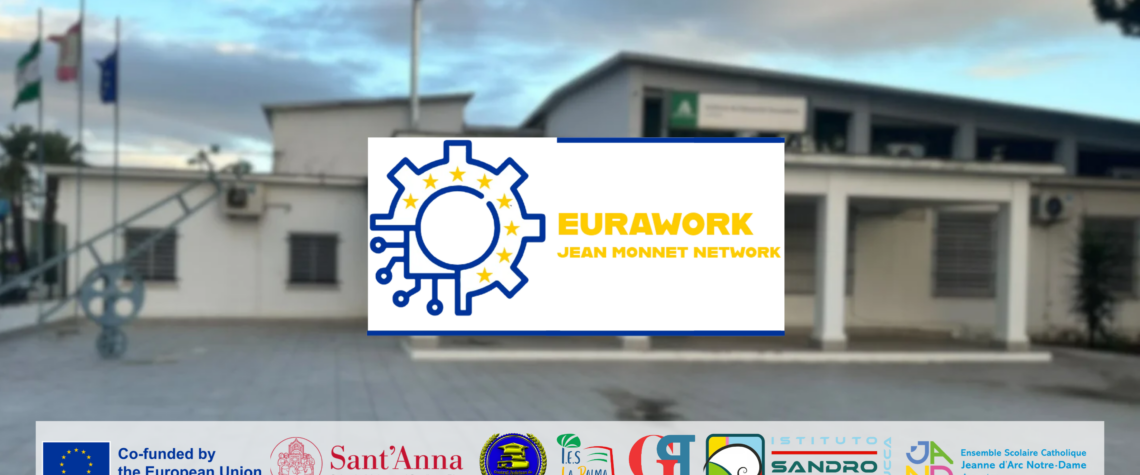
Located in La Palma del Condado, in the province of Huelva, in Spain, IES La Palma is one of the leading public educational institutions in the region and a partner in the Jean Monnet project European Union and Digital Transition: The Age of a Renewed Interplay Between Robotics, Artificial Intelligence, and Meaningful Work (EURAWORK).
Founded in 1968, the school currently welcomes more than 1,000 students and employs around 90 teachers. Its educational offer includes Secondary Education, Baccalaureate, Adult Education and a wide range of Vocational Education and Training programmes. From automotive mechanics and hairdressing to administrative management and olive oil and wine production, its courses reflect the needs and professional opportunities of the local community.
Europe has been part of IES La Palma‘s identity for many years.
Its international journey began with the Comenius programme and continued through several European partnerships and Erasmus+ projects, focusing on teacher training, educational innovation, cultural exchange and student mobility. Over the years, the school has developed a strong network of European connections, giving students and teachers opportunities to gain experience abroad and discover different educational and professional environments.
Today, this commitment is stronger than ever, because through its Erasmus+ accreditation and participation in different European mobility consortia, IES La Palma offers international learning opportunities across all its educational sectors, including Secondary Education, Vocational Training and Adult Education.
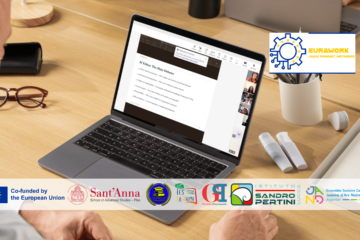
Adriano Angelucci and Alessandro Chiessi present the EURAWORK course on European citizenship and AI
“Joining EURAWORK is a natural next step in this journey” says María Inmaculada Iglesias Villarán, the teacher responsible for EURAWORK at IES La Palma. Coordinated by Scuola Superiore Sant’Anna in Pisa, the Jean Monnet project brings together European schools and academic institutions to explore how artificial intelligence, robotics and digitalisation are reshaping the world of work. Its central question is not simply how technology will change our jobs, but how to ensure that this transformation remains human-centred, inclusive and respectful of workers’ rights.
For IES La Palma, this is a particularly relevant challenge, since many of its students are preparing to enter the labour market through vocational pathways, making it essential for them to understand not only new technologies but also their ethical and social implications.
Through EURAWORK, the school aims to strengthen teachers’ knowledge of artificial intelligence, digital ethics, algorithmic bias and European legislation, while bringing these topics directly into the classroom through new teaching activities. Particular attention will be given to the relationship between technology and human dignity, the future of professional skills and the idea of Meaningful Work in the context of Industry 5.0.
The project will also create new opportunities to exchange experiences and good practices with partner institutions in Italy, France and Romania, further strengthening the school’s European dimension.
For IES La Palma, preparing students for the future means not only giving them more than technical skills, but it also means helping them become critical thinkers, responsible digital citizens and active participants in a rapidly changing European society.
The school is grateful to Scuola Superiore Sant’Anna and the EURAWORK project team for the opportunity to be part of this European initiative. Together, the partners aim to ensure that technological progress does not leave people behind, but instead creates new opportunities for a fairer and more meaningful future of work.
“We are confident that building this shared learning experience will enable our faculty to acquire new tools for educational innovation while empowering our students to successfully meet the technological challenges of the future labor market”, concludes María Inmaculada Iglesias Villarán.