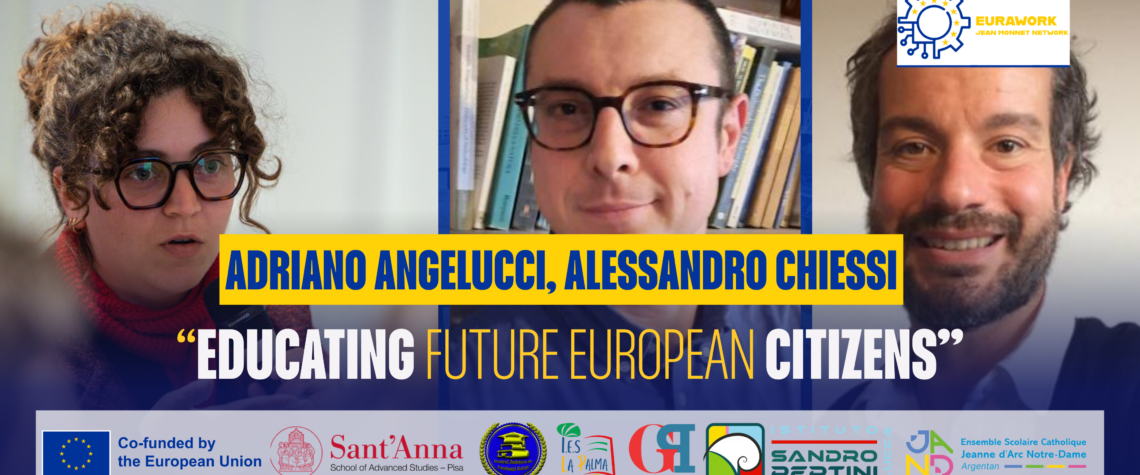
As part of the Jean Monnet EURAWORK project, the two scholars introduce a teacher training course exploring European citizenship, fundamental rights and the challenges posed by artificial intelligence. Interviewed by Focus Europe Italia journalist Sara Bertolli, they explain how philosophical reflection and European legislation can help students become more informed and responsible digital citizens.
How can European citizenship education prepare younger generations to navigate a world increasingly shaped by artificial intelligence? This is the central question addressed by Adriano Angelucci and Alessandro Chiessi in their teacher training course developed within the Jean Monnet EURAWORK project. During a video interview moderated by Sara Bertolli, journalist at Focus Europe Italia, the two scholars presented the objectives, methodology and educational relevance of their course, which is scheduled to begin on 15 December and focuses on the foundations of European citizenship and democratic participation in the digital age.
Adriano Angelucci, a philosopher and research fellow at the DIRPOLIS Institute of the Sant’Anna School of Advanced Studies in Pisa, conducts research on the psychological mechanisms and ethical implications of nudging, with particular attention to belief formation, the relationship between beliefs and behaviour, and environmental sustainability.
Alessandro Chiessi, Assistant Professor at the Interdisciplinary Centre for Sustainability and Climate, specialises in early modern English philosophy and philosophical anthropology, investigating their influence on social, political and economic systems. His research interests also include moral, legal and political philosophy.
Understanding European rights through the AI Act
The course aims to provide secondary school teachers with practical and conceptual tools to introduce European citizenship into classroom discussions, particularly in relation to the opportunities and risks associated with artificial intelligence.
As Angelucci explained, students represent a particularly vulnerable segment of the population in an environment where AI is becoming an increasingly important source of information, developing the ability to critically assess digital technologies is therefore essential to protecting their rights and strengthening their participation in democratic life. At the heart of the course is the European Union’s Artificial Intelligence Act (AI Act), used not simply as a piece of legislation to be studied, but as an interpretative framework through which students and teachers can examine situations in which the use of AI may threaten fundamental rights.
The proposed activities will draw on hypothetical scenarios as well as real-world examples taken from news reports and current events. These cases will encourage participants to reflect on the relationship between technological innovation, individual freedoms and the legal protections established by the European Union.
Reflective equilibrium: connecting principles with real-world challenges
One of the most distinctive elements of the training programme is its methodological approach, based on the philosophical concept of reflective equilibrium. As Angelucci outlined during the interview, the method involves starting from a general principle and applying it to a specific situation, whether real or hypothetical. Participants then examine how that principle should guide their judgement and whether the conclusions reached might require them to reconsider their initial assumptions.
This reciprocal process between general principles and particular cases offers teachers a way to engage students in critical reasoning rather than simply transmitting legal information. By applying this approach to the AI Act, students can explore questions concerning the protection of citizens’ rights and assess how European legislation responds to emerging technological challenges. The objective is to transform complex regulatory issues into accessible educational experiences, encouraging students to develop independent judgement and a deeper understanding of their role as European citizens.
Placing artificial intelligence within the history of European citizenship
Alessandro Chiessi emphasised the importance of situating the AI Act within the broader historical and legal development of European citizenship. The course will therefore connect contemporary AI regulation with some of the most significant milestones of European integration, including the Maastricht Treaty, the Lisbon Treaty and the Charter of Fundamental Rights of the European Union.
This historical perspective is intended to show that the protection of rights in the digital environment is part of a longer process through which European citizenship has progressively taken shape. Chiessi also highlighted that legal instruments alone are not sufficient, because citizens must be educated about their rights and the opportunities offered by the European Union if they are to participate effectively in democratic society.
EURAWORK, the Jean Monnet project to prepare students for the jobs of tomorrow
In this sense, the course combines legal awareness, historical understanding and philosophical reasoning, providing teachers with an interdisciplinary approach to citizenship education.
A shared educational framework across European schools
An important dimension of the EURAWORK project is its transnational character. Therefore, the initiative brings together schools from Italy, Spain, France and Romania, creating opportunities to develop a shared educational framework across different national contexts.
Although participating schools operate within different educational systems and social environments, the project seeks to establish common tools and approaches that teachers can adapt to their classrooms. The ambition is to help young people become more aware of their rights, their possibilities as European citizens and their capacity to respond critically to technologies that are rapidly transforming everyday life. This collaborative dimension reinforces the European scope of the initiative, making citizenship education not only a subject of study but also an opportunity for exchange and cooperation between schools.
The teacher training activities represent the first stage of the EURAWORK project. During the first year, participating teachers will receive specialised training on the themes addressed by the programme. They will subsequently transfer the knowledge, methods and educational tools acquired to their students, extending the project’s impact directly into secondary school classrooms. Through this approach, EURAWORK aims to create a multiplier effect, supporting teachers in their role as facilitators of European citizenship education.