On 10 November 2026, students from Italy and France will gather at the University of Salento for a Mock Assembly designed to test democratic deliberation in action. The initiative marks an important step in the Erasmus+ Teaching Environmental Democracy project.
What should a coastal community do when rising seas and coastal erosion threaten its future? Build a protective wall, restore natural dunes, or gradually relocate vulnerable infrastructure?
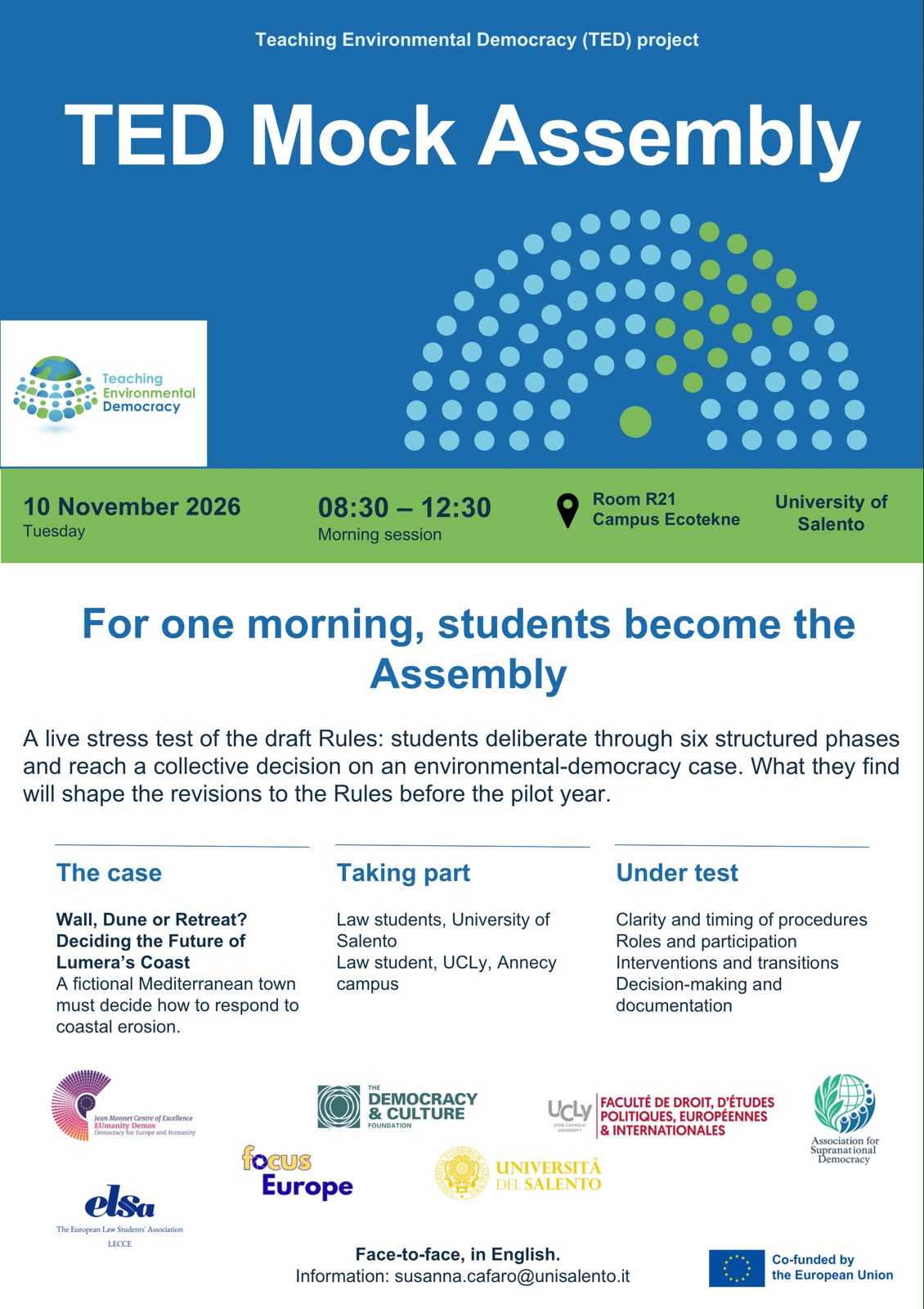
These are the choices that students from the University of Salento and Université Catholique de Lyon (UCLy) will face on 10 November 2026, when they participate in the TED Mock Assembly, an interactive educational exercise organised within the Erasmus+ project Teaching Environmental Democracy (TED).
Hosted at the University of Salento’s Ecotekne Campus in Lecce, the event will transform a university classroom into a simulated democratic assembly, allowing participants to experience the complexities of environmental decision-making, negotiation and collective responsibility.
Under the motto “For one morning, students become the Assembly”, the initiative aims to demonstrate that democracy is not merely a subject to be studied, but a practice that can be learned through direct participation.
Wall, dune or retreat? A Mediterranean environmental dilemma
At the heart of the Mock Assembly lies a fictional but realistic scenario entitled “Wall, Dune or Retreat? Deciding the Future of Lumera’s Coast.”
Students will be invited to imagine themselves as members of a democratic assembly tasked with deciding how the fictional Mediterranean community of Lumera should respond to the growing threat of coastal erosion.
The challenge reflects a broader dilemma facing many European coastal regions: how to reconcile environmental protection, economic interests, public safety and the long-term sustainability of local communities.
Different responses to coastal erosion may involve competing priorities. Engineering solutions can provide protection but may affect coastal ecosystems; nature-based interventions can support environmental restoration but require appropriate conditions; and managed retreat can reduce long-term exposure to risk while raising difficult social and economic questions.
Rather than searching for a predetermined correct answer, participants will be encouraged to examine competing arguments, consider different interests and work towards a collectively agreed decision.
The exercise will provide a practical opportunity to explore how environmental policies emerge from democratic processes in which scientific evidence, legal principles and social priorities must be considered together.
Learning democracy by practising it
The Mock Assembly is designed as an exercise in deliberative democracy, an approach that places informed discussion, reasoned argument and mutual understanding at the centre of collective decision-making.
Facilitated by a representative of the Democracy and Culture Foundation, the Athens-based partner responsible for developing TED’s participatory methodology, the exercise will unfold through six structured phases of deliberation.
Students will be encouraged to listen to different perspectives, formulate arguments, negotiate possible solutions and participate in collective decision-making.
The international dimension is particularly significant. Bringing together law students from the University of Salento and UCLy’s Annecy campus will create an opportunity for intercultural exchange and cooperation, exposing participants to different legal and educational backgrounds.
Through this experience, the project seeks to strengthen skills that extend beyond environmental law, including critical thinking, public speaking, negotiation and democratic citizenship.
A first practical test for the TED methodology
The event is not simply an educational simulation. It also represents an important milestone in the development of the TED project’s innovative teaching methodology.
One of the project’s central objectives is to establish a Students Assembly as an integral component of university education in European environmental law.
The Mock Assembly will provide an opportunity to test the draft procedural Rules developed within the project, examining whether they can support an inclusive, transparent and effective deliberative process.
Particular attention will be paid to the clarity of procedures, the distribution of responsibilities, opportunities for meaningful participation and the mechanisms through which collective decisions are reached.
The lessons learned will contribute to refining the methodology ahead of the project’s planned pilot training year in the 2027–2028 academic year.
In this sense, the initiative reflects an important principle of the TED approach: students are not merely recipients of educational innovation, but active participants in testing and improving it.
A European partnership connecting environmental law and democratic participation
The Mock Assembly forms part of the broader Erasmus+ Teaching Environmental Democracy (TED) project, which brings together four European partners with complementary expertise.
The project is coordinated by Université Catholique de Lyon (UCLy) in France, with Stefania Attolini as project coordinator. UCLy leads the overall management of the initiative and contributes its expertise in European environmental law and university education.
The University of Salento, which will host the Mock Assembly, leads the development and implementation of the project’s pilot educational programme, building on its academic expertise in European and environmental law and its Mediterranean territorial context.
The Democracy and Culture Foundation, based in Athens, leads the development of TED’s deliberative methodology, bringing experience in participatory democratic processes and citizens’ assemblies.
The fourth partner, CESUE – Centro Studi, Formazione, Comunicazione e Progettazione sull’Unione Europea e la Global Governance, an Italian organisation specialising in European affairs, education and communication, leads the project’s dissemination and communication activities through its European media and outreach channels.
Together, the partners aim to develop a transferable educational model that combines legal knowledge, environmental awareness and direct experience of democratic participation.
From the classroom to Europe’s environmental future
The challenges addressed by the TED Mock Assembly extend far beyond the fictional coastline of Lumera.
Across Europe, environmental decisions increasingly require public authorities and communities to balance ecological sustainability, economic development, social justice and democratic legitimacy.
Climate adaptation, biodiversity protection and the management of natural resources all raise questions that cannot be resolved through technical expertise alone. They also require public dialogue, informed participation and the ability to negotiate competing interests.
By introducing deliberative practices into university education, TED seeks to prepare future legal professionals and European citizens to engage with these challenges in a more informed and participatory way.
The Mock Assembly in Lecce will therefore represent more than a classroom exercise: it will be an opportunity to explore how the next generation can learn to make difficult environmental choices through democratic dialogue.
For one morning, students will become the Assembly. The ambition of TED is that the democratic skills they develop will remain with them long after the exercise ends.
Event information
TED Mock Assembly – “Wall, Dune or Retreat? Deciding the Future of Lumera’s Coast”
- Date: Tuesday, 10 November 2026
- Time: 08:30–12:30
- Venue: Room R21, Campus Ecotekne, University of Salento, Lecce, Italy
- Working language: English
- Format: In person
- Contact: susanna.cafaro@unisalento.it
The Teaching Environmental Democracy (TED) project is co-funded by the European Union under the Erasmus+ programme. Views and opinions expressed are those of the authors and do not necessarily reflect those of the European Union or the European Education and Culture Executive Agency (EACEA).