A delivery rider cycling through the rain guided by an app, an office worker monitored minute-by-minute by software, and a warehouse robot performing in a matter of seconds what used to take an entire shift are now everyday scenes that tell the story of a profound transformation driven by artificial intelligence and robotics. Yet, these issues are still rarely discussed in the classroom.
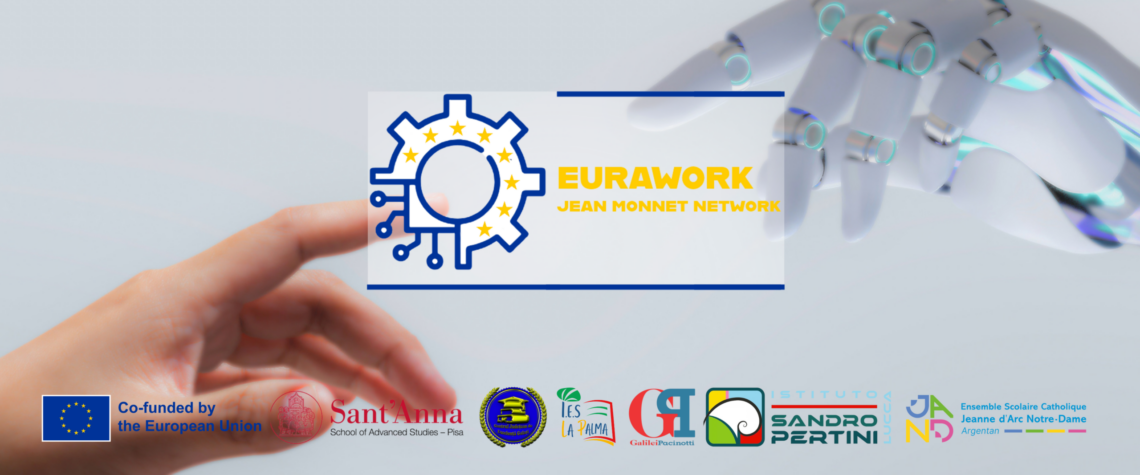
To bridge this gap, European Union and Digital Transition: The Age of a Renewed Interplay Between Robotics, Artificial Intelligence, and Meaningful Work (EURAWORK) was created: a project promoted by the Scuola Superiore Sant’Anna of Pisa (SSSA) involving five high schools from France, Italy, Spain, and Romania, funded by the European Union’s Erasmus+ Jean Monnet program. Launched in January, the initiative combines the analysis of European policies with the ethics of emerging technologies and the concept of “meaningful work”, work endowed with sense and dignity, framing it all within the context of European citizenship and educational dialogue between universities and schools.
Today’s students will enter a labor market already saturated with artificial intelligence, where technical skills alone will not suffice; critical thinking and awareness of their rights will be equally vital. Because the digital transition is still struggling to enter initial teacher training programs, EURAWORK chooses to act by starting directly with educators. The guiding concept is the cascade effect: training a single teacher multiplies knowledge across dozens of classrooms, enabling an interdisciplinary approach that weaves together history, philosophy, law, economics, computer science, and languages. Moreover, understanding how the European Union regulates technology helps close the gap between citizens and institutions, strengthening democracy and combating disinformation.
The European Union as a global forerunner
When it comes to regulating new technologies and their impact, the European Union has moved faster than other global actors. Back in 2022, it approved the Digital Services Act – which imposes strict rules on algorithmic transparency, advertising, and the protection of minors – and the Digital Markets Act, designed to ensure fair markets and counter the dominant positions of tech giants like Alphabet, Amazon, Apple, Meta, Microsoft, and ByteDance.
In 2024, the AI Act was introduced as the world’s first comprehensive legal framework on artificial intelligence. It classifies risks, including those related to workforce management and evaluation, and imposes transparency requirements on general-purpose models – a structure later partially streamlined by the AI Omnibus. Finally, the 2024 Platform Work Directive establishes a presumption of employment status when certain control criteria are met and regulates algorithmic management with human oversight guarantees, pending national implementation by member states by late 2026.
The EURAWORK project
In order to realize this vision, the Scuola Superiore Sant’Anna joined forces with five international schools. Representing Italy are the Istituto Galilei Pacinotti in Pisa and the Scuola Sandro Pertini, lead school of the “Artificial Intelligence and School” network and an INDIRE educational innovation hub. Joining from abroad are IES La Palma from Spain, Lycée Jeanne d’Arc in Argentan from France, and the Centrul Județean de Excelență from Romania, which distinguished itself at the world robotics championships. EURAWORK’s primary goal is to engage 40 teachers and approximately 2,500 students through 160 teaching units over a three-year period.
The first year of the project focuses on training teachers at partner schools through academic experts from SSSA. The second year features a Seasonal School hosted at the Scuola Superiore Sant’Anna campus in Pisa, where a selected group of students – chosen based on merit and inclusion – will act as school “ambassadors”. They will dive into five thematic modules ranging from ethics to the history of robotics, subsequently sharing their insights with their peers. In the third year, students and teachers will travel to Brussels for a multi-day workshop featuring meetings with members of the European Parliament, EU agencies, and tech stakeholders, as well as participation in a dedicated session at the European Parliament.
Ultimately, the project answers a fundamental question: what kind of work do we want to shape for the future? The core principle driving EURAWORK is that technology must remain a tool at the service of humanity to guarantee dignified employment.