With an established academic tradition in European Union law, supranational democracy and environmental studies, the University of Salento plays a central role in the Erasmus+ Teaching Environmental Democracy project, leading the development and implementation of an innovative pilot training programme that connects legal knowledge with democratic participation.
A University at the Crossroads of European Law and Democratic Innovation
How can universities prepare students to participate in decisions that will shape Europe’s environmental future? And how can academic knowledge about democratic institutions become an opportunity to experience democracy in practice?
These questions are particularly relevant to the University of Salento (Università del Salento – UNISAL), one of the four European partners involved in T.E.D. – Teaching Environmental Democracy, an Erasmus+ Cooperation Partnership in Higher Education coordinated by the Université Catholique de Lyon (UCLy), France.
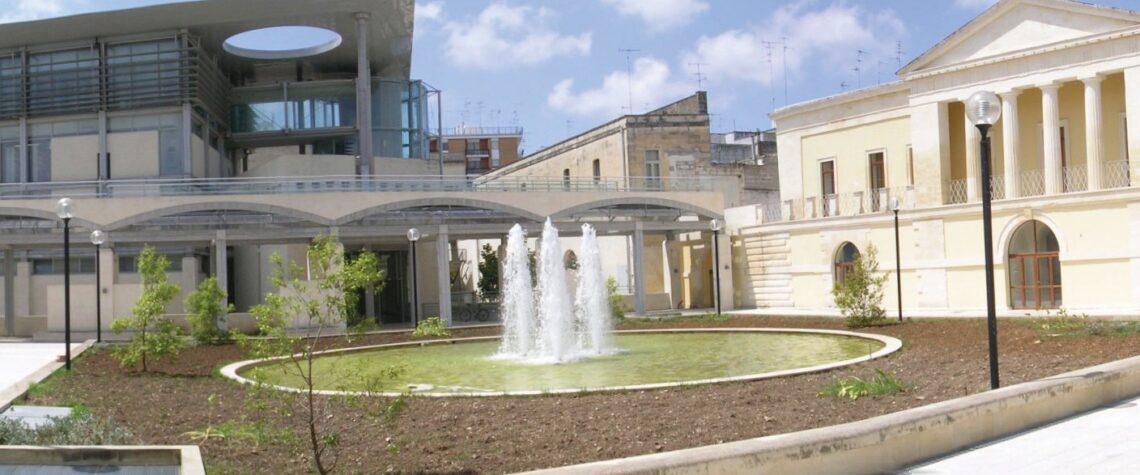
Located in Lecce, in southern Italy, the University of Salento brings to the project a combination of academic expertise in European Union law, democratic governance, environmental regulation and interdisciplinary research.
Founded in 1955, the university has progressively strengthened its role as an educational and research institution with a broad international outlook. Its academic offer spans legal studies, economics, engineering, natural sciences, humanities and social sciences, reflecting a commitment to connecting university education with contemporary societal challenges.
Within T.E.D., UniSalento leads Work Package 3 – Laying out and implementing a pilot-training, taking responsibility for coordinating the development of the programme’s academic content and its experimental implementation during the 2027–2028 academic year.
This responsibility builds on a particularly relevant institutional background: the university’s longstanding engagement with the study of European democracy and its capacity to connect legal theory with practical questions of democratic participation.
An International Reference Point for Supranational Democracy Studies
The University of Salento has developed an important academic tradition in the study of European integration and democratic governance beyond the nation-state.
Its Department of Law has promoted a research agenda examining the European Union not merely as an international organisation, but as a distinctive political and legal system capable of contributing to wider debates on supranational democracy.
This academic commitment has been supported by two Jean Monnet Chairs.
The first, “Legal Theory of European Integration: A Supranational Democracy Model”, explored the theoretical and institutional foundations of the European Union’s democratic structure.
The second, “European Supranational Democracy: A Lab for the World” (2023–2026), expanded this perspective by examining the European experience as a potential laboratory for democratic innovation at the international level.
Building on these initiatives, UniSalento is also home to the Jean Monnet Centre of Excellence EUmanity Demos – Democracy for Europe and Humanity (2025–2028), coordinated by Professor Susanna Cafaro, with Professor Claudia Morini serving as Vice-Director.
The Centre strengthens the university’s research and educational activities concerning democratic governance, European integration and the broader challenges facing democracy in an increasingly interconnected world.
A further expression of this commitment is the Supranational Democracy Dialogues, an international academic forum organised since 2018.
The event has brought together academics, researchers, representatives of civil society organisations and young scholars from more than 40 countries to discuss the future of democracy and the challenges of global governance.
The eighth edition, held in Brindisi on 23–24 April 2026, addressed questions ranging from democratic participation and education to technological transformation, environmental sustainability and institutional innovation.
Among the sessions was Democracy and Active Citizenship, chaired by Professor Claudia Morini, which explored new forms of citizen participation and their implications for European and supranational governance.
This international environment provides a valuable foundation for T.E.D., whose educational methodology draws on the idea that democratic participation should be experienced as well as studied.
Susanna Cafaro: Connecting European Integration and Democratic Participation
A central figure in UniSalento’s contribution to T.E.D. is Professor Susanna Cafaro, Full Professor of European Union Law and a leading scholar in the field of supranational democracy.
Her academic work focuses on the institutional architecture of the European Union, European economic governance, international organisations and the evolution of democratic decision-making beyond national borders.
As coordinator of the Jean Monnet Centre of Excellence EUmanity Demos and a driving force behind the Supranational Democracy Dialogues, Professor Cafaro has helped create an international space for interdisciplinary discussion on the democratic challenges facing Europe and the wider international community.
Within T.E.D., she leads WP3 and represents the University of Salento on the project’s Steering Committee.
Her contribution is particularly important for connecting the theoretical foundations of European democratic governance with the practical development of the Students’ Assembly.
Through this innovative educational format, students will be invited to examine environmental issues, consider competing interests and engage in structured deliberative processes.
The objective is to bring democratic principles into the learning experience itself, allowing students to understand not only how European decision-making mechanisms function, but also the complexity of participating in collective decisions.
Professor Cafaro’s expertise provides an important scientific foundation for this transition from the study of democracy to its practical application.
Claudia Morini: European Rights, Gender Equality and Inclusive Democratic Participation
Professor Claudia Morini, Associate Professor of European Union Law at the University of Salento, brings an equally important contribution to the scientific and educational development of T.E.D.
Her academic experience combines European and international law, fundamental rights, democratic governance and research on social inclusion and equal participation.
She holds a PhD in International and European Union Law and has developed an international research background that includes experience at the Sant’Anna School of Advanced Studies in Pisa and participation in European research initiatives.
Among her academic contributions is the book “Dialogue and Participation in the Governance of the European Union”(2020), which examines questions directly connected to the democratic foundations of the T.E.D. methodology.
Professor Morini has also coordinated the Jean Monnet Module EU-ProWomen – Protection and Promotion of Women’s Rights in the European Legal Order: From Gender Equality to Active Participation in the Democratic Life of the European Union (2022–2025).
The initiative explored the relationship between the protection of women’s rights, equal opportunities and participation in European democratic life.
Her research has also addressed intersectional discrimination, gender-based violence, women’s political participation and the external dimension of EU gender equality policies.
In addition to her role as Vice-Director of the Jean Monnet Centre of Excellence EUmanity Demos, she is involved in academic initiatives dedicated to diversity and inclusion and serves as Vice-President of the Association for Supranational Democracy.
Within T.E.D., Professor Morini contributes to the design and functioning of the Students’ Assembly and to the development of the project’s academic content.
Her expertise is particularly relevant to ensuring that democratic participation is understood not only as the formal possibility of taking part in decision-making, but also as a process requiring inclusiveness, equal opportunities and meaningful representation.
She will contribute to safeguarding gender balance throughout project activities, while supporting the development of learning environments in which students can participate in respectful, informed and structured debate.
This dimension is especially significant for environmental democracy.
Environmental policies frequently affect different social groups in unequal ways, and democratic decision-making must be attentive to whose perspectives are represented, whose voices are heard and how collective interests are defined.
By bringing together European legal studies, fundamental rights and an inclusive approach to democratic governance, Professor Morini strengthens one of the project’s central educational ambitions: preparing students to participate responsibly in pluralistic democratic processes.
Massimo Monteduro: Bringing Environmental Law and Ecology Together
The interdisciplinary character of UniSalento’s participation is further strengthened by Professor Massimo Monteduro, Full Professor of Administrative Law and a specialist in environmental law.
His academic research explores the relationship between legal systems and ecological sciences, with particular attention to the protection of ecosystems, environmental resilience, sustainable development and the evolution of environmental legal principles.
Over the years, his work has contributed to the development of an approach that recognises the need to understand environmental law through the scientific complexity of ecological systems.
This research perspective is reflected in his work on agroecology and the relationship between law and ecosystems, as well as in his 2026 publication “Glossario introduttivo di diritto dell’ecologia”.
The publication examines how legal systems incorporate ecological concepts and provides a systematic analysis of the terminology through which environmental science enters legal regulation.
Within T.E.D., Professor Monteduro contributes to the development of the environmental and legal content of the educational programme.
His expertise is particularly relevant to the design of case studies addressing real-world environmental conflicts, where scientific evidence, legal principles, economic interests and public responsibilities intersect.
The involvement of scholars with complementary expertise in democratic governance, fundamental rights and environmental regulation enables UniSalento to contribute a genuinely interdisciplinary perspective to the project.
Leading T.E.D.’s Pilot Training Programme
UniSalento’s principal responsibility within T.E.D. is to coordinate the development, implementation and evaluation of the pilot training programme under WP3.
The work will translate the methodology jointly developed by the European consortium into an academic programme combining conventional legal education with participatory and experiential learning.
The programme will include foundation courses on European environmental law, sustainable development and democratic instruments under EU law, together with specialised modules focused on different European environmental ecosystems.
The University of Salento will contribute its expertise on the Southern and Eastern Mediterranean, addressing the particular environmental and socioeconomic challenges of maritime and Mediterranean territories.
This perspective will complement the Alpine and urban focus of the Université Catholique de Lyon’s Annecy campus.
By comparing these different territorial environments, students will be able to explore how common European environmental rules interact with local ecological conditions and competing social and economic priorities.
UniSalento will also coordinate the preparation of educational materials, legal case studies and practical exercises that will be tested during the pilot.
The 2027–2028 academic year will be dedicated to the experimental implementation of the programme, involving students and teaching staff from the two partner universities.
The training model foresees an initial semester of common courses, followed by a second semester including international mobility, specialised learning activities and participation in the Students’ Assembly.
Approximately 30 students and six teachers are expected to participate in the pilot phase.
The evaluation will examine the effectiveness of the educational approach, the experience of students and the potential for integrating the programme into university curricula.
The expected outputs include a Training Programme Handbook, an evaluation and recommendations report, and a survey of participating students.
The Students’ Assembly: From Academic Knowledge to Democratic Practice
A central element of the T.E.D. educational experience will be the Students’ Assembly, developed under the methodological leadership of the Democracy and Culture Foundation and implemented through the cooperation of all project partners.
The assembly will involve students in deliberative processes addressing concrete environmental cases.
Rather than simply analysing existing environmental legislation, participants will be encouraged to examine competing legal and scientific arguments, discuss different perspectives and formulate collective recommendations.
This educational format is intended to develop competences that are essential to democratic citizenship: critical thinking, negotiation, active listening, evidence-based argumentation and responsibility for collective decisions.
For the University of Salento, the Students’ Assembly also represents an opportunity to connect two well-established academic traditions: the study of European supranational democracy and the development of innovative teaching practices.
The combination of Professor Cafaro’s expertise in democratic governance, Professor Morini’s research on rights and inclusive participation, and Professor Monteduro’s work on environmental law creates a strong interdisciplinary foundation for the initiative.
The result is an educational model designed to help students understand that environmental democracy involves not only rights and institutions, but also practical choices, conflicting interests and the need to build legitimate collective decisions.
From the Mediterranean to a European Model of Democratic Education
The University of Salento contributes to T.E.D. as part of a European partnership coordinated by the Université Catholique de Lyon, alongside the Democracy and Culture Foundation – Athinaiki Agora and CesUE – Centre for European Union Studies.
Each organisation brings complementary expertise, from academic research and educational programme development to deliberative democracy and the dissemination of project results.
The long-term objective is to develop a sustainable educational model that can be integrated into the curricula of the participating universities and eventually transferred to other European higher education institutions.
The pilot programme and its evaluation will therefore have an important role in determining how the methodology can be adapted, improved and replicated.
For UniSalento, participation in T.E.D. represents both a continuation of its established work on European democracy and an opportunity to advance new forms of university education.
By combining its expertise in supranational governance, fundamental rights and environmental law with practical democratic experimentation, the University of Salento is helping to turn environmental democracy from an academic subject into an educational experience.
From the Mediterranean to the wider European academic community, this contribution reflects a shared ambition: to prepare a new generation of graduates who are not only knowledgeable about the legal and environmental challenges facing Europe, but also capable of taking an active and responsible part in addressing them.
T.E.D. – Teaching Environmental Democracy is co-funded by the European Union under the Erasmus+ programme, Cooperation Partnerships in Higher Education (KA220-HED), 2025–2028.
Funded by the European Union. Views and opinions expressed are, however, those of the author(s) only and do not necessarily reflect those of the European Union or the European Education and Culture Executive Agency (EACEA). Neither the European Union nor EACEA can be held responsible for them.