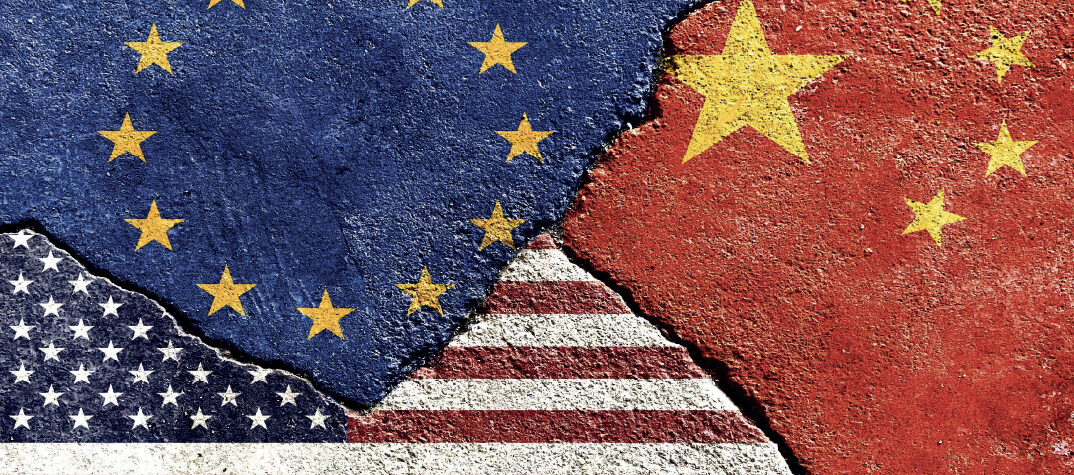
How are relations between the European Union, China and the United States reshaping the global economic and political landscape? This was the central question addressed at the conference “The EU, China, and the United States: Economic Relations, Global Governance, and the Changing International Order”, held on 6 November at the Jean Monnet Centre of Excellence fEUture of eCampus University, at its premises in Via Matera 18, Rome, and online.
The event brought together academic experts and political representatives to examine the transformations underway in the international system, the growing interdependence of global economies and the challenges facing multilateral governance.
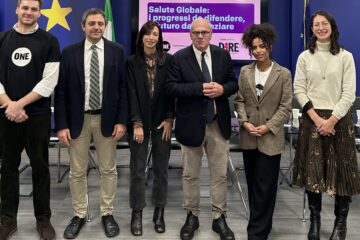
The discussion was introduced by Roberto Castaldi, Director of the Jean Monnet Centre of Excellence fEUture. The speakers included Professor Paolo Farah of the University of Tulsa (United States), Professor Shiping Liao of Beijing Normal University (China), Giorgia Sorrentino, PhD and representative of the European Federalist Movement, and Brando Benifei, Member of the European Parliament for the Socialists and Democrats (S&D). A question-and-answer session with the audience followed the presentations.
Economic security and Europe’s strategic autonomy
A key theme throughout the conference was the changing relationship between economic interdependence and national security. In a world increasingly shaped by geopolitical competition, trade, technology and industrial policy can no longer be considered separate from strategic and political considerations.
In his contribution, Brando Benifei highlighted the importance of strengthening Europe’s economic security and strategic autonomy. The European Union must develop its own industrial and technological capabilities in sectors such as semiconductors, steel, cloud computing and artificial intelligence, while reducing excessive dependencies on external actors, particularly the United States and China.
This does not mean pursuing isolationism or abandoning international cooperation. Rather, Europe needs to become a stronger and more credible global actor, capable of protecting its interests while remaining committed to open markets and multilateral engagement. Achieving this objective also requires greater political unity among EU member states.
China, trade and labour standards
The relationship between China and the European Union was another central focus of the discussion. Professor Shiping Liao examined the challenges associated with international trade and the implementation of labour standards across global supply chains.
He addressed the role of Chinese companies in meeting European expectations and the potential contribution of monitoring technologies and digital tools to improving compliance. China’s experience with environmental monitoring, he suggested, could offer useful insights into the development of systems for monitoring labour conditions.
The discussion also highlighted the importance of distinguishing between technological monitoring and the actual protection of workers’ rights. As Professor Farah observed in his concluding remarks, digital tools can improve traceability and transparency, but they cannot by themselves demonstrate that rights are being respected. Effective protection also requires independent audits, verification mechanisms and appropriate remedies.
Globalisation is changing, not disappearing
Giorgia Sorrentino placed current geopolitical and economic developments in a broader historical perspective. Recalling the political roots of globalisation and its development since the seventeenth century, she challenged the idea that the end of the Cold War had marked the definitive triumph of a stable liberal international order.
The contemporary return of trade disputes and tariff tensions illustrates how economic and political dynamics remain deeply interconnected. Competitiveness is no longer determined by economic performance alone: it increasingly depends on political power, technological capacity and the quality of governance.
Sorrentino also reflected on the contrast between the optimism that followed the fall of the Berlin Wall and the subsequent European integration process, including the Maastricht Treaty and the introduction of the euro, and the prolonged crisis that has affected Europe since 2009. The current climate, marked by uncertainty and declining confidence in the future, raises questions about the direction and pace of European integration.
Global governance and the role of the European Union
Professor Paolo Farah argued that globalisation is not coming to an end but is undergoing a profound reorganisation. Economic security and the resilience of supply chains have become increasingly important, but excessive securitisation risks undermining the principles and rules that support international trade.
In this context, the World Trade Organization and the multilateral trading system remain relevant. Farah also emphasised the EU’s influence as a regulatory power, pointing to instruments such as the General Data Protection Regulation (GDPR) and the AI Act.
Artificial intelligence was a particularly important subject in the discussion. Its rapid development creates regulatory challenges that cannot be addressed by individual countries acting alone. Farah stressed the importance of a precautionary approach to AI governance and argued that cooperation remains necessary even in periods of geopolitical tension. Areas such as artificial intelligence, anti-corruption and counterterrorism offer opportunities for continued international engagement.
A stronger European political role
The conference also addressed the institutional and political limitations that affect the European Union’s ability to influence the international order. In his concluding remarks, Roberto Castaldi observed that the EU still lacks the status of a unified political actor comparable to that of the United States or China.
The European project, he argued, offers an alternative model based on shared sovereignty and political integration. A stronger and more united Europe could contribute to a more cooperative international system, rather than allowing global relations to be defined exclusively by competition between major powers.
Castaldi also stressed the importance of peaceful coexistence between the United States and China, underlining the need for dialogue and cooperation in addressing shared global challenges.
The discussion with the audience further explored the implications of geopolitical competition, including the situation around Taiwan and the strategic importance of semiconductor production. These issues illustrated how regional tensions can have global economic consequences, given the high degree of interdependence within contemporary supply chains.
Questions also returned to the broader debate on the future of globalisation and the relationship between technological change and political governance. The references to Francis Fukuyama’s thesis on the “end of history” provided an opportunity to reflect on the gap between the optimism of the post-Cold War period and today’s increasingly uncertain international environment.
The conference highlighted the complexity of the current international transition. The European Union, China and the United States are simultaneously economic partners, competitors and influential actors in global governance. Their relationships will play a decisive role in determining the future of trade, technological development, international institutions and political stability.
The central message emerging from the discussion was that strategic autonomy and international cooperation need not be opposing objectives. For Europe in particular, the challenge is to strengthen its political and economic capacity while continuing to support multilateral solutions to global problems.
The event also looked ahead to the next initiative announced by the Jean Monnet Centre of Excellence fEUture: an international conference scheduled for 19–20 March 2027 in Rome, marking the seventieth anniversary of the Treaties of Rome.
Click here to rewatch the full event
[Foto di Università eCampus]