Six interdisciplinary online modules, expert interviews, interactive learning activities, participatory workshops and international mobility bring together European universities to explore conspiracy thinking, misinformation and radicalisation risks.
How can universities prepare students to understand conspiracy theories in an increasingly complex information environment? What connects health-related misinformation, political narratives, scientific distrust, digital technologies and alternative spiritual beliefs? And how can higher education move beyond traditional teaching to develop critical thinking, media literacy and active citizenship?
These questions are at the heart of CONSPIRE – CONSPIracism and RAdicalisation Risks in Europe, an Erasmus+ Cooperation Partnership in Higher Education coordinated by the University of Turin.
The project has developed an interdisciplinary European training programme designed primarily for social sciences students, combining academic knowledge with participatory learning, professional perspectives and innovative educational methodologies.
Through six online modules, face-to-face workshops and international student mobility, CONSPIRE aims to provide students with the conceptual and practical tools needed to understand how conspiracy theories emerge, how they influence public perceptions and how they may interact with processes of radicalisation.
The ambition is not simply to teach students how to identify false information. It is to help them critically analyse competing arguments, understand the social mechanisms behind conspiracy thinking and develop the competences required for informed participation in democratic life.
Why conspiracy theories matter for higher education
Conspiracy theories are not limited to isolated rumours or misleading social media posts. They can become complex explanations of social reality, connecting political events, scientific controversies, cultural identities and institutional mistrust.
Health-related conspiracy narratives are particularly relevant to CONSPIRE.
The COVID-19 pandemic demonstrated how debates about vaccines, public health measures, scientific expertise and medical technologies can become intertwined with broader suspicions about hidden interests and powerful institutions.
These narratives may influence public trust, attitudes towards healthcare, civic participation and democratic debate.
Understanding them requires more than fact-checking. It demands an interdisciplinary approach capable of exploring the relationships between scientific knowledge, communication, political discourse, spirituality, social experiences and collective beliefs.
For this reason, CONSPIRE brings together different European academic traditions to examine conspiracy thinking as a complex social phenomenon.
Its educational programme is designed to strengthen students’ ability to distinguish evidence-based information from unsupported claims, recognise misleading arguments and understand the conditions under which conspiracy narratives become persuasive.
Six modules, one interdisciplinary European learning pathway
At the centre of CONSPIRE is a structured online programme comprising six educational modules, each addressing a different dimension of conspiracy thinking.
The introductory module has a duration of three hours, while the five thematic modules comprise ten hours each, for a total of 53 hours of online learning.
Together, the modules connect theoretical research with contemporary social challenges, allowing students to examine conspiracy theories from complementary perspectives.
Module 1 – Introduction to the programme
University of Turin | Stefania Palmisano and Luca Ozzano
The introductory module establishes the conceptual and methodological foundations of the course.
Students are introduced to the objectives of CONSPIRE and to the participatory learning methods that characterise the project.
Particular attention is given to community organising, a methodology encouraging dialogue and interaction between students and wider communities.
The module also introduces the educational tools used throughout the programme, including the Conspirology role-playing methodology and the guidelines for the ConTrust documentary.
Rather than treating learning as a process confined to lectures and academic materials, the introductory module prepares students to engage actively with the social realities explored by the project.
Module 2 – COVID-19 and Disease
Universitat Autònoma de Barcelona | Mar Griera
The second module examines the relationship between health-related conspiracy theories, scientific communication and public trust.
Focusing on the COVID-19 crisis, it investigates how conspiracy narratives spread during health emergencies and how they can influence attitudes towards vaccines, medical technologies and healthcare institutions.
Students explore the mechanisms through which inaccurate or misleading information circulates, as well as the social and cultural factors that make certain health-related narratives persuasive.
The module contributes to a broader understanding of the relationship between medical knowledge, institutional authority and public perceptions of risk.
Module 3 – Communication, Media and Technology
Aalborg University | Mette Marie Roslyng
The third module explores how conspiracy theories circulate through contemporary communication environments.
From traditional media to digital platforms, students examine the mechanisms through which information is produced, shared, amplified and contested.
A particular focus is placed on artificial intelligence and emerging technologies, reflecting their growing relevance to media communication and the circulation of misleading information.
The module helps students understand how online and offline communication processes influence public debate, shape perceptions of credibility and contribute to the dissemination of conspiracy narratives.
Module 4 – Religion and Spirituality
University of Turin | Stefania Palmisano
The fourth module examines the relationship between conspiracy theories, religion and contemporary spirituality.
One of its central concepts is conspirituality, a framework describing the intersection between conspiratorial thinking and spiritual beliefs.
Students explore how religious and spiritual narratives can interact with alternative interpretations of science, health and social reality.
The module adopts a sociological perspective, investigating the cultural meanings associated with these beliefs and the ways in which they circulate through communities and public discourse.
Module 5 – Politics
Istanbul Technical University | Doğan Gürpınar
The fifth module examines conspiracy theories within political and historical contexts.
It explores how conspiracy narratives emerge in different societies, interact with political ideologies and influence public debate and institutional trust.
Through a comparative European perspective, students analyse the similarities connecting conspiracy theories across different geographical and cultural environments.
The module encourages reflection on the relationship between political narratives, social conflict, power and radicalisation risks.
Module 6 – Science
University of Tartu | Anastasiya Astapova
The final module investigates the relationship between scientific knowledge, environmental issues, scientific communication and conspiracy thinking.
Students explore how scientific information can be challenged, distorted or incorporated into alternative narratives.
Particular attention is given to the ability to distinguish reliable, evidence-based information from fake news and unsupported claims.
By connecting scientific literacy with the social study of conspiracy theories, the module encourages students to recognise the importance of evidence, verification and methodological reasoning.
How the online modules work: a structured and interactive learning experience
Beyond their interdisciplinary content, the CONSPIRE modules are built around a common pedagogical structure designed to make online learning accessible, engaging and intellectually rigorous.
Each thematic module combines three academic mini-lectures and three expert interviews, allowing students to encounter complementary perspectives on the same subject.
The academic lectures establish the theoretical and conceptual foundations, while the expert interviews introduce professional experiences and practical insights from journalists, scientists, activists, religious figures and other relevant practitioners.
An introductory overview explains the module’s objectives, connects the different contributions and introduces the teachers and experts involved.
This approach allows students to understand not only what they will learn, but also why the different perspectives are relevant and how they contribute to the broader CONSPIRE educational pathway.
Rather than presenting online learning as a simple collection of recorded lectures, the programme integrates academic content with selected readings, knowledge checks, discussion activities and opportunities for independent investigation.
Selected readings: connecting research and professional practice
Each module includes a concise Key Readings Packet designed to provide reliable background information without overwhelming students.
The proposed format brings together one or two selected academic excerpts and a high-quality report from a non-governmental organisation or fact-checking body.
These materials are accompanied by a short introduction explaining their relevance to the module and a list of additional recommended readings.
The objective is to expose students to different forms of trustworthy knowledge, including peer-reviewed research and evidence-based analysis produced by professional organisations.
This combination reflects the project’s interdisciplinary approach and encourages students to compare academic perspectives with practical approaches to misinformation and public communication.
Interactive quizzes: turning information into understanding
The CONSPIRE teaching methodology also includes interactive knowledge checks.
Each thematic module is designed to incorporate a short quiz comprising approximately five to seven multiple-choice questions connected to the main academic lectures.
Students receive immediate feedback, including a brief explanation of the correct answer.
This approach supports self-assessment and reinforces key concepts while allowing learners to identify topics requiring additional attention.
The quizzes are intended as tools for learning and reflection, helping students consolidate their understanding before moving to more complex discussions and practical activities.
Fact-checking tools: learning how to assess a claim
An optional component of the teaching framework is a reusable Fact-Checking Toolkit.
The proposed worksheet guides students through four essential steps: identifying a claim, recording the sources consulted, summarising the available evidence and formulating a concise evidence-based response.
Students can also add notes and screenshots documenting their research process.
The purpose is to turn the abstract principle of critical thinking into a practical method.
Rather than simply deciding whether a statement appears credible, students are encouraged to investigate its origin, assess supporting evidence and explain their conclusions.
The toolkit can be used across different subjects, from health misinformation and political narratives to claims involving artificial intelligence, scientific research or spiritual beliefs.
Discussion forums: learning through dialogue
Another important methodological element is the use of discussion prompts and peer-learning activities.
Each module is designed to include four or five open-ended questions encouraging students to connect academic concepts with practical examples and personal reflection.
Questions may invite learners to examine why certain conspiracy narratives appear convincing, how information can be manipulated or what makes some claims particularly difficult to challenge.
Discussion activities can take place asynchronously through the learning platform or during facilitated sessions.
Their objective is to encourage interaction, develop argumentative skills and allow students to compare different interpretations in a constructive learning environment.
This dimension is particularly valuable for CONSPIRE because understanding conspiracy thinking requires not only knowledge, but also the ability to listen, question, explain and respond to competing viewpoints.
Bringing professional voices into university education
One of the distinctive features of the CONSPIRE programme is its commitment to combining academic teaching with contributions from professionals working outside universities.
The educational approach involves not only researchers and lecturers, but also journalists, scientists, religious leaders, activists and other practitioners.
Their contributions bring practical perspectives into the learning process, connecting theoretical concepts with professional experience and real public debates.
This approach is important because misinformation and conspiracy thinking affect several sectors simultaneously, including journalism, healthcare, education, public communication and civic participation.
Students are therefore encouraged to understand how different professional communities encounter these challenges and how research-based knowledge can inform practical responses.
By bringing together academic and non-academic perspectives, CONSPIRE seeks to bridge formal university education and non-formal learning.
From online modules to participatory workshops
The online programme represents the first stage of a broader educational pathway.
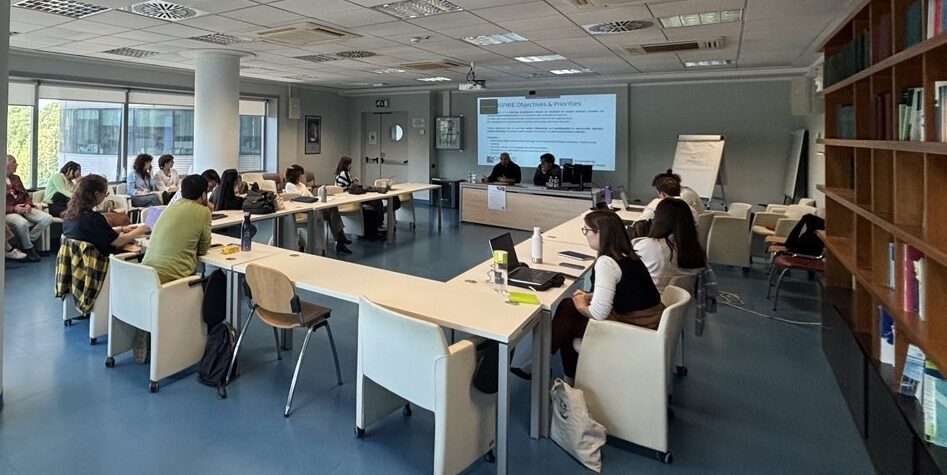
After completing the modules, students participate in local “Play the Conspiracy” face-to-face workshops, designed to transform theoretical knowledge into practical experience.
The syllabus envisages 25 hours of experiential learning at partner universities, allowing participants to work on the conspiracy-related themes addressed in their respective modules.
The workshops use Conspirology, a narrative role-playing game based on collective storytelling.
Students are divided into three functional groups.
Conspiracy supporters develop a fictional conspiracy narrative, selecting information and constructing arguments to make the story convincing.
Debunkers critically examine the proposed narrative, challenge its assumptions and develop counterarguments.
Judges evaluate the competing interpretations, assessing the credibility of the evidence and the strength of the arguments presented.
The exercise creates a structured environment in which students can explore how conspiracy narratives are constructed, defended and challenged.
By taking different positions, participants experience the relationship between persuasive communication, evidence, uncertainty and judgement.
The goal is not to encourage conspiratorial beliefs, but to help students recognise their mechanisms and develop the skills needed to evaluate them critically.
Community organising and storytelling: connecting learning with society
The CONSPIRE methodology goes beyond online teaching and classroom simulation.
An important component is community organising, which encourages students to engage with people and communities outside the university.
Through relational meetings and participatory activities, students can explore how conspiracy narratives are understood and discussed in everyday social environments.
This approach recognises that misinformation is not exclusively a technological issue.
Conspiracy theories also circulate through social relationships, collective identities, experiences of uncertainty and perceptions of institutional trust.
Community organising enables students to connect academic concepts with public experiences, while strengthening their capacity for listening, dialogue and civic engagement.
At the same time, storytelling becomes an educational method through which students explore how narratives are constructed and how different interpretations can shape perceptions of reality.
Together, these methodologies transform the learning process into an active investigation of contemporary social challenges.
Replay the Conspiracy: taking learning across borders
The educational pathway culminates in an international mobility experience hosted by the University of Turin.
The activity, titled “Replay the Conspiracy”, is designed as a five-day programme comprising 40 hours of transnational learning.
Selected students from partner universities will come together to participate in an advanced version of Conspirology.
While the local workshops focus on conspiracy narratives developed within individual university contexts, the international mobility introduces a new challenge: combining the different national stories into a single overarching narrative.
The result is conceived as a “conspiracy of conspiracies”, bringing together themes, perspectives and experiences from across the partnership.
Through this collaborative process, students will compare national contexts, exchange ideas and explore how conspiracy narratives can cross geographical and cultural boundaries.
The activity will also contribute to the production of ConTrust, a documentary intended to capture significant moments of the role-playing experience and communicate the educational methodology to wider audiences.
This transnational phase reflects one of the central ambitions of Erasmus+: connecting students across countries and transforming international cooperation into a shared learning experience.
Five dimensions of learning: the Dublin Descriptors
The CONSPIRE syllabus explicitly connects its educational objectives to the Dublin Descriptors, the competence-based framework used within the European Higher Education Area.
Rather than focusing exclusively on the acquisition of information, the programme aims to develop five interconnected dimensions of learning.
Knowledge and understanding. Students acquire concepts, theories and methodological tools for analysing conspiracy thinking across health, politics, religion, science, communication and technology.
Applying knowledge and understanding. Through case studies, participatory activities and role-playing, students apply theoretical knowledge to complex situations and practical problems.
Making judgements. Students strengthen their capacity to evaluate evidence, question assumptions, interpret conflicting information and reflect critically on social and political phenomena.
Communication skills. Participants learn to present arguments, discuss findings and communicate complex issues to both specialised and non-specialised audiences.
Learning skills and lifelong learning. The programme aims to support independent learning beyond the project activities, with continued access to educational resources through the e-learning platform and project website.
These five dimensions give CONSPIRE a clear educational foundation.
The objective is not simply to increase students’ awareness of conspiracy theories, but to support the development of transferable competences relevant to academic, professional and civic life.
An innovative approach to European higher education
CONSPIRE’s educational model is built around three complementary dimensions of innovation.
The first is theoretical: the programme develops an interdisciplinary framework for understanding health-related conspiracy thinking and its connections with wider social phenomena.
The second is pedagogical: the project integrates academic expertise with professional contributions, selected readings, interactive quizzes, discussion forums, community organising, storytelling and role-playing.
The third is practical and civic: students are encouraged to connect their learning with public debate, social experiences and democratic participation.
This combination reflects an important shift in contemporary higher education.
Universities are increasingly called upon not only to transmit specialised knowledge, but also to help students navigate uncertainty, interpret complex information and engage responsibly with society.
CONSPIRE responds to this challenge by creating a learning environment where knowledge, experience and critical reflection reinforce one another.
Beyond misinformation: educating for democratic resilience
Conspiracy theories present a difficult educational challenge because they operate at the intersection of information, belief, identity, emotion and social trust.
Understanding them requires more than identifying inaccuracies or correcting individual claims.
It requires the ability to analyse arguments, examine evidence, recognise persuasive mechanisms and understand the social contexts in which particular narratives become influential.
This is the approach adopted by CONSPIRE.
Through its six-module online programme, participatory workshops and international mobility, the project connects research-based education with active learning and civic engagement.
Students are encouraged to move from understanding conspiracy narratives to analysing them, from recognising manipulation to evaluating evidence, and from individual learning to collective discussion.
The result is a European educational pathway designed to strengthen critical thinking, media literacy, communication, independent judgement and active citizenship.
In an age of increasingly complex information environments, these competences are essential not only for university students, but for the wider democratic life of European societies.
CONSPIRE starts from a simple educational principle: understanding how conspiracy theories work is an important step towards learning how to question them critically, discuss them responsibly and make informed judgements in a democratic society.