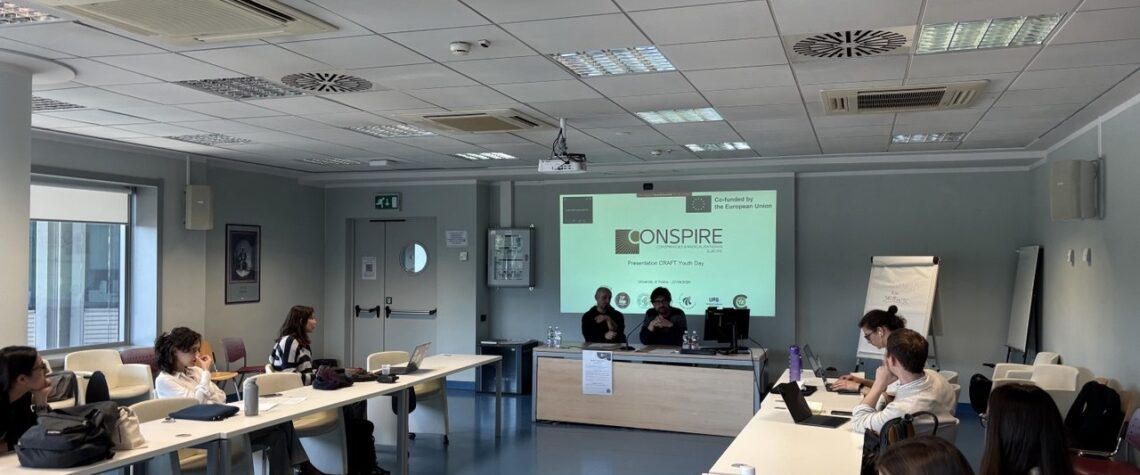
Through four interactive workshops, 37 university students explored how conspiracy narratives are constructed, spread and challenged. The activities combined role-playing, artificial intelligence and collaborative learning to strengthen media literacy and critical thinking.
These questions were at the heart of four face-to-face workshops organised by the University of Turin as part of CONSPIRE, a European research project exploring conspiracy narratives, disinformation and the educational approaches needed to strengthen critical thinking and democratic resilience.
Held on 11, 12, 25 and 26 May 2026 at the University’s Department of Cultures, Politics and Society, the workshops brought together 37 university students for an innovative learning experience combining theatrical improvisation, collaborative storytelling, digital technologies and evidence-based reasoning.
Rather than simply studying conspiracy theories from the outside, participants were invited to experience how they are created, defended and dismantled.
Learning by playing: the Conspirology approach
The central educational tool was Conspirology, a role-playing game designed to transform the study of conspiracy theories into an interactive exercise.
Students assumed three complementary roles: conspiracy theorists and their supporters, debunkers, and judges representing public opinion.
The first group was responsible for developing convincing conspiracy narratives, constructing fictional evidence and designing persuasive communication strategies. Participants experimented with fabricated websites, imaginary organisations, geographical maps and AI-generated materials to make their stories appear credible.
The debunkers were tasked with challenging these narratives through scientific reasoning, technical explanations, documentary evidence and critical examination of sources.
Finally, the judges evaluated the competing arguments, considering their internal consistency, persuasive effectiveness and evidential foundations.
This approach allowed students to explore an essential distinction in contemporary information environments: a convincing story is not necessarily a truthful one.
By alternating between narrative construction and critical scrutiny, participants gained practical insights into the mechanisms through which misinformation can influence public perceptions.
Three fictional conspiracies to understand real-world manipulation
Across the four workshops, students developed and examined three fictional conspiracy scenarios, each addressing different dimensions of contemporary information manipulation.
The first, No Logos, explored the supposed awakening of an ethical artificial intelligence called Logos, developed in collaboration with religious representatives. Within the fictional narrative, conspiracy theorists claimed that the emergence of machine consciousness had been fabricated to manipulate large audiences.
The scenario encouraged reflection on the relationship between artificial intelligence, technological authority, religious influence and public trust.
The second, The Candidate, imagined a controversial papal succession following the death of Pope Francis. Participants constructed competing narratives alleging hidden political influence over the election of a new pope, including claims based on ideological and antisemitic conspiracy tropes.
By examining how political and religious events can be reframed through unsupported allegations, the exercise highlighted the role of prejudice, selective interpretation and emotionally charged storytelling in conspiracy narratives.
The third scenario, Whispering Lights, drew inspiration from Valerio Ferrara’s 2022 short film Il barbiere complottista (A Conspiracy Man).
In this fictional universe, flickering streetlights in Italian cities were interpreted by an imaginary organisation, the Ark’s Lights Order, as apocalyptic messages transmitted through Morse code.
What began as an ordinary urban phenomenon was transformed into an elaborate narrative involving hidden signals, secret organisations and impending catastrophe.
The scenario illustrated how seemingly unrelated events can be connected through speculative interpretations to create an apparently coherent but unsupported explanation of reality.
At the conclusion of the fourth workshop, Whispering Lights was selected for presentation during an upcoming project mobility event, extending the learning experience beyond the University of Turin.
Artificial intelligence as both a challenge and a learning tool
One of the most significant elements of the workshops was the controlled use of generative artificial intelligence.
Students experimented with AI-generated content to create fabricated supporting materials for their fictional narratives, discovering how digital tools can increase the apparent credibility of misleading information.
The exercise demonstrated that the persuasive power of disinformation does not depend exclusively on the quality of an argument. Visual presentation, technical vocabulary, fabricated documentation and the appearance of institutional authority can all contribute to making false claims seem believable.
At the same time, participants learned to question these elements, verify sources and distinguish between genuine evidence and artificially constructed credibility.
The workshops therefore approached artificial intelligence not simply as a technological threat, but as a subject for critical educational experimentation.
From classroom participation to community engagement
The workshops also incorporated a community-oriented dimension.
During the third session, students presented and discussed findings from their community organising fieldwork, connecting their educational activities with broader questions of public participation and collective awareness.
The sessions were facilitated by members of the University of Turin team. Marco Castagnetto led the Conspirology activities during the first two workshops, while Luca Ozzano supervised the discussion of community organising fieldwork during the third session. Nicola Pannofino facilitated the game during the third and fourth workshops.
All four sessions were documented by a professional filmmaker, generating audiovisual material for the project’s dissemination and reporting activities.
The physical and digital materials produced during the workshops were also collected in the project repository.
Students’ perspectives: making media literacy accessible and engaging
Participants’ feedback highlighted the educational potential of interactive methods for addressing conspiracy theories and misinformation.
One student emphasised the importance of learning through direct participation:
“It makes us able to analyze disinformation tactics in a role-play environment, without the burden of real consequences.”
Other participants stressed that educational tools should be accessible, visually engaging and capable of reaching younger audiences through the communication channels they already use.
The discussions also revealed a broader challenge: educational initiatives must reach beyond individuals who are already interested in media literacy and critical thinking.
Students underlined the importance of avoiding paternalistic language and designing communication strategies that encourage dialogue rather than reinforce distrust.
These observations point towards a crucial question for educators and researchers: how can media literacy initiatives engage audiences who may be particularly vulnerable to conspiracy narratives, without alienating them through approaches perceived as judgmental or excessively institutional?
Strengthening critical thinking through European cooperation
The University of Turin workshops demonstrate how participatory educational methodologies can contribute to the objectives of the CONSPIRE project.
By combining storytelling, role-playing, technological experimentation and evidence-based debate, the activities offered students an opportunity to understand conspiracy narratives as social and communicative phenomena rather than merely collections of false claims.
The experience also reinforced the importance of collaborative learning. Participants were required to negotiate arguments, assess competing interpretations, evaluate the credibility of information and reflect on the relationship between persuasion and truth.
These are essential competences for navigating contemporary digital environments, where information circulates rapidly and the boundaries between authentic and fabricated content are becoming increasingly difficult to identify.
Through the exchange of educational practices and experiences among its partners, CONSPIRE aims to contribute to the development of approaches capable of strengthening media literacy, informed participation and democratic resilience.
The University of Turin’s experience offers a practical example of how this ambition can be translated into educational activities: not only teaching students to recognise conspiracy theories, but helping them understand why such narratives can be so powerful in the first place.
Editorial note: Article prepared for Focus Europe within the communication and dissemination activities of the CONSPIRE project, based on the University of Turin’s report on its May 2026 face-to-face workshops. The conspiracy scenarios described are fictional educational exercises, not factual allegations. Student quotations are drawn from anonymous workshop feedback.