Through university workshops, secondary-school activities and doctoral training, the University of Tartu brought the CONSPIRE methodology to different educational settings, exploring how conspiracy theories spread, adapt and gain credibility.
What happens when a country’s genetic data allegedly falls into the hands of foreign investors? Why can the familiar streets of a small town become the setting for an extraordinary conspiracy theory? And how can humour, storytelling and role-playing help people recognise the mechanisms behind misleading narratives?
These questions were explored through a series of educational activities organised by the University of Tartu, the Estonian partner of CONSPIRE – CONSPIracism and RAdicalisation Risks in Europe, an Erasmus+ project coordinated by the University of Turin.
Between October 2025 and May 2026, the university brought the study of conspiracy theories into three different educational contexts: doctoral training, secondary education and university workshops.
The activities combined academic research, narrative analysis, interactive discussion and Conspirology, the role-playing methodology developed within CONSPIRE.
Together, they demonstrated how the study of conspiracy thinking can move beyond traditional lectures, encouraging participants to investigate how information becomes persuasive, how trust is constructed and how conspiracy narratives adapt to different cultural and social environments.
From witches to 5G: why conspiracy theories survive
The first activities took place during the Sustainability Fall Symposium at the University of Tartu on 9–10 October 2025, involving doctoral students and early-career researchers.
A lecture entitled “From Witches to 5G: Recycling Conspiracy Theories” explored conspiracy thinking from a distinctive perspective: folklore and cultural sustainability.
Although conspiracy theories often appear to be responses to contemporary events, many reproduce narrative structures that have existed for centuries.
Stories about hidden elites, invisible threats, secret plots and communities under attack can be found across different historical periods and cultural contexts.
The lecture examined how these recurring patterns connect historical witchcraft accusations with contemporary narratives involving vaccination, 5G technology, COVID-19, biological laboratories and the so-called Great Reset.
The central idea was that conspiracy theories survive partly because they can be adapted to new situations while maintaining familiar narrative structures.
Like fairy tales, legends, jokes and proverbs, they circulate through repetition, transformation and reinterpretation.
This perspective offers an important contribution to media literacy education.
Rather than focusing exclusively on correcting individual false claims, educators can help students identify the recurring narrative mechanisms that make conspiracy theories recognisable and persuasive.
Understanding these patterns may provide tools for recognising misleading explanations even when the specific events, technologies or political actors involved change.
Can humour challenge conspiracy thinking?
The Sustainability Fall Symposium also included an interactive workshop entitled “Laughing into the Void: How Humor Shapes—and Escapes—Conspiracy Theories.”
The activity explored the ambiguous relationship between humour and conspiracy narratives, particularly in digital environments.
Humour can play contradictory roles.
On the one hand, jokes, memes, irony and satire can contribute to the circulation of conspiratorial ideas, making extreme or unsupported claims appear less threatening or more socially acceptable.
On the other hand, humour can expose contradictions, challenge manipulative narratives and encourage audiences to question apparently convincing explanations.
Participants examined how absurdity and emotional storytelling interact in online communication, including situations where humorous content gradually acquires the appearance of a serious claim.
The workshop also addressed the ethical limits of satire.
Ridiculing conspiracy beliefs may sometimes reinforce social divisions, alienate audiences or reproduce harmful stereotypes rather than encourage critical reflection.
For CONSPIRE, this approach is particularly relevant because it highlights the importance of understanding not only what people believe, but also how communication styles, emotions and social relationships influence the circulation of ideas.
Taking Conspirology beyond universities: the Sillamäe experience
On 4 January 2026, the University of Tartu extended the CONSPIRE educational approach to Sillamäe Gymnasium, working with secondary-school students in a Russian-language workshop.
The activity combined an introduction to conspiracy theories with an adapted version of the Conspirology role-playing game.
Students first explored the differences between conspiracy theories, rumours, misinformation and fake news, discussing how emotions, social media, personal experience and perceived authority influence the credibility of information.
They were then divided into three groups: conspiracy theorists, fact-checkers and judges.
The exercise developed through three rounds, each designed to explore a different mechanism of conspiracy thinking.
A mysterious presidential announcement
The first scenario involved a hypothetical video circulating on TikTok and Telegram.
In the video, the president appeared to announce:
“It is time for me to tell the truth.”
Conspiracy theorists were asked to construct an explanation for the supposed revelation, imagining hidden information, political pressure and possible institutional attempts to prevent the truth from emerging.
Fact-checkers examined alternative interpretations, including selective editing, manipulation, artificial intelligence, satire and missing context.
Judges evaluated the persuasiveness of the competing explanations.
The activity illustrated how a short, ambiguous message can become the starting point for elaborate stories, particularly when audiences have limited information about its source or authenticity.
When a familiar city becomes evidence of a conspiracy
The second round introduced a fictional scenario based on the students’ own city.
Social media posts claimed that Sillamäe’s regular urban layout and its coastal location provided evidence that the Earth was flat.
Additional narratives described the city as a secret observation point near the supposed edge of the planet.
The conspiracy theorist group was asked to connect familiar features of the city — its architecture, maritime location, port and historical associations — into a coherent alternative explanation.
Fact-checkers challenged the assumptions behind these claims, particularly the confusion between personal observation and scientific evidence.
The exercise demonstrated how conspiracy narratives can exploit local identities and familiar environments.
A place that students know personally can become especially persuasive when ordinary features are reinterpreted as signs of hidden meaning.
This local adaptation made the exercise particularly relevant to its audience while encouraging reflection on the distinction between everyday experience and reliable scientific knowledge.
Changing sides: the importance of authority and credibility
The final round at Sillamäe introduced unexpected changes in participants’ roles.
A prominent conspiracy theorist joined the fact-checkers, a science communicator became a judge, and a judge moved to the conspiracy theorist group.
Students had to explain these changes from their new perspectives and reconsider how the identity or authority of a speaker influences the credibility of a claim.
This activity highlighted an important aspect of conspiratorial communication: audiences do not evaluate information solely on the basis of evidence.
Trust, personal relationships, perceived expertise and group identities can also affect whether an explanation appears convincing.
The concluding discussion encouraged students to reflect on the relative influence of facts and emotions, and on how credibility changes through social interaction.
The Sillamäe experience demonstrated the flexibility of Conspirology and its potential application in educational settings beyond higher education.
University of Tartu: 40 students explore a conspiracy about genetic data
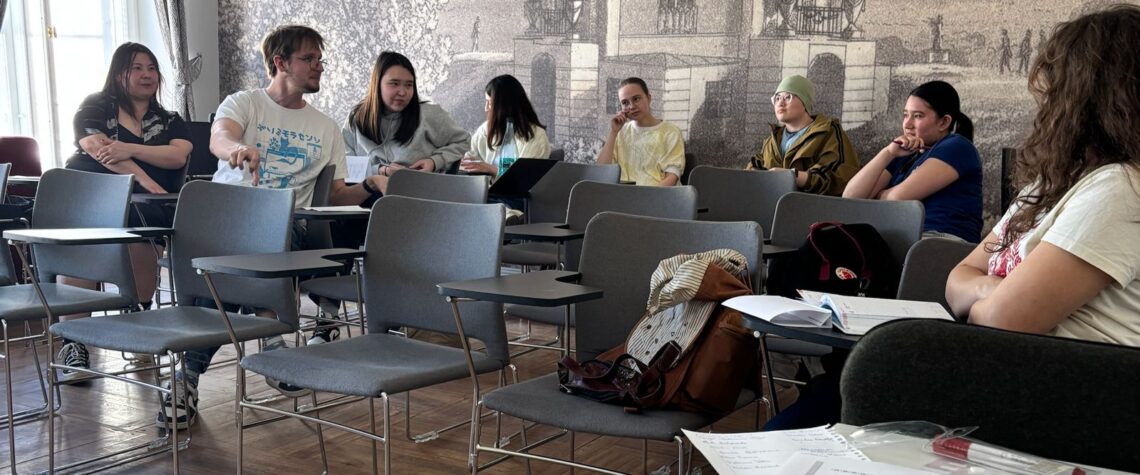
The central university-level “Play the Conspiracy” activities took place on 5, 12 and 14 May 2026, involving a total of 40 students at the University of Tartu.
The three workshops involved nine students in the first session, fifteen in the second and sixteen in the third.
Each workshop followed the same fictional scenario, focusing on scientific research, genetic data, political influence and institutional trust.
The opening situation presented students with an allegation that Estonia had sold anonymised DNA information from its national biobank to a private company connected to foreign investors.
Screenshots of alleged contracts circulated on social media, accompanied by accusations involving transhumanist surveillance, commercial interests and electoral manipulation.
Ambiguous institutional statements about international scientific cooperation provided further material for speculation.
The fictional scenario created an environment in which legitimate questions about data protection, biomedical research and public accountability could be transformed into broader conspiracy narratives.
Students were asked to investigate these claims through the Conspirology methodology, experiencing how different interpretations can emerge from the same information.
Constructing, challenging and judging a conspiracy narrative
Participants were assigned to teams by drawing lots, with conspiracy theorists, debunkers and judges taking different roles throughout the exercise.
The game developed through three rounds.
In the first round, students were introduced to the fictional allegations concerning genetic data. Teams had a limited time to prepare their arguments before presenting them.
The conspiracy theorists developed explanations involving corruption, foreign influence, economic interests and secret political agreements.
Debunkers were responsible for challenging these claims and identifying weaknesses in the evidence and reasoning.
Judges assessed the competing presentations, considering their credibility and persuasive effectiveness.
During the second round, new developments complicated the scenario.
A fictional news headline reported that a member of the Estonian parliament had demanded the resignation of the Minister of Health following allegations involving a biotechnology lobbyist.
Social media memes connected the supposed DNA controversy to previous scandals, while an investigative YouTuber released a video entitled “Estonia’s Genetic Gold Rush.”
A fabricated document suggested that Finland might become involved in a similar arrangement.
Students had to incorporate these developments into their arguments, responding to new information while defending their positions.
The third round introduced an additional challenge: prominent participants were reassigned to different groups.
This unexpected change forced students to reconsider their assumptions, adapt their arguments and experience the same narrative from a new perspective.
Each session concluded with a debriefing discussion connecting the role-playing experience with the broader themes of the CONSPIRE course.
Why conspiracy theorists often appeared more convincing
One of the most interesting findings from the University of Tartu workshops concerned the relative success of the different teams.
According to the workshop report, conspiracy theorist teams generally achieved higher scores during the exercises.
Students frequently described the conspiracy theorist role as the most enjoyable and liberating because it allowed greater freedom of expression, creativity and storytelling.
The debunker role, by contrast, required a more constrained form of argumentation.
Participants had to engage with existing claims, assess their credibility and develop responses without relying on the same freedom to invent connections or introduce speculative explanations.
Some students nevertheless preferred the debunker role because it better reflected their personal attitudes and reasoning styles.
These observations highlight a significant challenge in contemporary information environments.
Conspiracy theories can be persuasive not only because of the claims they make, but also because they offer compelling narratives, identifiable characters, emotional explanations and apparent connections between unrelated events.
Responding effectively therefore requires more than providing factual corrections.
It also involves understanding the emotional and narrative appeal of misinformation.
The role of identity, emotion and public trust
The University of Tartu workshops also examined how the identities adopted by participants influenced the credibility of their arguments.
Students were encouraged to create fictional personas representing different social positions and forms of authority.
Conspiracy theorists often portrayed themselves as ordinary citizens or social media influencers, presenting their claims as expressions of public concern and resistance to powerful institutions.
These identities allowed participants to establish an appearance of authenticity and emotional proximity to their imagined audiences.
Debunkers sometimes adopted the roles of politicians or wealthy entrepreneurs.
Interestingly, these apparently powerful positions did not necessarily make their arguments more convincing.
In some cases, they undermined credibility by reinforcing the impression that the speakers represented institutions or elites whose interests might be questioned.
This illustrated an important lesson: social authority and public trust are not always the same thing.
Students also used emotional appeals involving children, families and vulnerable groups, connecting the fictional genetic data controversy to broader concerns about privacy, health and public accountability.
These strategies demonstrated how conspiracy narratives can draw strength from fear, solidarity and collective identity.
Learning through experience and reflection
The workshops encouraged students to apply concepts from the CONSPIRE course in an interactive environment.
Participants developed arguments, responded to opposing interpretations, negotiated roles and adapted their strategies as the scenarios evolved.
The changes introduced during the game required flexibility and encouraged students to reconsider perspectives they had previously defended.
According to the report, the activities stimulated creativity, participation and critical reflection.
However, the educational value did not lie solely in the competitive element.
The debriefing discussions were particularly important because they connected students’ experiences with wider questions about misinformation, scientific authority, public trust and the appeal of conspiracy narratives.
Students reflected on why certain arguments appeared convincing, how emotional communication influenced judgement and what made some narratives more difficult to challenge.
The feedback collected during these sessions also offered useful indications for future applications of Conspirology.
In particular, the University of Tartu team identified opportunities to provide additional guidance on the selection of fictional personas and to deepen reflection on the advantages and difficulties associated with conspiracy theorising and debunking.
From doctoral research to school classrooms: the value of educational transferability
Taken together, the three educational experiences demonstrate one of the most promising dimensions of the CONSPIRE methodology: its adaptability to different audiences and learning environments.
At the Sustainability Fall Symposium, doctoral students and early-career researchers examined conspiracy theories through folklore studies, humour and cultural sustainability.
At Sillamäe Gymnasium, secondary-school students explored how familiar places, digital videos and changing authority figures can influence the credibility of conspiracy narratives.
At the University of Tartu, university students investigated a fictional controversy involving genetic data, scientific research and political influence through Conspirology.
Although these activities differed in their audiences and educational objectives, they shared a common methodological principle.
Participants were encouraged to move beyond passive learning and actively investigate how narratives are constructed, communicated, contested and evaluated.
This experience is particularly relevant to the future Transferability Toolkit envisaged by CONSPIRE, which aims to facilitate the application of its educational methodologies beyond the university sector.
The Estonian activities provide concrete examples of how interdisciplinary content and participatory techniques can be adapted to local cultures, age groups and educational needs.
Folklore studies as a resource for media literacy
The University of Tartu brings to CONSPIRE a distinctive academic perspective rooted in folklore studies, cultural analysis and the investigation of contemporary belief systems.
Its contribution demonstrates that conspiracy theories should not be understood exclusively as false information circulating online.
They are also cultural narratives that evolve through repetition, storytelling, humour, personal experience and collective identity.
Studying these mechanisms helps explain why certain conspiracy theories remain influential even when individual claims are challenged.
It also offers additional possibilities for education.
By recognising familiar narrative patterns, examining the emotional appeal of stories and understanding how credibility is constructed socially, students can develop a more comprehensive approach to misinformation.
This perspective complements the project’s broader interdisciplinary work on health, politics, religion, science, media and technology.
Beyond debunking: educating for critical awareness
The activities organised by the University of Tartu reveal an important educational challenge.
Conspiracy theories can be creative, engaging and emotionally compelling. Their appeal cannot always be addressed through factual correction alone.
Effective education must therefore help students understand how narratives work, why certain explanations become persuasive and how trust is influenced by social identities and cultural contexts.
Through lectures, discussion, humour analysis and role-playing, the Estonian partner demonstrated different ways of approaching this challenge.
The activities also highlighted the importance of adapting educational approaches to the experiences of specific audiences.
A familiar city, a political announcement, a scientific controversy or a humorous online meme can become the starting point for exploring broader questions about evidence, trust and democratic communication.
By bringing together university students, secondary-school learners and doctoral researchers, the University of Tartu has demonstrated how the CONSPIRE approach can connect academic research with participatory education and wider society.
The central lesson is that developing critical thinking requires more than teaching people to reject false claims.
It requires helping them understand why stories become convincing, how information gains authority and how evidence can be evaluated even when narratives appeal to fear, identity or personal experience.
Through its Estonian activities, CONSPIRE takes another step towards developing educational methods that strengthen media literacy, critical judgement and democratic resilience across different learning environments.