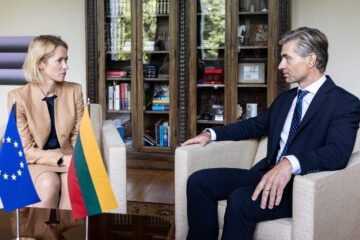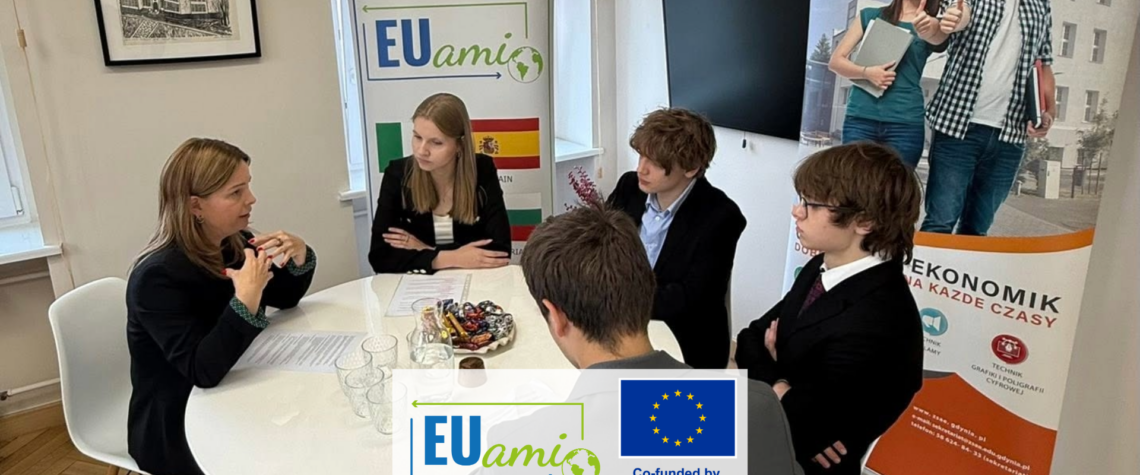
As part of the EU project EUAMI, students from the Complex of Administrative and Economic Schools in Gdynia (ZSAE) conducted on June 15th an exceptionally important conversation. Their guest was the Deputy Mayor of Gdynia, Oktawia Gorzeńska. The subject of the interview touched upon crucial issues for the future of our region: migration, multiculturalism, and the demographic challenges facing the city.
The interview has been done within the framework of European Values and Migration (EUAMI) project and it specifically answer the necessity to confront with policy-makers on European issues.
What picture of Gdynia emerges from this conversation?
Above all, it is of a city that sees diversity as its greatest opportunity, not a threat.The Labor Market and Demographics: Migrants are Support, not Competition One of the main topics of discussion was the clash between economic realities and migration processes. Deputy Mayor Oktawia Gorzeńska clearly emphasized that in an era of a deepening demographic decline, new residents from abroad are a key pillar of the local economy.
- Necessity, not an alternative: Gdynia, like the rest of Poland, is facing the problem of depopulation. In many industries, there is already a shortage of workers.
- New sectors of development: New specialists will be urgently needed for the implementation of strategic investments, such as the development of the maritime economy and projects related to nuclear energy.
- Systemic support: The city does not leave foreigners to fend for themselves. The District Labor Office in Gdynia actively helps them with the legalization of their stay, career counseling, and direct contact with employers.
The School as the Heart of Integration Gdynia’s multiculturalism is perfectly visible in school classrooms – young people representing about 60 different nationalities currently study in Gdynia’s educational institutions. For the city, this is a clear signal that the education system must react flexibly to new needs.
“The key to success is integration, joint events, and dialogue between residents, rather than building barriers.”
Gdynia’s authorities are constantly developing tools to support foreign students. Intercultural assistants work in schools, and young people can count on the support of the student ombudsman as well as programs carried out in the “Spilno” space. Interestingly, research clearly shows that in the process of acclimatizing to a new country, the absolute most important and invaluable factor turns out to be… peer support.
Security Hidden in Dialogue The Deputy Mayor of Gdynia also addressed the concerns that sometimes appear in public debate. Her message is unambiguous: migration must not be equated with a threat. True security is built through a wise integration policy, counteracting negative stereotypes, and creating spaces to get to know one another.
A Vision of Gdynia in a Decade: What Will It Be Like?
In 10 years, Gdynia is envisioned as a dynamic, modern, and – above all – open city. To halt the trend of population decline, the city has made it a priority to attract young people: students, graduates, and high-class specialists. It aims to achieve this by creating excellent conditions for studying, working, and simply – living a good life.
At the end of the meeting, Oktawia Gorzeńska directed an important message to the students of “Ekonomik” and the entire young generation of Gdynia students. She reminded them of the values that should act as a signpost in a dynamically changing world:
- Openness and respect for other human beings,
- Continuous dialogue and acceptance of diversity,
- The ability to make conscious choices in a world that offers infinite possibilities.
The interview, conducted as part of the EUAMI project, proves that young people want and are able to discuss difficult and important matters, and that Gdynia’s authorities view multiculturalism as a valuable resource that will shape the city’s identity for generations to come.
Watch here the video of the interview (sub eng)