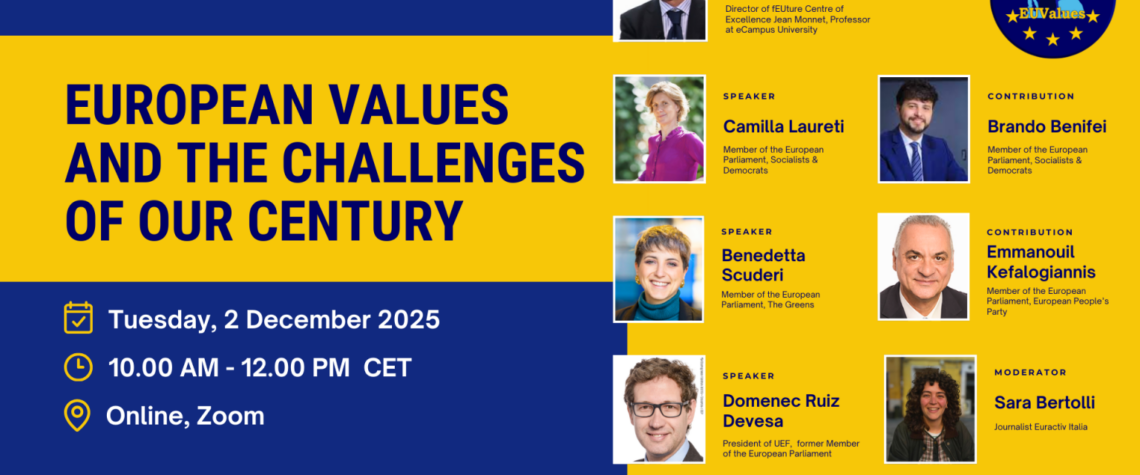
On December 2, 2025, the Jean Monnet project “European Values” reached its official conclusion. The final event brought together students, academics, and policymakers to discuss the European Values facing the current international challenges and the urgent need for shared sovereignty in an increasingly volatile geopolitical landscape.
The three-year initiative – led by University eCampus and supported by CesUE (a spin-off of the Scuola Superiore Sant’Anna) – concluded its journey with a high-level online forum. The project involved a diverse network of schools: Italy’s IIS Montessori Repetti and IIS N. Machiavelli, Greece’s 2nd Geniko Lykeio of Arta, Denmark’s Ørestad Gymnasium, and Cyprus’s Lykeio Agiou Antoniou.
Opening the debate, Prof. Roberto Castaldi, Director of the eCampus research centre RECIPE, delivered a stark reality check on the state of the Union. He argued that while the EU’s values freedom, democracy, and the Rule of Law are under threat from both within, citing erosion in Poland and Hungary, and without, Russia’s invasion of Ukraine, the EU remains a “spectator” in global conflicts.
Regarding the capacity of guranteeing secutirity, “the EU spends 33% of what the US spends on defense, but with only 10% of the efficiency,” Castaldi noted.
He emphasized that the “cost of non-Europe” is not just a theoretical concept but a financial burden, pointing to €250 billion lost annually due to national tax competition and energy costs that remain double those of the United States. His proposal? A leap toward shared sovereignty in defense, energy, and fiscal policy to transform the EU into a true global player alongside “continent-states” like China, India, and the US.
The heart of the project was the active participation of students who spent three years engaging with the machinery of European democracy.
Nicola from Montessori Repetti (Italy) noted that despite the climate crisis and war, his generation chooses hope as a fundamental value to build a better future. On the other side students from Denmark and Italy discussed the fragility of democracy, highlighting how low voter turnout in certain regions weakens the entire system.
Several Members of the European Parliament (MEPs) and experts joined the discussion to provide an institutional perspective.
In his speech, Domènec Devesa, President of the Union of European Federalists and former MEP, addressed the shift from “soft Power” to “hard Power”. In a world of unpredictability – exacerbated by shifting US foreign policy and the “Trump factor” – Devesa argued that the EU must develop a credible defense pillar within NATO.
Camila Laureti (S&D) focused on the intersection of climate and food security. Responding to Danish students concerned about the environmental impact of farming, she defended the “one health” approach that links human, animal, and planetary health. She also criticized the unanimity rule in the Council, which she claims paralyzes the Union’s ability to act on the Green Deal.
Manolis Kefalogiannis, Greek MEP from the EPP, urged students to lead the digital transition with solidarity, while Brando Benifei (S&D) highlighted the landmark AI Act as a prime example of the EU setting global standards for the protection of citizen rights in the age of automation.
The event concluded with a call to action. While the moderator, Sara, acknowledged the “uncertainty and fear” regarding the future, she reminded the young participants that defending democracy is a collective effort.
Prof. Castaldi closed the session by encouraging students to exercise their rights as European citizens, ensuring that the dialogue between the classroom and the European halls of power becomes a permanent fixture of their education.
Click here to watch the full event
The original article is available here.