At the Complutense University of Madrid, 16 students took part in a three-day role-playing workshop exploring how conspiracy narratives are constructed, challenged and evaluated. Through the CONSPIRE methodology, participants discovered why misinformation can be persuasive — and why critically assessing it requires more than simply identifying false claims.
How difficult is it to distinguish a genuine political scandal from an unfounded conspiracy theory? Why can a convincing story appear more credible than carefully verified evidence? And what happens when students are asked to defend, challenge and judge conspiracy narratives themselves?
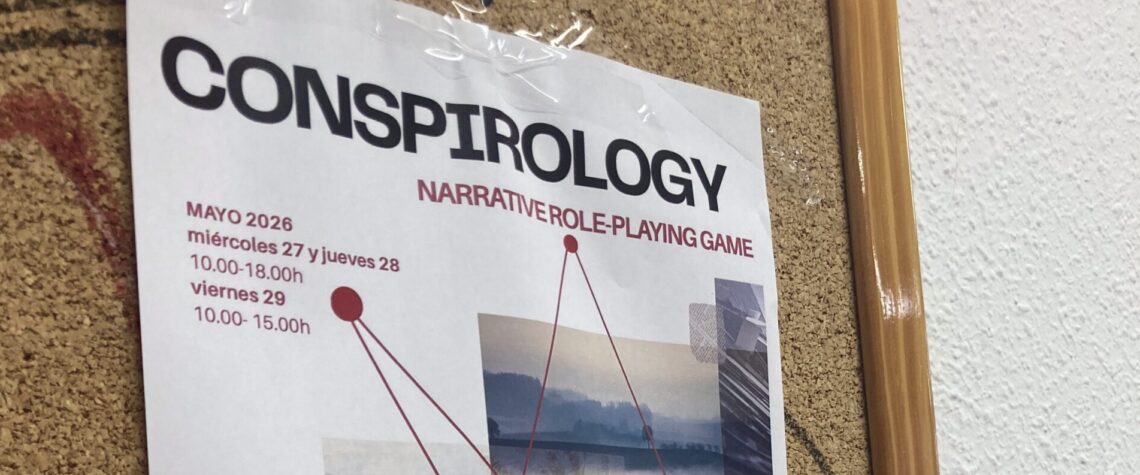
These were among the questions explored during “Play the Conspiracy”, a face-to-face workshop organised at the Complutense University of Madrid (UCM) from 27 to 29 May 2026, as part of the Erasmus+ project CONSPIRE – CONSPIracism and RAdicalisation Risks in Europe.
Hosted by UCM’s Faculty of Political Science and Sociology, the workshop brought together 16 students from anthropology, sociology, gender studies, international studies and religious studies. Participants included undergraduate, master’s and doctoral students, bringing different academic backgrounds and perspectives to the experience.
Over three days, they engaged in Conspirology, the educational role-playing game developed within CONSPIRE to help students understand how conspiracy theories emerge, become persuasive and influence public perceptions of reality.
Rather than simply studying misinformation through lectures, students experienced the mechanisms of conspiratorial thinking from different positions, alternating between constructing conspiracy narratives, challenging them with evidence and evaluating competing interpretations.
Welcome to Iberalia: a fictional country with very real problems
The workshop began with an immersive fictional scenario set in Iberalia, an imaginary contemporary European country experiencing political polarisation, economic insecurity and declining trust in public institutions.
The scenario presented a society shaken by interconnected crises: a serious health emergency, allegations of institutional corruption, concerns about artificial intelligence and a mysterious nationwide power outage.
At the centre of the narrative was a hantavirus outbreak aboard a cruise ship, followed by an unprecedented military isolation operation on remote islands.
Political figures and online influencers began accusing a private biomedical conglomerate, Grupo Médico Helix, of deliberately engineering or releasing viral strains for financial gain.
Meanwhile, a judicial investigation known as Operación Hipócrates uncovered genuine corruption involving public contracts, political favouritism and unauthorised harvesting of medical data connected to an AI-powered healthcare system called Synapsis.
However, investigators found no factual evidence that the virus had been artificially created.
A second crisis further complicated the situation: a national electricity blackout generated competing explanations involving alleged foreign cyberattacks, corporate manipulation and environmental sabotage.
The students were therefore confronted with a deliberately ambiguous information environment, where documented wrongdoing coexisted with speculation, invented testimonies and unsupported accusations.
This was the central educational challenge.
How can citizens distinguish justified suspicion from conspiracy thinking when real abuses of power provide a convincing foundation for misleading narratives?
The scenario reflected an important characteristic of conspiracy theories: they often combine recognisable facts, genuine concerns and fragments of reality with misleading interpretations, creating explanations that can appear coherent even when they lack reliable evidence.
Three roles, three ways of understanding conspiracy thinking
The workshop was structured around three groups: conspiracy theorists, debunkers and judges.
Each group approached the same events from a different perspective, developing arguments and responding to the challenges posed by the others.
The conspiracy theorists were tasked with constructing persuasive narratives. Drawing selectively from the available information, they connected events, developed fictional characters and introduced emotional appeals and invented testimonies.
Their stories involved pharmaceutical profiteering, political cover-ups, foreign cyberattacks, environmental false-flag operations and AI surveillance.
One recurring strategy was to shift claims when challenged. For example, an allegation that a company had created a virus could be reformulated as an accusation about its government contracts, allowing the broader narrative of suspicion to survive even when the original claim lacked proof.
The debunkers faced a different challenge. Their responsibility was to examine the available evidence, identify logical inconsistencies and develop more plausible explanations.
They consulted external sources, scholarly research and official reports, applying principles such as distinguishing correlation from causation and recognising that an absence of evidence cannot automatically be treated as evidence of a cover-up.
The judges were responsible for assessing the competing arguments. They developed criteria based on the credibility of sources, the quality of evidence, the plausibility of explanations and fairness in evaluating opposing perspectives.
The result was a dynamic educational exercise in which arguments evolved through successive rounds of debate.
Why inventing a conspiracy can be easier than disproving one
One of the most striking findings from the Madrid workshop concerned the imbalance between constructing a conspiracy narrative and challenging it.
Students playing conspiracy theorists often found it relatively easy to create persuasive explanations by connecting unrelated events, appealing to fear or introducing new suspicions.
Debunkers, by contrast, had to invest considerable effort in verifying information, examining claims and explaining why apparently meaningful connections did not necessarily demonstrate causation.
As one doctoral student observed:
“When you’re a debunker, you have to work twice as hard to prove something, whereas if you’re a conspiracy theorist, you just have to make up whatever you want.”
A master’s student expressed a similar frustration:
“The conspirators get to be creative; we have to be correct. That’s not fair.”
These reflections capture a fundamental challenge in addressing misinformation: the effort required to produce a convincing but unsupported narrative can be much smaller than the effort needed to investigate and correct it.
The exercise also demonstrated how conspiracy theories can adapt to criticism. When challenged with contradictory evidence, participants defending conspiracy narratives sometimes reinterpreted the challenge itself as further evidence of concealment.
This helped students recognise how certain claims become effectively unfalsifiable, making them resistant to ordinary processes of verification.
Changing roles to understand different perspectives
A distinctive feature of the Madrid workshop was the rotation of roles during the second and third days.
Students who initially acted as conspiracy theorists became debunkers or judges, while other participants moved into different positions.
This rotation prevented students from settling into a fixed perspective and encouraged them to reconsider arguments they had previously defended.
The game also introduced unexpected developments through dice rolls, forcing participants to adapt their narratives and strategies as new information emerged.
Facilitators guided the process, managed discussions and encouraged participants to explain their reasoning.
Questions such as “What would you count as proof?” and “Does a coincidence in time actually demonstrate causation?”helped students reflect on the assumptions underlying their arguments.
The rotation proved particularly valuable for developing emotional distance from the positions adopted during the game.
Students could experience the attraction of constructing a compelling narrative while also confronting the intellectual responsibility involved in evaluating evidence.
As one facilitator explained:
“Switching roles has been key to giving them perspective and emotional distance; not all roles have been equally fun, but the learning process has been clearer and the lessons have stuck better.”
From online learning to practical experience
The Madrid workshop was also an opportunity to connect the theoretical content of the CONSPIRE online course with an immersive educational experience.
Before the game began, participants shared what they had learned during the online modules. Throughout the three days, facilitators organised reflection sessions to connect the activities with the academic concepts introduced during the course.
These discussions highlighted an important distinction: students were often able to recognise manipulation and critically examine arguments during the game, but did not always spontaneously recall the theoretical concepts behind their reasoning.
The facilitators therefore dedicated additional time to connecting the practical experience with the course content.
Four areas proved especially relevant: psychological and social needs during periods of crisis; health-related misinformation and infodemics; scientific literacy and the manipulation of scientific authority; and political narratives involving anti-elitism and scapegoating.
This process illustrated the educational value of combining formal academic learning with non-formal, experience-based methodologies.
The course provided conceptual tools, while the role-playing workshop offered a practical environment in which students could apply, question and consolidate them.
Critical thinking, media literacy and judgement skills
According to the workshop report, the Madrid experience produced valuable learning outcomes across several interconnected areas.
Critical thinking developed as students learned to identify manipulative narratives, recognise logical fallacies and distinguish legitimate questions about institutional accountability from unsupported accusations.
Media literacy was strengthened through exercises involving source verification, lateral reading and the comparison of information across independent and reliable sources. Students examined how social media algorithms, echo chambers and influencer communication can contribute to the circulation of conspiracy narratives.
They also explored techniques for responding to misleading claims, including prebunking, which helps people recognise manipulation strategies in advance, and debunking, which addresses false claims using verifiable evidence.
An important reference was the FLICC framework, which identifies common techniques associated with science denial and misinformation: fake experts, logical fallacies, impossible expectations, cherry-picking and conspiracy theories.
Collaborative learning emerged through teamwork, negotiation and the need to adapt arguments as the scenario developed. Students learned to listen to different perspectives and respond collectively to complex situations.
Finally, judgement skills became particularly visible in the work of the judges.
During the first day, judges sometimes appeared influenced by the passion and confidence of the conspiracy theorists. As the workshop progressed, however, they increasingly demanded reliable sources, objective data and verifiable arguments.
This shift was among the clearest examples of learning through experience: students became more aware of the difference between a persuasive presentation and a well-supported explanation.
Understanding misinformation without dismissing real concerns
One of the most significant aspects of the Madrid experience was the decision to include real institutional misconduct alongside invented conspiratorial claims.
The fictional narrative drew inspiration from recognisable public controversies, including corruption scandals that were unfolding in the Madrid region at the time.
This created a complex educational environment in which suspicion could sometimes be reasonable, even when particular conspiracy theories remained unsupported.
Students were therefore encouraged to avoid two opposite mistakes: accepting accusations simply because they sound plausible, and dismissing every expression of institutional distrust as irrational.
The exercise helped participants understand that critical thinking involves examining evidence carefully, acknowledging genuine problems and resisting the temptation to turn uncertainty into unfounded certainty.
This distinction is particularly important for CONSPIRE, whose educational approach seeks to understand conspiracy thinking as a social, cultural and communicative phenomenon rather than treating it exclusively as a collection of false claims.
Madrid’s contribution to the CONSPIRE learning pathway
The Complutense University of Madrid brings to CONSPIRE its expertise in anthropology, sociology, health-related beliefs and the relationship between science, institutions and society.
The Madrid workshop reflected this interdisciplinary approach by linking biomedical controversies with political corruption, technological surveillance, media narratives and public trust.
Through Conspirology, students experienced how conspiracy theories can exploit genuine social concerns while transforming them into explanations that are difficult to verify or challenge.
The workshop also demonstrated the potential of role-playing as a teaching methodology: students were not merely exposed to theoretical explanations, but became active participants in the production, criticism and evaluation of knowledge claims.
The experience forms part of the wider “Play the Conspiracy” phase, implemented across the CONSPIRE partner universities, and contributes to the preparation of “Replay the Conspiracy”, the project’s future international learning experience in Turin.
Learning to question, not simply to believe or disbelieve
The Madrid workshop offered an important lesson about the nature of critical thinking.
Recognising misinformation is not simply a matter of deciding whether a statement is true or false. It also requires understanding how narratives are constructed, how emotions affect judgement, how uncertainty can be manipulated and why credible evidence matters.
By moving between the roles of conspiracy theorists, debunkers and judges, students confronted these challenges directly.
They discovered that persuasive storytelling and reliable reasoning are not necessarily the same thing, that genuine corruption does not validate every accusation, and that questioning institutions responsibly requires evidence rather than suspicion alone.
Through the Madrid experience, CONSPIRE demonstrates how universities can combine academic research with participatory educational methods to strengthen media literacy, intellectual independence and democratic awareness.
The central lesson of “Play the Conspiracy” is that critical thinking cannot be reduced to telling students what to believe. It must also give them the opportunity to question, investigate, debate and learn how to judge for themselves.