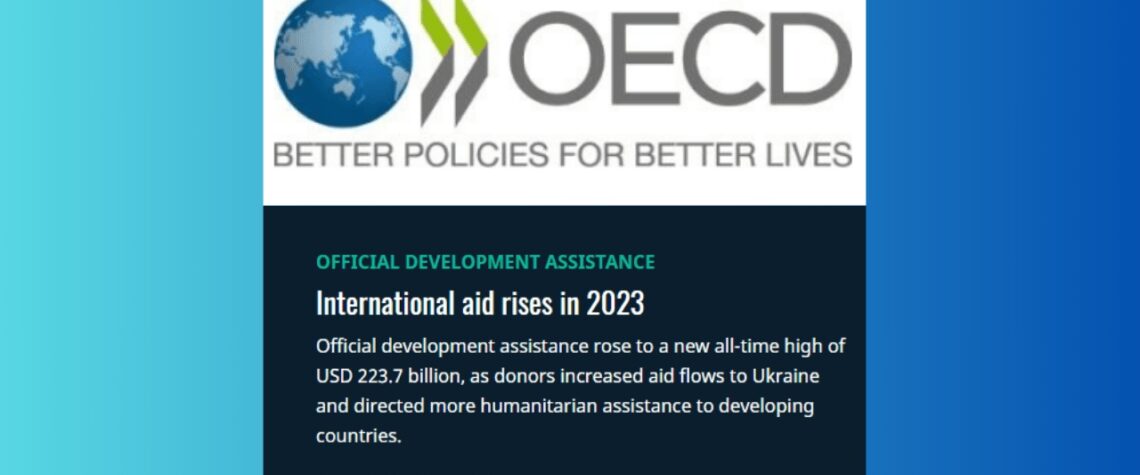
Official Development Assistance (ODA) to Africa is declining. In mid-year, the OECD provisionally reported that total ODA had fallen by 23.1% in real terms in 2025, the largest decline in history. This was mainly due to President Trump’s dismantling of the United States Agency for International Development (USAID), which resulted in a 57% reduction. But the United States was not the only donor to reduce its contribution, as all the other major donors also cut their aid: Germany (-17.4%), France (-10.9%), the United Kingdom (-10.8%) and Japan (-5.6%). If we add the 7.1% cut already recorded in 2024, this means 30% fewer resources for development, which are particularly important for many African countries.
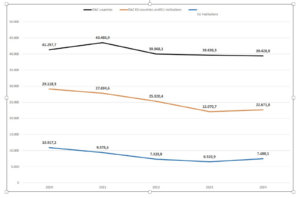
As shown in Figure 1, between 2020 and 2024 (the latest year for which data by recipient country are available), ODA from traditional donors belonging to the OECD Development Assistance Committee (DAC) fell by 4.5%. Since 2022, ODA has declined every year. ODA from the European Union institutions and its Member States, which together constitute the world’s largest donor bloc, fell by 22.1%, with only a very slight recovery between 2023 and 2024. ODA from the Community Institutions fell by 31.4%.
Figure 1. Evolution of ODA to Africa, 2020–2024.
Source: OECD-DAC, CRS.
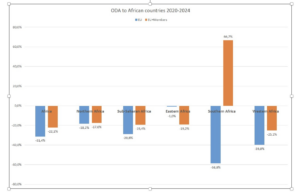
Over the past five years, ODA has declined across all regions, both in the funding provided by the European Commission and in the figures that include contributions from the Member States.
As shown in Figure 2, the only exception was Southern Africa in the case of the EU and Member States, due to a 131% increase in aid to Namibia and in ODA to the region for which no sector was specified.
However, there is considerable heterogeneity. While ODA provided by the Commission declined across all regions (by almost 59% in Southern Africa and by 1% in East Africa), ODA provided by the EU and its Member States fell less than that provided by the Commission for the continent as a whole and for Sub-Saharan Africa. In North Africa, the reduction was quite similar, while the decline was more pronounced in East Africa on the part of the Member States.
Figure 2. Relative change in ODA to Africa between 2020 and 2024
Source: OECD-DAC, CRS
Looking solely at ODA provided by the EU institutions (Figure 3), ODA disbursements declined in 38 of Africa’s 53 countries, accounting for 71.7% of the total.
Figure 3. ODA from the European institutions to African countries: relative change in ODA between 2020 and 2024
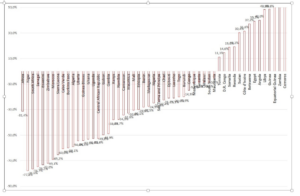
Note: For ease of visualization, the left-hand axis is truncated at 50%. The countries exceeding this threshold were Equatorial Guinea (157.9%), Zambia (218.5%), Comoros (357.6%) and Eritrea (3032.7%).
Source: OECD-DAC, CRS.
One of the defining features of ODA in Africa is the wide variation in its relative importance compared with Gross National Income (GNI). While in some countries ODA accounts for no more than 0.15% of GNI (Algeria, Equatorial Guinea, Egypt and Angola), others still rely heavily on this external and solidarity-based flow of resources to support their development. For example, in 2023, according to the World Bank, the ODA/GNI ratio stood at 27.3% in the Central African Republic (having reached 32% in 2014), 20.4% in Somalia (38% in 2011), 18.3% in Burundi, 15.3% in Mozambique and 14.6% in Gambia.
This lack of resources is particularly serious in countries experiencing severe economic fragility, as defined by the OECD[1]. In Africa, the following five countries stand out as particularly fragile: South Sudan, Sudan, Eritrea, Somalia and Zimbabwe.
Table 1
| 2020 | 2021 | 2022 | 2023 | 2024 | TOTAL | Change 2020-2024 | |
| Eritrea | 3,20 | 1,57 | 1,29 | 46,62 | 100,18 | 152,86 | 3032,7% |
| Somalia | 184,62 | 380,22 | 154,00 | 160,35 | 219,62 | 1.098,82 | 19,0% |
| South Sudan | 130,40 | 125,53 | 96,62 | 110,06 | 119,28 | 581,88 | -8,5% |
| Sudan | 116,17 | 170,01 | 205,86 | 135,08 | 151,44 | 778,55 | 30,4% |
| Zimbabwe | 129,60 | 63,67 | 59,12 | 36,73 | 36,31 | 325,43 | -72,0% |
Source: OECD-DAC, CRS. Values in constant 2024 US dollars, in millions.
As shown in Table 1, ODA from European institutions has increased significantly in Eritrea, with a rate of more than 3,000%. However, this is mainly due to disbursements in 2024 and the very low volume of aid received at the beginning of the period.
In Sudan, the flow has been more stable over the five-year period, with ODA increasing by 30% in the final year compared with the first. Somalia also recorded a positive rate and received the largest volume of EU resources among the five countries, exceeding one billion US dollars. Finally, South Sudan and Zimbabwe recorded negative ODA growth rates of 8.5% and 72%, respectively.
This situation is particularly concerning, as a significant body of literature argues that ODA should be concentrated, in particular, in Fragile and Conflict-Affected States, since other sources of financing, whether private or non-concessional, are unwilling to assume the risks involved in supporting these countries. Without the active presence of European donors, it is highly likely that other donors, such as China, will fill the development financing gap, tending to orient their support towards strategic interests such as the supply of minerals and raw materials needed for China’s own growth process.
Against this new backdrop of fewer solidarity-based resources and a greater focus by some donors on securing transactional benefits, Africa must maintain a strong voice within international organisations and call for recognition as a reliable partner with which to build a fair partnership for comprehensive development, rather than being portrayed as the cause of ODA’s lack of effectiveness.
In addition, Africa should continue to pursue its own 2063 Development Agenda, promoted by the African Union to transform the continent into a global power of the future, with a focus on global health, education, food sovereignty and integral ecology, particularly by addressing climate risks and the involuntary displacement of populations.
Finally, Africa should remain closely involved in the development of the Seville Platform for Action, launched in the city in July 2025 as a follow-up to the Seville Commitment adopted at the Fourth International Conference on Financing for Development. Among the Platform’s actions, the following are particularly relevant to Africa.
First, by making use of the global facility for debt swaps for local climate and social protection projects, as well as debt suspension clauses in the event of climate-related disasters, while continuing to advance initiatives aimed at creating greater fiscal space to expand social protection coverage for vulnerable populations.
Second, by continuing to promote leadership in the ownership and prioritisation of national development plans, while learning from successful institutional experiences such as South Africa’s Just Energy Transition Partnership. Third, by strengthening national development funds and development banks and drawing on the experience of the African Development Bank to coordinate the actions of bilateral and multilateral donors, such as the EU, in order to reduce the lack of coordination, simplify procedures and achieve greater mobilisation of private resources, an objective that has remained outstanding since the Fourth High-Level Forum on Aid Effectiveness, held in Busan in 2011.
For its part, Spanish Development Cooperation is focusing on the creation of inclusive employment across the continent and on investment in West Africa and the Sahel.
The European Union, for its part, is expected to further adjust Global Gateway so that it does not focus solely on physical infrastructure that benefits European companies, in a move that mirrors China’s Belt and Road Initiative and the United States International Development Finance Corporation.
[1] OECD (2025). States of Fragility 2025. The OECD multidimensional fragility framework.
José María Larrú (Associate Professor of Applied Economics, CEU San Pablo, Madrid)