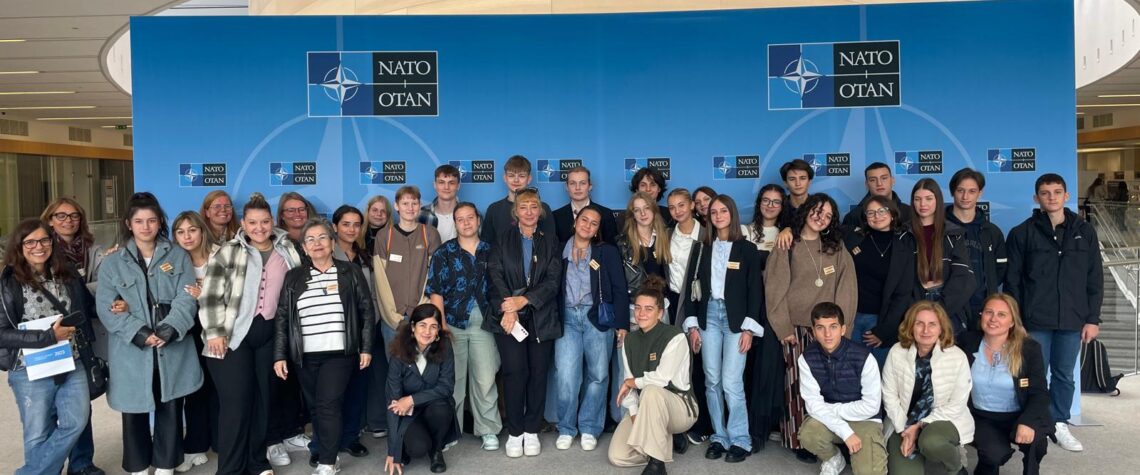
On September 12th, a group of students from five schools from four different countries, participating in the Erasmus+ “Jean Monnet” project, had the opportunity to visit the NATO headquarters in Brussels.
This article has been written by Francesco De Gioia, a student who has taken part in the first EU Values Summer school in Brussels.
During the visit, they received a restricted tour of the facility and met with prominent NATO members, including Ettore Marchesoni, the Advisor and Programme Manager from the SPS Management Unit and the Innovation, Hybrid and Cyber Division.
Marchesoni discussed NATO’s Civil-Military Cooperation (CIMIC) initiatives and highlighted the Alliance’s focus on teamwork and cooperation in areas such as crisis management, civil defense, and scientific collaboration. He emphasized the importance of addressing new challenges and developing strategies to deal with emerging issues, including artificial intelligence (AI).
NATO’s revised AI strategy outlines a comprehensive approach to responsible AI adoption within the Alliance. It emphasizes leveraging AI technologies while mitigating associated risks and ensuring ethical use.
Key objectives include accelerating AI adoption in defense capabilities, protecting AI technologies, addressing adversarial threats, and fostering a collaborative AI ecosystem. The strategy addresses various challenges, such as data availability, workforce implications, and the potential for AI-enabled disinformation.
NATO aims to lead by example and encourage responsible AI development and use among Allies, while also collaborating with partners, industry, and academia to advance AI capabilities and address shared challenges.
The SAPIENCE drone competition, supported by NATO’s Science for Peace and Security (SPS) Programme, showcased the potential of autonomous drones for crisis management.
Four teams from different countries competed in a challenge to adapt technology for disaster response scenarios. The teams used commercially available drones and AI for guidance, navigation, and control, demonstrating the valuable insights that can be gained from such competitions in overcoming technical challenges and applying AI to real-world problems.
Through these experiences, the students gained a deeper understanding of AI and its potential applications. They learned about the importance of responsible AI development and the role it can play in addressing global challenges.
As AI continues to evolve, NATO’s commitment to its responsible and ethical use is essential for ensuring its positive impact on defense and security.
[Edited by Sara Bertolli]
The original article is available here.