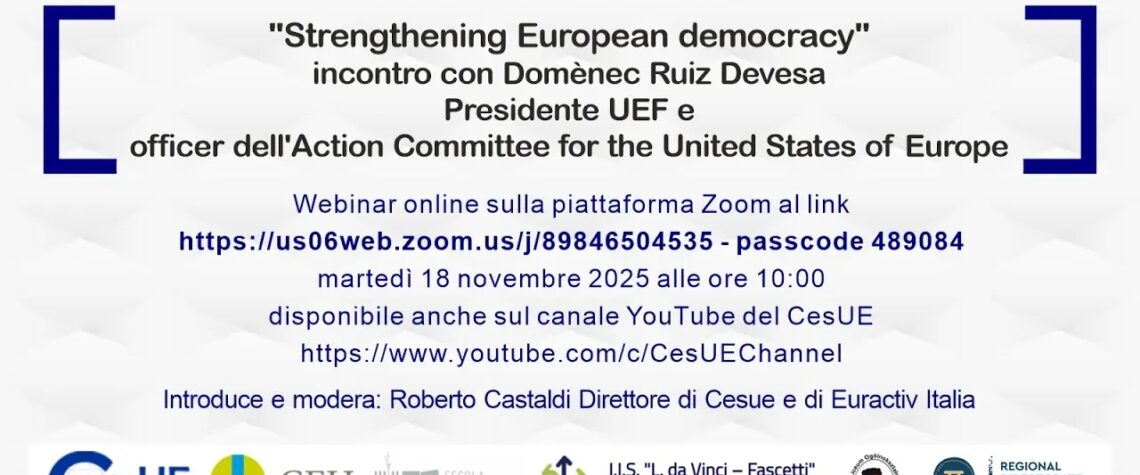
On 18 November 2025, students from the schools participating in the EUdemos Project had the opportunity to attend an in-depth lecture by Domènec Ruiz Devesa, President of the Union of European Federalists (UEF), member of the Action Committee for the United States of Europe, and former Member of the European Parliament.
His talk, titled “Strengthening European Democracy,” offered a rigorous and accessible overview of the challenges and future directions of democratic governance in the European Union.
Understanding Europe’s Democratic Deficit
Ruiz Devesa opened his lecture by tracing the historical evolution of the European Parliament, highlighting how its limited initial powers contributed to what became known as Europe’s democratic deficit.
In its early decades:
-
The Parliament was not directly elected by the citizens.
-
It held restricted budgetary powers.
-
It had no legislative authority, which remained largely in the hands of the Council and the Commission.
This institutional imbalance shaped the perception that the EU lacked adequate democratic legitimacy.
A turning point came when the Parliament became directly elected, an achievement strongly supported by civil society movements. Further reforms strengthened its role: the Maastricht Treaty expanded its legislative relevance, while the Lisbon Treaty (2007) made co-decision—now the ordinary legislative procedure—the standard rule of EU lawmaking.
Yet, Ruiz Devesa stressed that important limitations persist, such as:
-
The Parliament still lacks full legislative initiative, relying on the Commission in most cases.
-
Fiscal and financial constraints limit democratic control over key areas.
-
The unanimity requirement in crucial fields—including foreign policy, defence, the multiannual financial framework, social policy, and treaty reform—remains incompatible with democratic majoritarian principles.
Proposals for a Stronger European Democracy
Ruiz Devesa outlined a series of reforms that could reinforce the democratic functioning of the EU. Among his proposals:
-
Expanding the legislative initiative of the European Parliament.
-
Overcoming unanimity in the Council by introducing qualified majority voting and using the passerelle clauses.
-
Extending the ordinary legislative procedure to more policy areas.
-
Strengthening the Parliament’s budgetary authority to enhance its institutional influence.
He also argued for gradual progress when formal treaty reform is not immediately achievable. Other key measures included:
-
Reinforcing European citizenship education across all Member States.
-
Introducing transnational lists in European Parliament elections to enhance the European public sphere.
-
Promoting deliberative democracy tools—such as citizens’ panels—alongside representative democracy.
Dialogue With Students
The session concluded with an engaging Q&A session. Students asked insightful questions on:
-
The political and social implications of transnational electoral lists.
-
The opportunities and risks associated with treaty reform.
-
How passerelle clauses operate in practice.
These exchanges demonstrated students’ growing understanding of EU governance and highlighted EUdemos’ role in fostering critical thinking on the future of European democracy.
A Commitment to Civic Education
This event reaffirmed EUdemos’ mission: bringing European politics closer to young citizens through direct dialogue with policymakers, experts, and institutional leaders. The session with Domènec Ruiz Devesa provided participants with valuable insights into the structural challenges of the EU and inspired them to reflect on the reforms needed to strengthen democracy at the European level.
Through initiatives like this, EUdemos continues to empower the next generation of Europeans to play an active role in shaping the Union’s future.
[A cura di Luca Gualco & Luca Sanna]