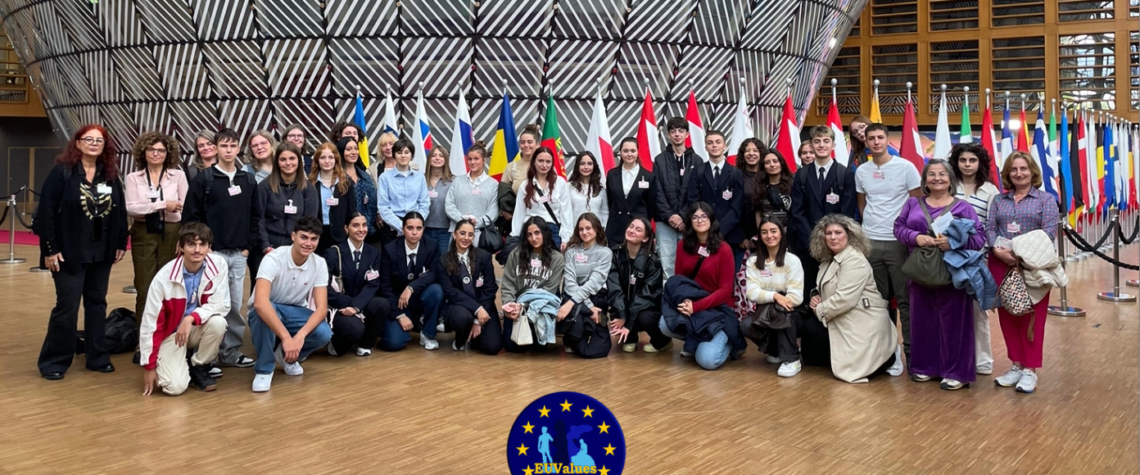
From 14 to 20 September 2025, forty students from Italy, Greece, Denmark and Cyprus took part in the second edition of the Jean Monnet Network European Values Summer School. The programme led them to the very heart of European democracy, with a series of visits to the EU’s key institutions and debates on the themes shaping Europe’s future.
This article has been written by Matilda Aleandri, collaborator at Euractiv Italia.
At the European Parliament, participants discovered how legislation is debated and adopted, and toured the Hemicycle. On the morning of 16 September, the group was guided through the Parliament’s visitors’ areas and the Hemicycle itself, gaining insights into the decision-making process of the only directly elected EU institution. This offered a first-hand look at how elected representatives shape the legislative process of the Union.
Later the same day, the Summer School continued with a guided tour of the House of European History, allowing students to connect the EU’s present with its past. They explored the museum’s permanent exhibition, which traces Europe’s political, cultural, and social history and highlights the path that led to the creation of today’s Union. The experience offered a broader context for reflecting on the importance of European integration and the shared values underpinning it.
A visit to the European Council, held on 18 September, introduced them to the institution where the Member States negotiate and decide on the Union’s political direction. The programme included an initial information session, followed by a tour of the visitors’ centre, enabling students to better understand the Council’s role in coordinating policies and setting priorities for the Union.
The group was also welcomed at the European Commission, where they learned more about its executive role and policies related to the green transition, foreign affairs, and defence. On 19 September, students attended a presentation on the role of the Commission within the EU, which was followed by a lively question-and-answer session. This exchange gave them the opportunity to reflect on how the institution balances its responsibilities across different policy areas.
The original article is available here.