The role of regions within the European Union has grown alongside the evolution of cohesion policies. To ensure their voices are heard and to actively participate in European political dynamics, many regions have established permanent representations in Brussels.
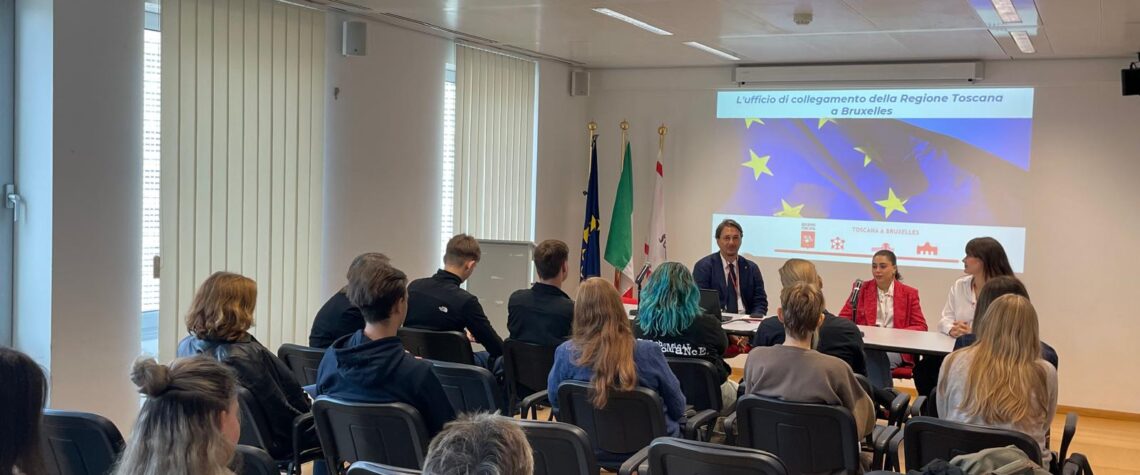
On the 10th September, the EU Values group activities were hosted by the Regional representation of Tuscany (Italy) in Brussels.
“European Values” involves, in addition to eCampus University as lead partner, five high schools from Italy (’IIS N. Machiavelli‘ of Lucca and “IIS Montessori Repetti” of Marina di Carrara), Cyprus (’Lykeio Agiou Antoniou‘ of Limassol), Denmark (’Ørestad Gymnasium‘ of Copenhagen) and Greece (’2nd Geniko Lykeio’ of Arta). It is also supported by the Study, Training, Communication and Design Centre on European Union and Global Governance (a spin-off of the Scuola Sant’Anna of Pisa). The project aims to systematically integrate European issues into the teaching and activities of partner schools.
These offices play a crucial role in connecting local and regional governments with EU institutions, promoting multi-level governance and bringing European decisions closer to citizens.
Massimiliano Lelli, Head of Communication at the Regional Representation of Tuscany, discussed the role and tasks regions perform in the Belgian capital, such as lobbying and advocacy with political decision-makers, networking with other European regions to form alliances, monitoring the legislative activity of European institutions, organizing awareness-raising and information events on the EU, and, last but not least, facilitating access to European funding for economic, social, and territorial cohesion.
The regional offices in Brussels hold a vital position within the institutional framework of the European Union. Serving as bridges between local entities and EU institutions, these offices empower regions to actively engage in European policymaking, advocate for their citizens’ interests, and foster more balanced and inclusive governance.
In a Europe facing growing political complexity and shared challenges like climate change, economic disparities, and digital transformation, these regional offices remain crucial in ensuring that proposed solutions address the unique needs of local areas, thus playing a key role in shaping an increasingly participatory European Union.
Monika Bochenek, Jean Monnet Programme Manager, also participated in the meeting, greeting the students and reminding them of the importance of Jean Monnet projects in providing opportunities to discuss European issues, as demonstrated by the ‘European Values’ project.
The European Commission’s Jean Monnet Projects promote teaching, research, and dialogue on European integration issues globally, funding academic initiatives that enhance understanding of EU policies and institutions.
The original article is available here.