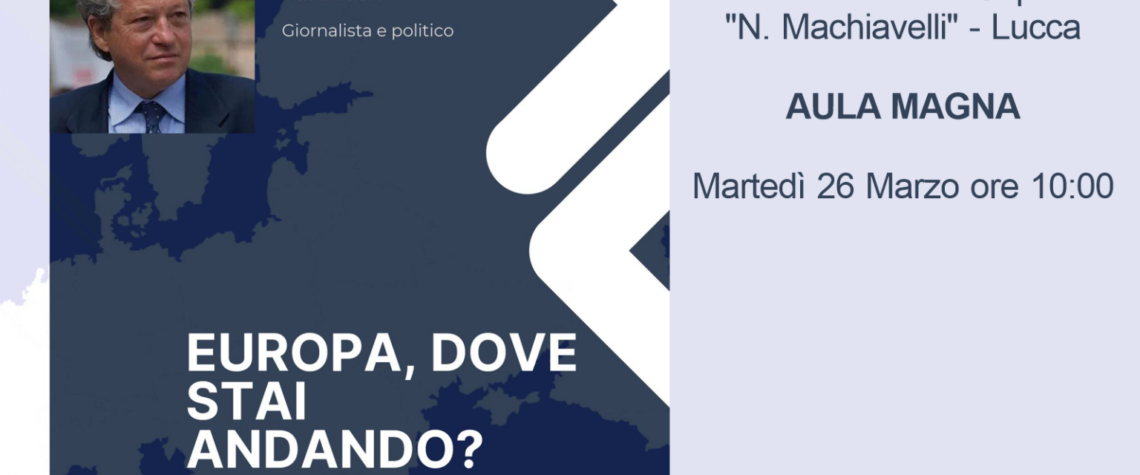
Tuesday 26th March 2024 was an enriching day for the students of a high school in the small town of Lucca, Italy. Eighteen and nineteen year old were presented with the opportunity to attend an interactive lecture with former Italian MP (1987-2001) and Eurodeputy (1989-1994) Marco Taradash, who is now still active in journalism and politics with a minority pro-Europe party.
This article has been written by Zubin Battaglia, final year student and meeting Chair.
The meeting’s main focus was to realize how current major events around the globe will impact the future of Europe, and how the latter should respond, building a stronger backbone for both the short run and the long run.
The first section of the lecture was focused on the diplomatic relations between the EU – together with its democratic allies – and Putin’s Russia.
To deeply understand our relationship with Russia and to comprehend the reasons for which Putin undertook such an unprecedented – at least so in post-WW2 history – conflict on European soil – Taradash argues – we must retrace the waves of European diplomatic history which have made the flow of events converge to this very present. Ever since the Westphalia Treaty which posed an end to the Thirty Years War (1618 al 1648), European history – including that of Tsarist Russia – has been fundamentally characterized by repeated wars aimed at improving one State’s position over the other, resulting in three hundred years of diplomacy based on hard stone-cold geopolitical calculations aimed at maintaining the power equilibrium with no space for morality or idealism. With the two World Wars, the common path between the West and the Soviet heirs of Tsardom diverged: under the guidance of the United States, a devastated Western Europe adopted the idealistic approach to diplomacy which is typical of liberal democracies, and which aimed first and foremost at the preservation of peace through the self-determination of nations and collective security. Under the new ideological mask of communism, on the other side, the Soviet Union continued the tradition of old-style iron diplomacy which, as a response, eventually led to the remilitarization of Western Europe under NATO. After forty years of relative peace – not of outright war, as Mr. Taradash stresses in underlining the success of NATO diplomacy – the Russian Federation which had been born from the ashes of the USSR seemed to reunite itself with Europe by starting a process of democratization, but the new leader, Boris Yeltsin, was substantially an alcoholic and had very little will or power. As the years passed, Putin’s domestic and foreign policies involuted more and more towards the typically Soviet and Tsarist tradition of limiting individual liberty and asserting the need for a Russian lebensraum. It is not culture in its strict sense which divides us from Russia – Mr. Taradash underlines: as we read Dostoevsky and Bulgakov, listen to Rachmaninov and Tchaikovsky, we recognize that the feelings the author conveys sprout from our same sensibility. However, whereas countries like Germany have gone through a deep process of acknowledgment of their brutal past and opened themselves to the new liberal-democratic world, in Russia the past is glorified, and the idea has remained strong and deeply rooted that the Motherland must exercise its will to power and fulfill the “destiny” of the Russian people.
After these observations had been expressed, a hand rose up from the audience: “Is it not true that, after all, Putin has succeeded in uniting a heterogeneous empire under one strong identity, while Europe stands divided and has to deal with repeated racial tensions with minority immigrants?”
The strength of the free world – rebuts Mr. Taradash – lies not in homogeneity but in pluralism. It is the dynamicity of free debate between different views and ways of living that creates the unprecedented variety of services, goods, and arts we Europeans can take pride in. If an African man has saved up enough money to emigrate from his birthplace, he will choose not to go to Russia, but to Europe. Europe has the power to maintain and even feed its identity through the contemporary existence of plural identities: whether you interpret the Qur’an, the Bible or any other sacred text in a way that does not undermine the very principles of freedom which let you profess your own faith, then you can be European. The tension we see with immigrants is not a racial problem as much as it is a problem stemming from the issues surrounding economic integration: issues like this can only be resolved by the interaction between individuals in a liberal-democratic framework – one may look at the United States, for instance – and not by arbitrarily imposing an identity. Many of these problems, including the lack of political unity in the EU, would indeed be relieved by the creation of a European Federation.
At this point the lecture transitions to its second part: the importance of a European Federation as a means to pursue military self-sufficiency and socio-economic strength. As Donald Trump’s ratings increase in the presidential polls, the question intensifies whether the US will pull out military investments from NATO and leave Europe to its own means.
Regardless of the election’s outcome in November, but even more so if Mr. Trump is elected, the EU must seriously pursue the project of a common European defense. In the status quo, national armies require much more spending in maintenance than a common defense would require, and such a defense scheme would make us independent from NATO and masters of our own future. It goes without saying that the direction of a common defense would be maximized in efficiency under a Federal European Government.
An efficiently run Federation would drastically minimize waste not only in defense – Mr. Taradash continues – but in public spending in general: many more resources could be directed towards fields in which Europe is losing a lot of competitiveness, such as Artificial Intelligence and sustainable energy. In this way, Europe would not improve its position on the global table only politically, presenting itself as a single coherent Federation, but it would alsoimprove its competitiveness, gaining positions with the US and China, which are currently leading the global economy at increasing rates.
In pursuing this vision – Mr. Taradash reminds us – we must not forget that democracy and freedom are not by any means a natural condition which we should take as a given. To maintain and especially to improve the liberal framework we must work continuously every day, acknowledge the challenges that are set before us, and have the will to embrace the work that we must execute. This is important especially today, in a time where Italian politics is dominated by people who, in great part, only aim to improve their personal position, sacrificing their values – the speaker adds. As a consequence of this, Italians have become increasingly distrustful of politics, which is in many cases regarded as dishonest work, and have progressively been abstaining in the polls, giving up their very own political power in democracy.
Great visions, actions, and reforms are fulfilled by great people who truly want to fight for their beliefs. This was the case with people like Altiero Spinelli, Ernesto Rossi and Eugenio Colorni who, imprisoned by the Fascist regime in the small island of Ventotene, envisioned and fought for a united Europe which would reject war and the enslavement of the individual in favor of peace and freedom for all. The legacy of those who fought for our free world must not be forgotten, but embraced and revived – our guest concluded .
A Student-run Jean Monnet Dissemination Event part of the Jean Monnet Project “EU VALUES”
26 March 2024, Aula Magna Liceo Classico “N. Machiavelli” LUCCA.
The original article is available here.