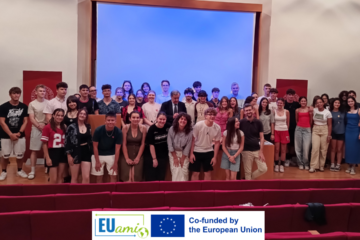
For a group of students from Zespół Szkół Administracyjno-Ekonomicznych (ZSAE) school in Gdynia, Poland, what began as a long overnight coach journey became an unforgettable dive into the heart of European democracy.
As part of the Jean Monnet European Values and Migration (EUAMI) project, the Polish students travelled in July to Bressanone (Brixen), a charming bilingual town in the South Tyrol region of northern Italy, for the EUAMI week-long summer school that combined academic lectures, cultural discovery, and cross-border friendships.
The journey itself was an education. Setting off from Gdynia Railway Station, the group crossed Poland, passed through Berlin and Munich, wound through the Austrian Alps via Innsbruck, and finally arrived in Bressanone – a medieval town nestled between hills covered in vineyards, fed by two rivers, and dotted with churches.
One of the first things to strike the students was something unexpected: they were in Italy, yet everyone spoke German. The mystery was solved during a visit to the local Hofburg Museum, where they learned that South Tyrol had once been under Austrian rule, leaving behind a lasting linguistic and architectural legacy.
Learning the Language of Democracy
The academic programme did not shy away from complexity. Over the course of the week, students attended lectures on the structure and role of the European Union, the mechanics of political lobbying and protest, and – most powerfully – the realities of migration and asylum.
On one of the most memorable days, the classroom gave way to personal testimony: guests who had experienced migration shared their stories directly with the students. “These were very emotional and moving stories,” one participant wrote in their travel journal.
The week culminated in a simulation of the European Parliament, where students were divided into parties and tasked with drafting legislation on migration. It was a fitting conclusion to a programme designed not just to inform, but to engage.
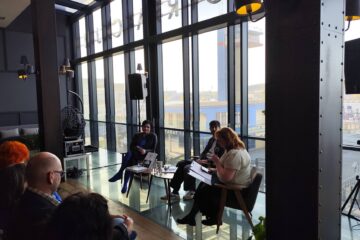
A highlight of the final days was a live debate featuring three Italian Members of the European Parliament – Alessandra Moretti, Herbert Dorfmann, and Leoluca Orlando – who discussed migration and European policy in what students described as “a very interesting and interactive discussion.”
Beyond the lectures, the programme offered something equally valuable: the experience of living and learning alongside peers from Italy, Bulgaria and Spain. Students explored the town together, went to a water park, hiked mountain trails at dawn, and shared pizza – not all of it to their taste, as an anchovy topping earned a special mention in the travel diary.
“I had the opportunity to meet new people, learn about their culture, visit new places, gain knowledge and broaden my horizons,” wrote one student in a reflection at the end of the journal. “But more importantly, I saw their perspective and understood how they perceive the world.”
The EUAMI project, funded by the Erasmus+ programme (ERASMUS-JMO-2023-NETWORKS, Project No. 101127284), aims to strengthen young people’s understanding of the European Union, its values, and the challenges it currently faces – from democratic participation to the integration of migrants. For the students from Gdynia, it delivered on that promise and then some.
“I encourage everyone who can to take part in it and taste this adventure,” the student concluded, “because this knowledge and experience is something worth experiencing.”
Read here the: Travel Journal