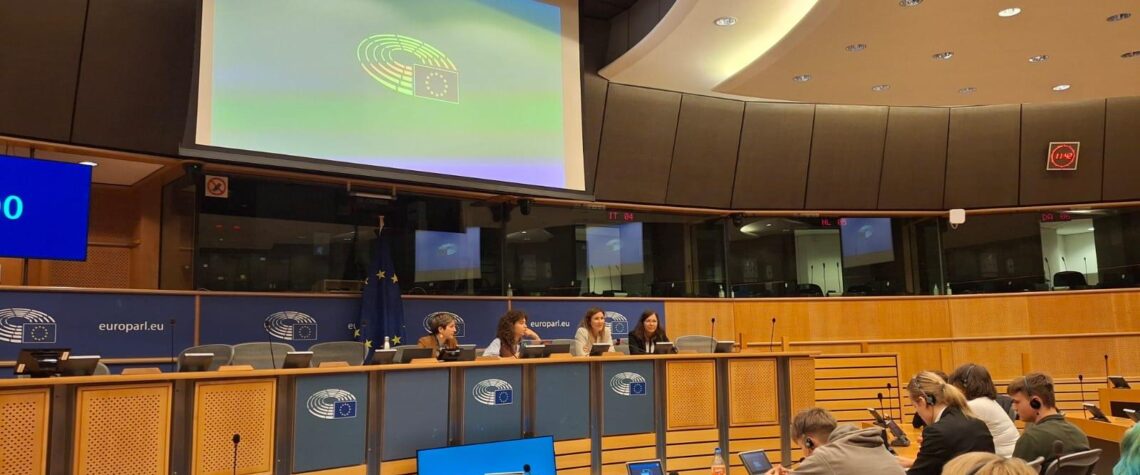
During their visit to the European Parliament, the Jean Monnet project students had the opportunity to meet two Italian MEPs: Alessandra Moretti (S&D) and Benedetta Scuderi (Greens/EFA).
This article has been written by Leonardo Franklin, Rebecca Volpe and Sofia Donati, students at IIS Machiavelli who took part in the EU Values Summer school in Brussels.
Alessandra Moretti has been an MEP since 2019, a member of the S&D and deputy head of the delegation of Partito Democratico (PD) to the European Parliament, she is also vice-president of the Delegation for relations with Afghanistan (D-AF), a member of the Committee on Women’s Rights and Gender Equality (FEMM) and substitute member for the Committee on Foreign Affairs (AFET).
Moretti is active for women’s rights in Europe and around the world.
After recalling some of the issues that emerged from the debate between the two candidates Donald Trump and Kamala Harris for the White House, regarding migration and abortion rights in the United States, she addressed the Taliban issue in Afghanistan.
“Women are invisible, they have no rights”, said Moretti, calling the situation of women in Afghanistan as “apartheid”. The restrictions imposed by the Taliban government make it impossible for women to lead a normal life.
Equally critical were statements about the United Nations-hosted meeting between the Taliban, Member State envoys and other stakeholders, which took place in Doha (Qatar) in July, at which neither women nor humanitarian NGOs were present, despite the focus being on women’s rights in the country.
According to Moretti, this is a clear sign of compliance with the Taliban regime by the international community.
Dealing with the Taliban
Since the establishment of the Taliban government, the European Union has strongly condemned the progressive erosion and violation of women’s rights, speaking out very harshly.
According to the MEP, the time has come to actively oppose the regime.
Among the various possibilities on the table, Moretti suggested two options.
The first involves the complete severance of all official diplomatic relations with the Taliban government, as an unrepresentative interlocutor of the population, and at the same time the direct funding of NGOs that support women.
The other option, less drastic than the first, envisages a gradual restoration of diplomatic relations, but suspending humanitarian aid, which would then become an instrument of blackmail.
Finally, she dwelled on how, despite the fact that women’s rights are better protected in Europe than in other parts of the world – such as Afghanistan, the risk of a restriction of rights is always possible. She cited Hungary as a key case in the EU.
This unique experience that the participants of the Jean Monnet project ‘European Values’ have had taught him a lot about the inner workings of the European Parliament and, more generally, of the European institutions.
[Edited by Sara Bertolli]
The original article is available here.