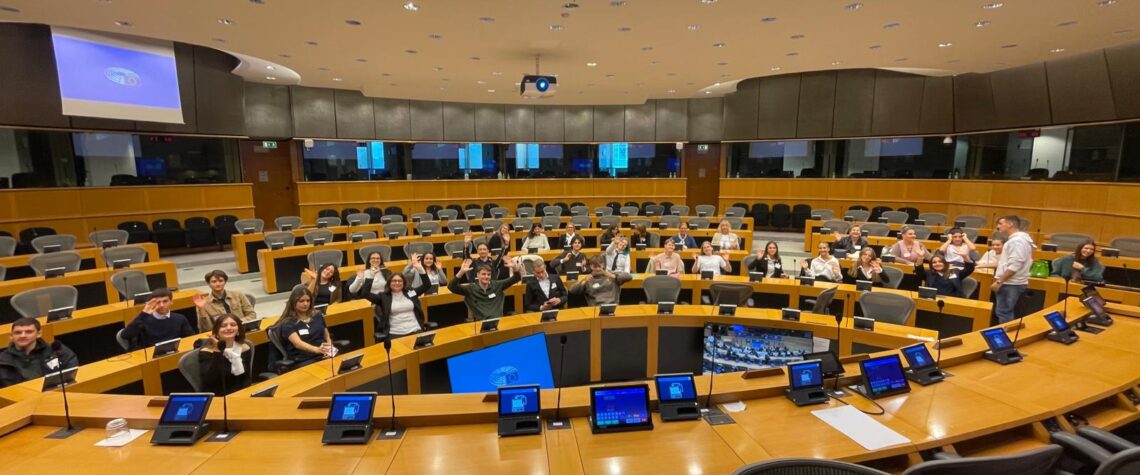
From 9 to 15 September, a group of students from the Liceo Classico N. Machiavelli of Lucca headed, as part of the Jean Monnet Network “European Values” funded by the European Union, to Brussels to discover the institutions, and together with Danish, Greek and Carrara colleagues they explored the city in depth.
This article has been written by Giulia Capriuli, Leonardo Franklin and Sofia Donati, students at IIS Machiavelli who took part in the EU Values Summer school in Brussels.
During the first day thay had the opportunity to get to know the other students, confronting each other about their respective countries: differences and similarities, focusing on the main issues affecting the planet and the decisions about them. On the second day, the students got actively involved by bringing their ideas and objections directly to representatives of the main institutions including: the European Parliament, European Commission and NATO.
During the field trip, a countless number of more or less crucial topics for Europe were discussed: the risk of the unlimited use of the veto, foreign policy, women’s rights, the environment and climate change, and European federalism.
The “Machiavelli students” visited: the European Parliament, where they had the opportunity to dialogue with two MEPs of the majority (Alessandra Moretti of the S&D and Benedetta Scuderi of the Greens), and the European Commission, where they confronted with the Head of Unit of DG Communication, Mr Alessandro Giordani, who commented on the reluctance of countries to cede their sovereignty to the EU, stating that in reality, sharing the responsibility is equivalent to recovering the ceded sovereignty.
Furthermore, they had the opportunity to visit the NATO Headquarters in Brussels, where foreign policy, internship and opportunities, and NATO prerogatives were discussed, and in conclusion, the last institution they discussed together was the Italian Permanent Representation in Brussels.
“European Values” involves, in addition to eCampus University as lead partner, five high schools from Italy (’IIS N. Machiavelli‘ of Lucca and “IIS Montessori Repetti” of Marina di Carrara), Cyprus (’Lykeio Agiou Antoniou‘ of Limassol), Denmark (’Ørestad Gymnasium‘ of Copenhagen) and Greece (’2nd Geniko Lykeio’ of Arta). It is also supported by the Study, Training, Communication and Design Centre on European Union and Global Governance (a spin-off of the Scuola Sant’Anna of Pisa).
The aim of the project is to systematically introduce European issues into the teaching and activities of the partner schools.
[Edited by Sara Bertolli]
The original article is available here.