How do we provide a better quality of news? How to avoid not only fake news, but inaccurate news? How to make journalists resilient to inertia and commonplaces, that tend to spoil their credibility towards the audience? How to raise their awareness, not merely knowledge, about the EU and European integration?
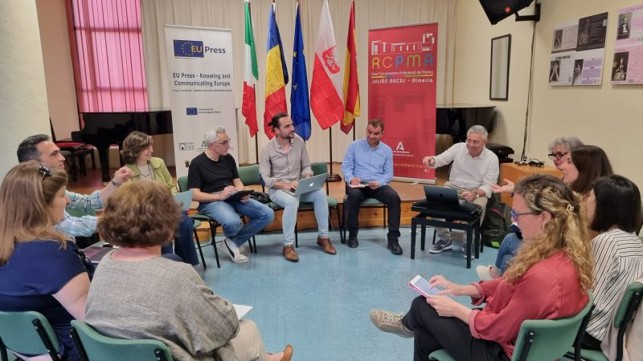
These are among the most relevant questions raised during the two-days coordination meeting of the EUPress project held in Almeria (13 and 14 April 2023). The agenda was rich and mainly focused on a critical assessment of the first two modules of the training course for teachers, but soon devoted to reflect on the future steps of the project. The first feature that attracted some debate was how to translate what was learnt during the training sessions for teachers to their students, how to motivate them to engage in the next phases, and how to set the criteria for selection of those who will take part in the following path, leading next year to the summer school, where an exchange of methods and contents is expected among all the participating schools, both teachers and students.
From this perspectives, some differences among the partners were highlighted as concerns their specificity, in particular the Real Conservatorio de Musica de Almeria that, being a highly professional-oriented music-centered school hosting students from 8 to 18, is less able to change the topics to accomodate issues related to the EU, while this process is much easier for the other schools involved. Matias and Maria explained their objective difficulties in this, but were also confident that common threads would be found to enrich the teaching of music with shared values. Suggestions came from all the group as how to enlarge the scope of some fields in order to implement a path to greater awareneness on the European dimension of music as a key identity-maker of the European perception and citizenship.
Pilar, a teacher in the History of Thought on Music, argued she might easily adjust her teaching to this end, and a debate emerged on how values in general and identity-building ideas might be discussed in classes. Juan Francisco also said he is ready to take up such challenge in his teaching of Electronic Music. All underlined that critical for the success of this process is the direct contribution from students themselves, that are often coming up with creative ideas about methodologies and contents that might be of greater interest to them and their fellow-mates.
Natalia and Katarzyna, from Warsaw, underlined that they have already started such process of ‘listening to students’ and have created a reflection group between teachers and students to design an effective path to implement the contents of the modules and put the general ideas of the project into practice. Alin from Romania also said they have already started building teachers-students teams. While Antonella and Domenico from Petrarca suggested a detailed path towards the next steps, agreed upon by Ludovica and Monica from Machiavelli.
The meeting was indeed a great chance for socialization among the partner schols and to exchange feelings and expectations concerning the project. Strenghtening personal ties and team building is crucial for the success of any initiative, and the meeting was a key moment for both assessing the first steps taken and to design and implement the next ones. As Fabio from Roma Tre wrapped up: “now it is time to involve students and make them realize the power of knowledge, awareness, and critical thought in disseminating their opinions”.